
70’s Big Females

The following post was written by Cori and Ellee from Safe Fitness in Chicago. They are sick of the lack of leadership in the female 70’s Big community, specifically the need for better and bigger asses.

What does it mean to be a 70’s Big Female?

Easy answer, ass size must be greater than 38” around. Why does this matter? Having a big ass means you can move and squat heavy weight, preferably at least your body weight. You might ask, well what about having a fat ass, does that count? No. Being a 70’s Big Female is not just about having a dumptruck on your backside, but you must also be able to haul that dumptruck wherever life may need it to go. Example: chin ups, pull ups, overhead squats, etc. It is more about having a GREAT ass.

In Cori’s 24 years of life on this planet – nearly all of them spent in a gym (playpen positioned right next to the chalk bowl, barbell in hand) – she has seen many women who would qualify as a 70’s Big Female, but has also seen many who would not represent. These women prefer to be skinny rather than strong. SKINNY = FAIL! What they don’t understand is that training hard, squatting heavy, and lifting serious weights is sexy.
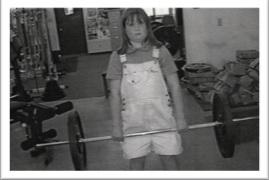
Lifting quite clearly makes you sexy (Cori as a youngster)


In addition, we have got to get other 70’s Big Females training to be to able haul their great asses off the ground from a dead hang position. This is not something that comes easily to most women, especially when you are carting around a 38” undercarriage, but with hard work, it is totally attainable. Pretty soon you’ll be cranking them out like Sarah Connor in Terminator 2, doing chin-ups in the mental hospital right before she beats the shit out of those guards. Sweaty, strong, and fucking badass.

Cori’s father runs a high school Olympic weightlifting program in Minnesota and recently told us he was having problems recruiting young female lifters. He asked one of the volleyball coaches why these girls did not want to train and get better at their sport. The volleyball coach stated that the leaders on the team wanted to “look smaller” rather than be a powerhouse volleyball team. Skinny instead of winning? Come on girls, it’s all about WINNING (sorry, Charlie)! We think the skinny mentality is toxic and could spread to the rest of the team. Where are our 70’s Big Female leaders? Who can tell these young girls that sexiness and winning comes from squatting BIG, not being a twig fairy. It happens by actually putting weight on the barbell and going up and down, up and down, up and down, etc. You get the point. We would like to empower women by encouraging them to strive to be “real women”. Strong women. Thirty-eight inch ass women. 70’s Big Women.
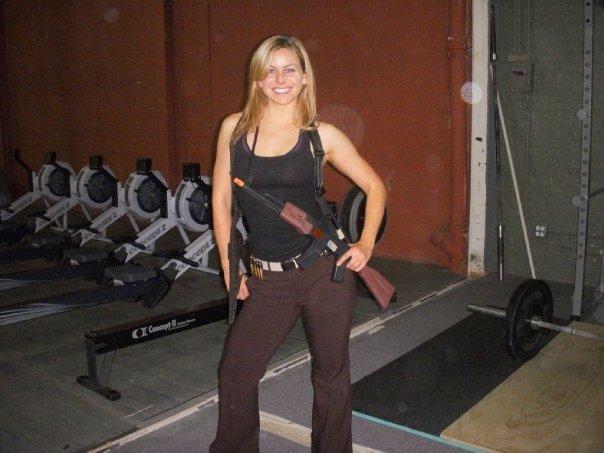
Ellee in Sarah Conner garb, pre-rip


Last Halloween, Ellee was doing a WOD (while wearing her Sarah Connor costume) where heavy overhead squats were the main attraction. Minutes into the overhead squats, she felt some intense restriction in the ass/thigh region of her pants while performing the squats, but she decided to power-through. However, her ass could not be contained, and her left butt cheek flew out of the cheap-ass material. We are talking a clean rip of about 14” centered over the left ass. Fellas, she only wears g-strings, so she had nothing to hide behind. Ellee was a bit embarrassed, but Cori guarantees that every female in the gym was thinking, “Damn! If my ass rips out of my pants – I sure hope it looks as good as hers!” Now that is a true LEADER!
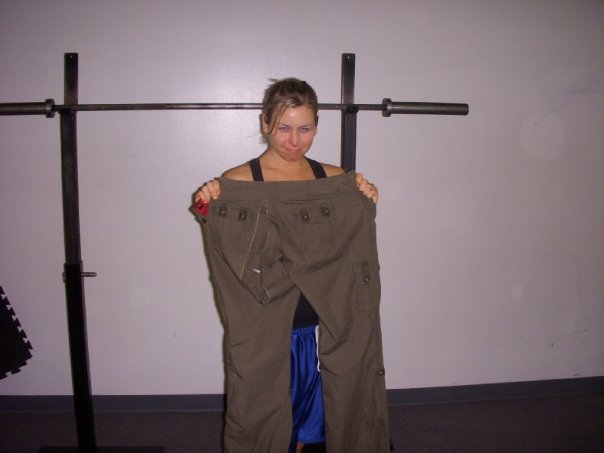
Post-rip


So 70’s Big Females, here is your challenge this week:

1 – Measure that ass and be proud!
2 – Make sure you can squat at least your bodyweight in one of your training sessions this week. Better yet, try to clean and jerk your body weight.
3 – Try to haul that ass up by working on your dead hang chin ups. Try to get one per day at first. Nothing sexier than that scene in Terminator 2.
4 – We dare you to try and blow out your pants!

Leave comments on your success! Until next time…
Cori & Ellee – 70’s Big Females
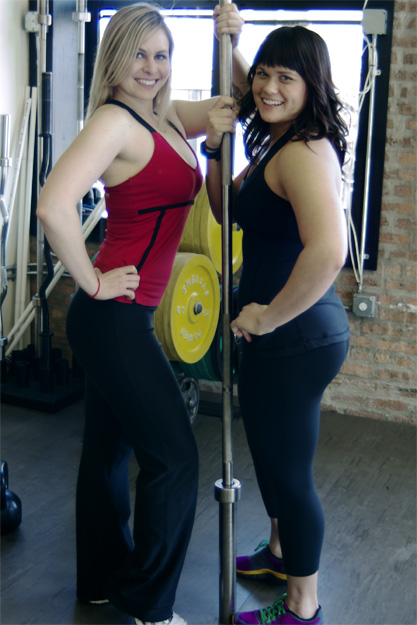
Ellee and Cori

Eye Opening

Folks, we talk a lot about barbell training on this site, but we ignore too many other forms of training out there. For instance, look at the utility in this equipment:


First, they save you $125. What you are saving it on is immaterial. Instead, look at the set-up. Yes, the actor may be a bit smaller than us, but look at his attire. He looks great! And he’s so functional — the shaking he experiences on the ring push-ups means he’s building functionality that can’t be attained anywhere else.

As far as programs go, P90X is magnificent. If you go to 1:48 in this video and watch the progress pictures, you’ll notice how P90X magnificently removed body hair from this subject. Magnificent ;-)


Lastly, a lot of you have been thinking about trying out Olympic lifting. I advise you, good sirs, to obtain optimal form with PVC pipe before attempting it with a bar. If you can’t do it with PVC, how can you do it with a load?


I am so excited to announce that it is PR Friday! I caution you “heavy eaters” out there to not post today, let’s focus on healthy eating in this PR Friday. The only people that can post are lifters who eat less than 50 grams of carbohydrates a day and squat more than 500 pounds. Also, if you don’t do everything I say, you can’t post here either. Oh, and you have to call me High Chancellor when you do it. Or else.

Paralysis by Analysis, Part 2

Most of you think that Part 1 doesn’t apply to you since I was targeting beginners, yet I’ve gotten questions on sets and rep schemes for curls and RDLs. Most programs are more complicated than they need to be. By only making a program more complicated when it has to be in order to advance strength, you’ll avoid worrying too much about it.

Yet almost all of you worry too much about your technique, particularly the low bar squat. The low bar squat isn’t as simple as going down and then coming back up; it’s harder than a power snatch or clean. But once you do some reading and research it, and the other barbell lifts, aren’t terribly hard. Don’t over complicate back angles, knee movements, and elbow positions. Most of you do, and it makes my job as the teacher via website more complicated. If I want to discuss what the knees are doing at the bottom of a squat, then all the Starting Strength fans get all worried and start analyzing their lifting footage. When I teach, I will give all of the technical details that I can, but I’ll take a step back and simplify it.

With coaching, we use “cues” to get the lifter to make a correction. Cues should apply a conceptual lesson and be a reminder for the practical lesson. All of you who have taught yourself how to squat lose out on the practical lesson and may miss out on at least half of the conceptual. But don’t worry! It’ll be okay, I promise. There are some very basic cues for each lift that will eliminate at least 75% of your problems.

Chris shows great form


Regardless of the type of squat, shove your knees out and think “mid-foot”. Shoving the knees out facilitates depth because the femur is no longer getting pushed into the Anterior Superior Iliac Spine (ASIS), or the hip pointer. Rippetoe detailed this in full in his “Active Hip” article. The femur can now move in a range of motion outside of the ASIS and get better depth. More importantly, the external rotators of the hip are contracted since the hip is in external rotation, and the adductors and, to a lesser extent, the hamstrings are stretched and under tension. Contraction in the external rotators and tension in the adductors means there is more tightness and muscle action around the hip, which makes for a stable, stronger squat. Yes, there are some frivolities between high bar and low bar (and even the wide stance high bar positioned lean-over-with-vertical-shins-as-if-we’re-wearing-a-squat-suit-even-though-we’re-lifting-raw squat, which is ridiculous), yet if all squatters focus on shoving the knees out, they are going to get stronger better than had they not. The “mid-foot” is directly in front of the heel of the foot (if you place your finger at the front (or arch side) of where your heel begins, that’s it). By imagining the load balanced on that point, the bar can track up and down over that point easier regardless of where the bar is positioned. This will help prevent backward and more specifically forward movement (that brings the lifter on their toes and jerks the knees forward at the bottom).

When deadlifting, it’s best to start with the bar over the foot and drag the bar up the shins and thighs. Getting the scapula over the bar is ideal, but that adds a third thing to think about. Instead, just set up with the bar over the mid-foot (often where the laces are tied), touch the shins to the bar, and drag it up the legs. Of course you should be squeezing your chest up and trying to have an extended back — this should be obvious — but worrying about the angle of the back and muscle activation is just going to complicate things. If the bar is dragged up the legs and doesn’t flop forward, then it’s going to be pretty damn efficient. If you can consistently do these two things (start with bar over mid-foot, drag it up legs), then you can start worrying about the frivolities. However, you’ll find there aren’t many of them.

Pressing merely requires a that your elbows are underneath or slightly in front of the bar at the start, and a vertical bar path. If you’re doing touch and go, you’ll have to think about bringing the bar straight down from the top — “keep it close” is a good cue that implies the bar should be close to the face.

These are all very simple cues. Before you even begin to think about worrying about what’s going on with your squat, make sure that you are addressing these cues. If your knees are shooting forward at the bottom of the squat, and you aren’t shoving the shit out of your knees and thinking mid-foot, then once you cue those two things, it’ll probably clear itself up. If you can’t keep the deadlift on your shins at the start of the pull, then you need to cue the “bar over mid-foot” and “drag against legs” cues. The fact that the bar is flopping away from you means that either your butt is too low or the shoulders aren’t extending, but you worrying about that is irrelevant if you’re not following the first two simple cues.

Most of you over complicate things because you try and learn how a system works by memorizing the “cause and effect” of the parts. You see the knees going forward and here an authority say, “The back angle is too vertical” so you associate all forward knee issues with a vertical torso. Or you see a thread on someone who was leaning over way too much in their squat and worry that you are too. Keep in mind that you aren’t the coach. You have to learn how the system, in this case the body as a whole, functions within each movement instead of how the body parts function in a specific scenario. In the squat and deadlift the trunk, thigh, and shin segments are all related. In the squat, a vertical torso will not have as much flexion at the bottom compared to a torso with more angle. This effects the musculature of the hip, but also the positioning and musculature around the knee. But that’s all fucking irrelevant because you’re not the coach.

Trying to make an analysis, especially on a video on the internet of someone you don’t know, is probably only going to confuse you and that person. And I’m not even getting to the situations when there are 5 things wrong in someone’s squat and the interwebz tells them how to fix 9 things. A lifter should only think about a maximum of two cues when they lift; anything else fucks things up. If the above cues are followed, then most problems will be non-existent or not a big deal.

Stop worrying so much about what your technique looks like and how it compares to other people. Just make sure it has a baseline of efficiency. You’ll be okay. I promise.

TSC Results

The DEADLINE for submitting Tactical Strength Challenge results to 70sBig.com is TONIGHT. After tonight, this post will be closed and Antigen will compile the results. Thanks to those who submitted their scores.

Post your Name, Body Weight, Division, Max Deadlift, # of pull-ups, and # of KB snatches.

Results will be compiled, and rankings will be produced. Enjoy.

Paralysis By Analysis, pt. 1

Barbell lifting is an interesting thing. Everyone here may not agree on what it means to “get good” at it. If a guy who walks in off the street can pull 600 pounds, does that mean he’s good at lifting? If a different guy has to put the work in to squat around 350 for reps, yet he’s done it with patience, persistence, and pretty good technique, does that mean he is worse since he is almost half as strong as the first guy?

Barbell lifting is a process. Whatever genetic ability a person has, what they do with it is important. The process is a collection of doing things right each workout as well as over time — simplified to technique and programming respectively. The problem, especially for a new trainee, is knowing what is “right”. Sources are varied across the internet to include bodybuilding, powerlifting, weightlifting, powerbuilding, DoggCrapp, MadCow, Lance Uppercut, Rock Strongbow, and Rusty Trombone. The good news is that the majority of these variations of programs (or frightening sexual techniques) are all derived from simplicity.

Athenaeus gave the first lesson of simple strength training by creating the myth of Milo of Croton. Milo merely lifted a little more today than he did yesterday; small, yet consistent increments were how his strength were developed. Nowadays we use barbells instead of farm animals (the desire for “same day cow” has grown) and we know that squatting, pressing, benching, and deadlift are how we establish strength and muscularity. We can make similar consistent process by lifting a bit more each time we lift. Most new trainees, including the skinny and weak ones, don’t understand that it’s an accumulation of strength work over time that makes people strong, not trying to increase the load as quickly as possible in a matter of months. Most soft tissue injuries are associated with pushing too much too soon. Remember that since Milo’s bull increased in small increments of weight each day, he never overreached. The bull didn’t increase 20 pounds suddenly, and Milo didn’t have to reset by removing the testicles (there is no correlation between lack of testicles and resetting, stay on task, sir).

Wolves killed Milo in the forest despite being jacked in his old age. Lesson: carry a weapon when alone in the forrest


Additionally, Milo’s programming wasn’t complicated. He just moved his future meal around and wrestled (six time Olympian and more). Programming with barbells doesn’t have to get complicated…in the beginning. But this is the point. If you are new to lifting (have done it less than a year or two), worrying about program is a waste of your time since you don’t require complicated program to have success. Dan John is excellent at creating simple strength and/or conditioning programs; he is your friend. Maintain simplicity over time and strength and muscularity will develop.

Here is a simple guideline of barbell lifts to establish a base of strength and muscularity.

– Squat 2x/week
– Deadlift 1x/week
– Press and Bench 1 or 2x/week each
– Chin-ups and pull-ups 2x/week

By virtue of doing these things every week over time, you will grow stronger. “Strong” doesn’t indicate a load on the bar, it more so indicates the structure and capability of your body. Beginners won’t benefit from hitting a maximal set of deadlift before their structures have developed to handle such an endeavor (QED). Instead, consistent and patient increases over time will lay the foundation. It isn’t complicated; don’t analyze it to death. If the body or structures are feeling fatigued and tired, it’s painfully logical to reduce the workout or rest. In a beginner, halving their previous workout will still give them stimulation to continue the “accumulated workload concept”, yet not cause as much stress.

There is far too much over analysis in programming, especially for beginners. Keep it simple and consistent and ensure the body is fresh for each workout. I promise the strength will come. In Part 2 I will discuss how lifters over analyze their technique.