Andy Bolton is still kicking ass, and now he’s doing it RAWWWWWWWWWWWWW!!!111!~`1`121J`3412R8I09SADJLKSDAJF
Ahem…Bolton competed at the BPC Push/Pull competition. He benched 280kg/617lbs just because, and then walked out and smoked the piss out of a 432.5kg/953lbs deadlift…just because.
Well, not “just because”, and you can read why here.
I went to this comp not really knowing what i would be able to do,after only 6 deadlift workouts since my knee surgery in november 2009 i went there in my mind would have been happy with 900 thats why i did not use a suit i wanted to hold it back and not get hurt again,so anyway warm ups went well up to 660lb then my opener 770 then to mid 8s after this it felt so so light so i wanted pull more than anybody else out there with no suit and it felt easy
Andy followed that statement up with a challenge for anybody to meet him at the 2011 Andy Bolton Deadlift Challenge, if the challengers were “up to it”. I wonder if Konstantinovs will be there? He has pulled 939 raw, although it was much more difficult than Bolton (and that was about a year ago):
Mike Barwis is the current strength and conditioning coach of the Michigan Wolverines. He’s an accomplished coach who has worked with all sports at the collegiate level, professional athletes, and Olympians. However, he’s best known for aiding the football programs at West Virginia (’03-’07) and Michigan (since ’08).
Let me preface the following thoughts with a few statements:
– I don’t know Barwis
– I’m not a Michigan fan
– At the time of this writing, I haven’t seen any programs by Barwis, only articles and a crazy YouTube video I’ll link below
– His track record speaks for itself
My impression is that Barwis has a general strength program, and then he quickly converts this strength into what I will refer to here as “usable strength”. Obviously if someone is very strong and they cannot apply that strength into proper, efficient, and effective movement on the field, then they are of no use to the football coaching staff. In the video below, Barwis explains his gamut of conditioning, movement based flexibility, and increasing the athlete’s ability to do their job on the field with sport specific work. It’s kind of hard to summarize the “Barwis Philsophy”, since his explanation of his program lasts nine minutes:
You’ll notice the guy is…full of energy. You’ll notice he has a raspy voice. You probably now understand why he garners respect from his athletes — he shows them that he cares by exhibiting his commitment to their success. As he succeeds, his reputation grows, and he is nearing Chuck Norris status.
Apparently he owned two pet wolves that he used to wrestle. He has a MMA background (that he doesn’t talk about much). Some West Virginia players attempted to catch him off guard and give him a friendly woopin’, but he took them out before they knew what happened (read about it here on Wikipedia). But most importantly, he treats his athletes like family.
And let’s not forget his accomplishments. One example is Brandom Graham, who weighed 315, benched 315, and power cleaned 225 when he got on campus. Now he’s 265, benching 495, and power cleaning 445. Barwis makes it known that they aren’t concerned with only weight room strength, but taking that strength and applying it to football, yet those numbers with Graham are still impressive nonetheless.
There are countless games where Michigan has performed well in the second half, and the entire team attributed it to their superior conditioning. Barwis gets is athletes strong and conditioned, and does so while earning the respect of all of his athletes — this means I’m a fan. Good stuff.
The term “stack” has its origins in Old Norse as having to do with haystacks. Shortly around this time, men were noted to say, “Aye, that women be stacked to the brim,” since a particularly well endowed female trait made the appearance of two neatly placed haystacks. That last sentence wasn’t actually true. For whatever reason, the term “stack” was associated with a nutritional (natural or otherwise) supplement to one’s training. I don’t know if it originated in bodybuilding, Olympic lifting, or power lifting, and to be honest, I don’t really give a poo. These days it seems to have a bodybuilding connotation, which is usually comically unnecessary. Modern bodybuilding literature (propaganda?) is infamous for its ridiculous products with promised results. Thus, in certain groups, “stack’ may have a negative connotation.
That is, until Brent Kim decided to be a pain in the ass.
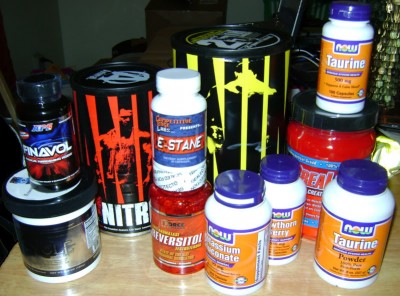
Typical waste of money stack
There are some essential items that a lifter should, in essence, stack onto their training. It is important to note that the value of these items is reduced to precisely “dick” if you aren’t eating appropriate amounts of protein and calories in order to recover and improve. But, for the sake of this post, we are going to assume you have this under control (Guideline: 1g of protein per lb of bodyweight, and if you aren’t recovering, then you aren’t getting enough calories).
It wasn’t too long ago that Brent’s training stack was a healthy dose of kimchee and bulgogie (Korean barbecue, which is top notch). Then there came a time when Brent duly noted the fish oil intake that I adhered to. The following conversation ensued:
Brent: How much should I take?
Me: Well, I take about 14g, so you should probably take 8 to 10
Brent: I’m going to take 28 grams because I am twice the man you are.
And thus Brent started thinking about his stack. Thinking led to reading, reading let to more thought, and then, Brent wanted to know what everyone else’s stack was. Relentlessly.
“Hey man, what’s your stack?” was asked both in a serious and comical manner. Serious, for he really did want to know, and comical because the usage of the term “stack” is previously associated with the bodybuilding silliness described above. When Brent first started saying it, it was embarrassing, because anybody who heard might think he was serious about the term. The problem was that he was serious, but now it’s okay because he/we have changed the term into its new accepted usage and meaning (which generally gets out of hand with my group of friends).
In any case, your stack is something that is “stacked onto” your training program and your food intake. If your food intake isn’t appropriate for your goals, then you don’t have any business worrying about your stack. If you don’t even know how you should be eating to accomplish your goals, then you have some research to do, and still don’t need to worry about your stack. Even if you did have all of those things taken care of, a lifter doesn’t need much in his stack to reap the supplemental rewards. Here are some essentials. Note: As always, consult your physician about any of this stuff. If you take any of this stuff because you read about it here, you do so at your own risk. If you are unsure about any of it, then don’t take it.
Whey Protein This may not even be considered part of a stack because it might be a staple to your diet. In any case, it’s supplemental to food, so I’ll include it here. If you aren’t getting your allotted protein intake, then nothing else really matters. Sometimes you’re in a pinch and can’t eat all of it in the source of meat, so whey protein is a nice, quick replacement. You don’t need to buy anything expensive, because all the brands will do the same thing anyway. Most brands are outfitted with BCAA’s, and generally the more money you spend, the better it tastes. However, if they make claims on the absorption rate or any of that other bullshit, just ignore it. It’s useless, and we are worried about the chronic intake of protein anyway. My buddy Mike likes the Optimum Nutrition brand because their protein is tasty, and they have lots of flavors. You can also get the EAS brand at Sam’s Club for pretty cheap.
Multi-Vitamin Vitamins and minerals are vital to a healthy, functioning body. Sometimes our diet doesn’t include all of the goodies that we may need. Even if you are eating plenty of Paleo-esque meats, fats, vegetables, and fruits, you may accidentally neglect something. In such a case, having a decent multivitamin can pick up the slack. If you are training hard then you’ll need more vitamins anyway, and if you’re eating to gain mass you’ll be purposely neglecting some healthy foods. Cover your bases with a generic brand multi-vitamin — you don’t have to spend lots of money on it. Bill Starr always recommended the shovel technique to get more than you’ll actually need. This is fine with water soluble vitamins (Vitamins C and B-vitamins) because you’ll just pee the excess out, but keep an eye on some brands that have crazy amounts of fat soluble vitamins like A, K, D, and E. I’m not saying shy away from them (especially because we’ll need more of most stuff when we’re training hard), but you won‘t need ridiculous amounts. Lastly, make sure your multi-vitamin is equipped with magnesium and zinc.
Fish Oil I haven’t done a literature review on fish oil, but I’ve seen some of the research. In any case, lots of people who are “in the know” regarding nutrition recommend fish oil for its anti-inflammatory properties, it’s improvement on blood lipid profiles, and its apparent ability to lower the chance of certain diseases, conditions, and cancers. As a lifter, you want it for the anti-inflammatory properties, because when you lift hard, you get lots of inflammation. Following that logic, it is something that has the potential to help with recovery, and that’s what we want. To get an idea of how much you should take, here is a fish oil calculator that my friend Melissa Urban created for Robb Wolf’s blog.
Creatine
“Creatine is one of the only supplements that does what it actually says it is going to do.” — paraphrased from conversations with Dr. Kilgore. As a clunky summary, it helps the phosphocreatine system reproduce ATP faster, and this helps in the recovery from short, intense bursts of work (like what happens in lifting). There has been talk on the internet of “non-responders”, but the real problem is getting it to absorb correctly (there are quite a few factors that can limit absorption). Dr. Kilgore once told me that mixing the monohydrate in chocolate milk is a fantastic way to help it absorb (the lipids and sugars each play their part — look up how these things are digested for clarification). The general consensus for ingesting creatine monohydrate is to load for 5 days at 0.3g/kg of bodyweight, and then maintain at .03g/kg bodyweight.
There is a new product called creatine ethyl ester which gets converted into creatine within the body. The draw is that it apparently absorbs better, but it’s more expensive, and I don’t have time for ‘more expensive’.
Fiber
When eating to increase or maintain mass, vegetables may get ignored. In such a case, you are gonna want to eat some fiber. I’ve written about it before here: http://www.70sbig.com/?p=1041
Intestinal benefits aside, it will make your bathroom time more enjoyable, especially if you’re drinking a gallon of milk.
Glucosamine and Chondroitin Sulfate
This stuff is supposed to help with joint health. Hell, I don’t know if it works. Some people swear by it and some people swear at it. I figured that since I want to lift throughout my entire life, and since I’m doing a lot of jumping around in the Olympic lifts, I my as well try it. I wouldn’t say I had sore knees, but I could feel them after some rough Oly workouts, sometimes the next day. I got a cheap pair of cloth knee sleeves and started taking glucosamine/chondroitin, and I haven’t noticed it anymore. Lots of factors go into this, but if you’re willing to try anything…
Again, I want to reiterate that none of this really matters if you aren’t eating well. Tons of people will have opinions on nutritional supplementation and most will get weirdly complicated. I’m not really into that; I just get a few things to try and maximize my recovery without spending a whole lot of money. I’m sure most of you will have some kind of comment today. Realistically, the only person you should listen to is Gant, because most of you don’t know why the hell you’re taking something.
Weight lifted, food eaten, children tossed, etc.
I expect the female participation to continue. Damn it.
Oh, and next week is the last week to get mustaches pics in. I’m gonna post some over the weekend.
———-
An e-mail from Micah, who just experienced his last day of high school:
Well Justin,
Right now i am on the path to being 70sbig. Right now I am 5’10” weighing in at 215. But anyways today was my last day of high school and at the water day party all i did was overhead press girls and then throw them in pools. Needless to say giggles and numbers ensued, and a lot of questions of why are you so strong? None of the 90’ssmall 6 packers were able to lift two girls at the same time. Yes being 70s big has many many perks.
Thanks 70sbig.com
Micah
When I e-mailed Micah back asking if he would mind me posting this on the site, he replied with, “Not at all, Justin. Post that shit up.”
———-
Here is a video of Colton finishing his linear progression. In August he was 120 pounds. Now he is 175 pounds. His squat went from 95 lbs to 275x5x3. Here is the second set (you can see the other sets on my YouTube page):
Just a tad sloppy, but not too shabby.
———-
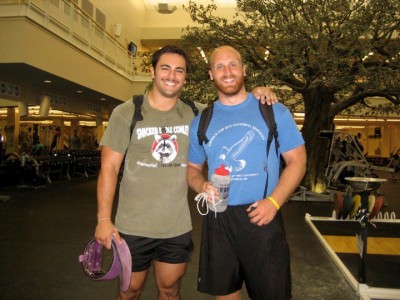
Two of my friends from Statesboro, GA. You all know Ace McGonague on the left, and then Taylor is on the right. There are rumors swirling that Taylor aims to weigh 320…
A couple years ago I spotted him on bench when he did 405 for a single (decent bounce, but we are more edumicated now).
———–
Chris just left for a much needed vacation before he dials his training in to get ready for the USAPL Raw National Championship in July. He and his family were planing the plane (which must be the opposite of the term “de-plane” the flight attendants always use), and Chris found himself in a precarious situation. After he shambled down the aisle of the plane and squeezed himself into the seat row, he made an attempt at sitting down. Buuuuuut, he couldn’t. You see, his 6′, 275 pound body didn’t fit in the seat. What could they do?
Well, this is a guy who broke five chairs in a week’s time not too long ago. Between going to school, training at the gym, and drinking beer at a bar, Chris managed to render five chairs inoperable…on accident. So what the hell were they doing to do with him on the plane?
Clearly the only solution was to move him to first class. It makes sense, after all. Do not anger the large man. Do what he says. Oh, you want some beer on your flight? Yes sir, Mr. 70’s Big, right away sir. Anything else sir?
Yes it’s true, the quest to 70’s Big has its perks.
———-
Strength+ Magazine
There’s a new online magazine that is dedicated to Olympic Weightlifting that just started. This is good because there aren’t many resources for American weightlifting, and that’s unfortunate. The magazine is called “Strength+” and is written and edited by Rachel Crass and Robert Hall. This first issue has a few athlete articles (notably on Kendrick Farris, the superstar of American weightlifting), an article about the French national team, and results and photos from the Arnold Classic.