I’ve been following 70sBig since the beginning of time, and have tried to contribute in many ways. Sometimes that means writing guest posts, sending in silly videos, or meet recaps, but it also means being an ambassador in the real world, which is something I take pretty seriously. This site has grown into a community, and I’m damn happy to be a part of it.
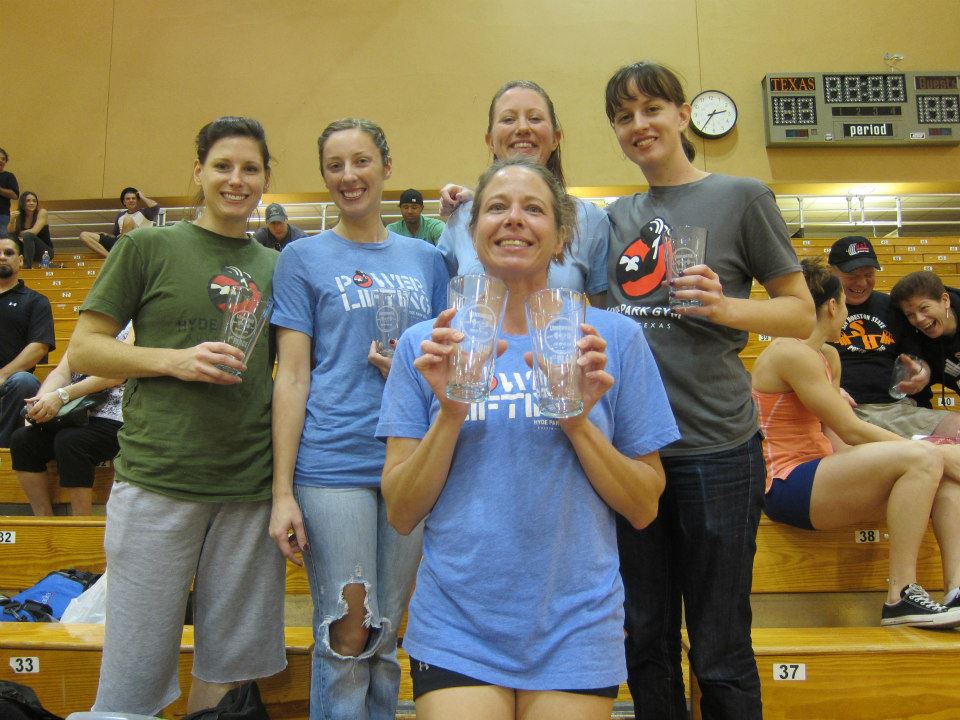
Back Row: Caroyln, Jessica, April, Sarah. Front Row: Dana and her two trophies.
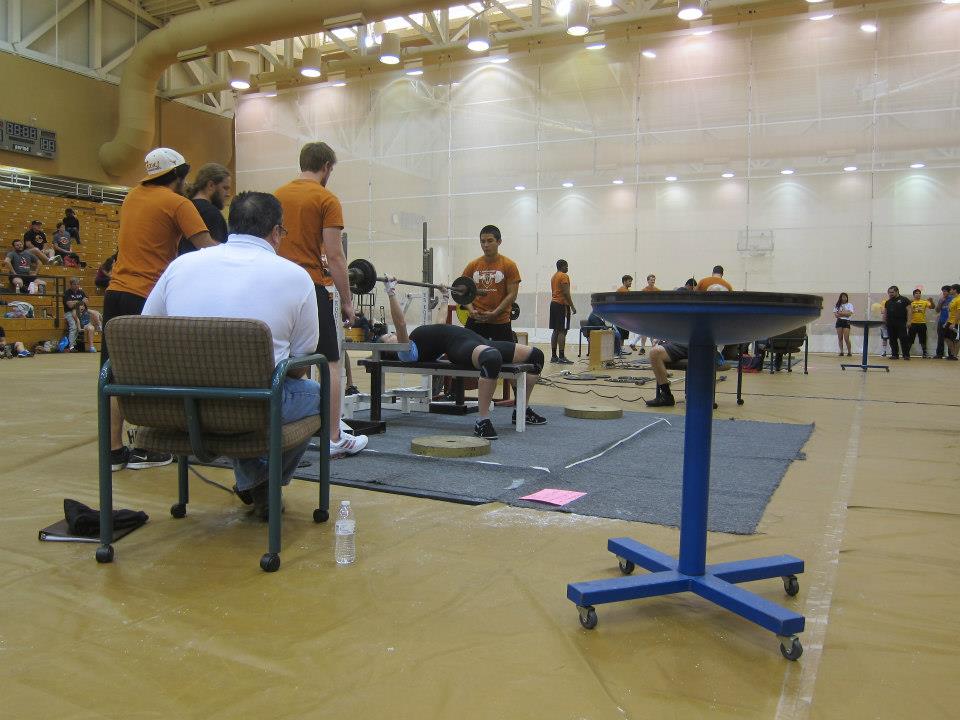
One thing I’ve been really proud of Justin for is his decision to make Mondays all about the ladies. I’m a huge fan of female lifters, and have a lot of fun coaching and helping many of them at Hyde Park Gym. My girlfriend has taken to competing this year, and the enthusiasm she shows is infectious. Between the two of us, we’ve successfully made a huge push to get more members of Hyde Park Gym in Austin competing. Remember, competing is one of the tenets of this site. Recently, we held a mock meet at the gym to introduce more people to the basics of a powerlifting meet, and on November 3rd we had about a dozen guys and gals from HPG compete (all raw) at the USAPL Longhorn Open in Austin. That group involved 5 awesome chicks which I’m going to brag about in this post. With their help, we were able to score a 2nd place combined team trophy in our first team competition.
Jessica showing off her bench arch
Let’s start with my special lady friend, Jessica. She’s relatively new to powerlifting, but already quite passionate about the sport. At Raw Nationals in August, she went 9/9 in the 60kg class, and was able to meet a bunch of legends, including sharing a platform with the famous Jennifer Thompson. For this meet, Jess cut down to 56kg, which had been a goal of hers for awhile. The cut was going great until the night before the meet, when a practice weigh-in at the equipment check proved that our home scale was a full kilo lighter than the meet scale. Drastic measures meant for a long Friday night and Saturday morning, and she ended up being the final morning lifter to make weight at exactly 56.0kg, with about a minute to go on the clock. This didn’t leave much time to re-hydrate before squats, and we made the easy decision to pass on her 3rd attempt to allow her to rest/feed/hydrate before benching. She ended up going 8/8 on the day, PRing her competition deadlift (125kg/275lbs), total (247.5kg), and Wilks, and then went on to help me handle several of the male lifters in the later flights. We learned some lessons for next time, for sure, but she made the best of her situation and came out smiling.
April in the warm-up room
We had two ladies in the 60kg class, both in their first official competition. April’s husband, Tanner, is a friend of mine who I really got to know at Raw Nats when I offered to help handle him, since I had another lifter in his 181 class (RoryT, who also posts on 70’s Big). I believe it was at that meet that Jessica convinced April she should also compete instead of watching from the stands. Since this was her first meet, April smartly stayed conservative with her lifts, and Tanner helped coach her to a very successful and confidence-inspiring 7/9 performance. The first meet is often the most memorable, but I have no doubt April will be setting lots of unforgettable PRs in the near future.
Dana says “gotta wear the granny glasses to see the smooth and knurling and get the weight balanced!”
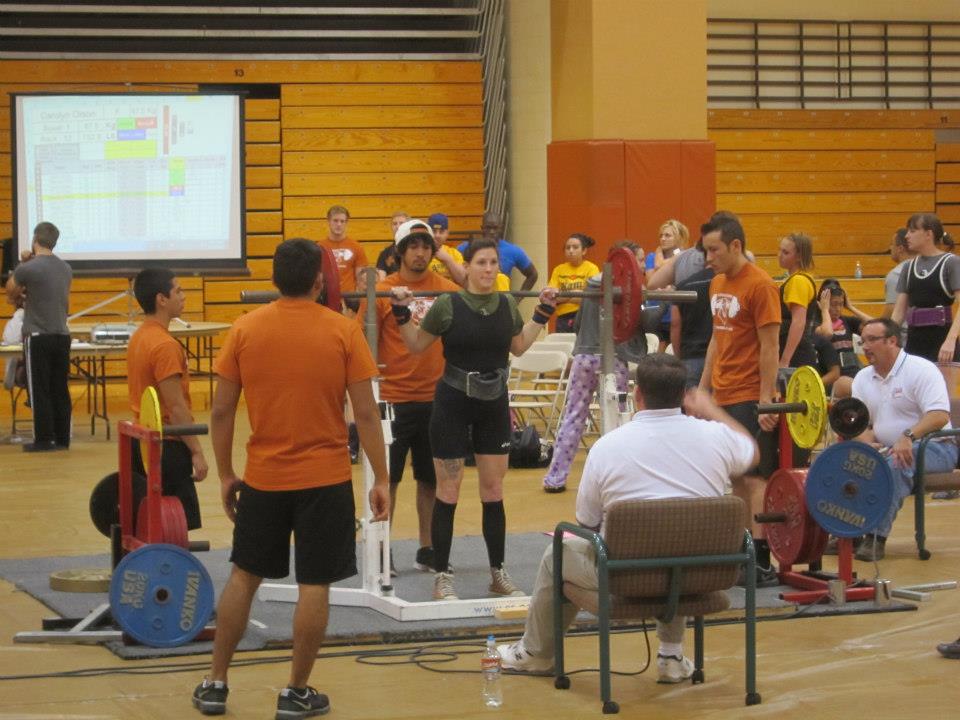
Our second 60kg lifter, Dana, is a self-described soccer mom. Her daughter out-cuted everyone at the equipment check, bragging about how strong her Mom was, and even asking her to flex her guns for all of us (we were impressed). Dana didn’t disappoint on Meet day, winning 1st in her Master’s class with a 8/9 performance. Her trainer at the gym, John, is an experienced (and ox-strong) powerlifter, and he set her up with a nice spreadsheet beforehand, so she had all of her attempts and even warm-ups planned out ahead of time. He wasn’t able to attend the meet, so I helped her out in the warm-up room (when, inevitably, timing always seems to go wrong), did my best to help settle her nerves, and everyone cheered her on for her big lifts. She ended up with a very nice 262.5kg total and an impressive 297 Wilks.
Sarah will kill me for using this picture.
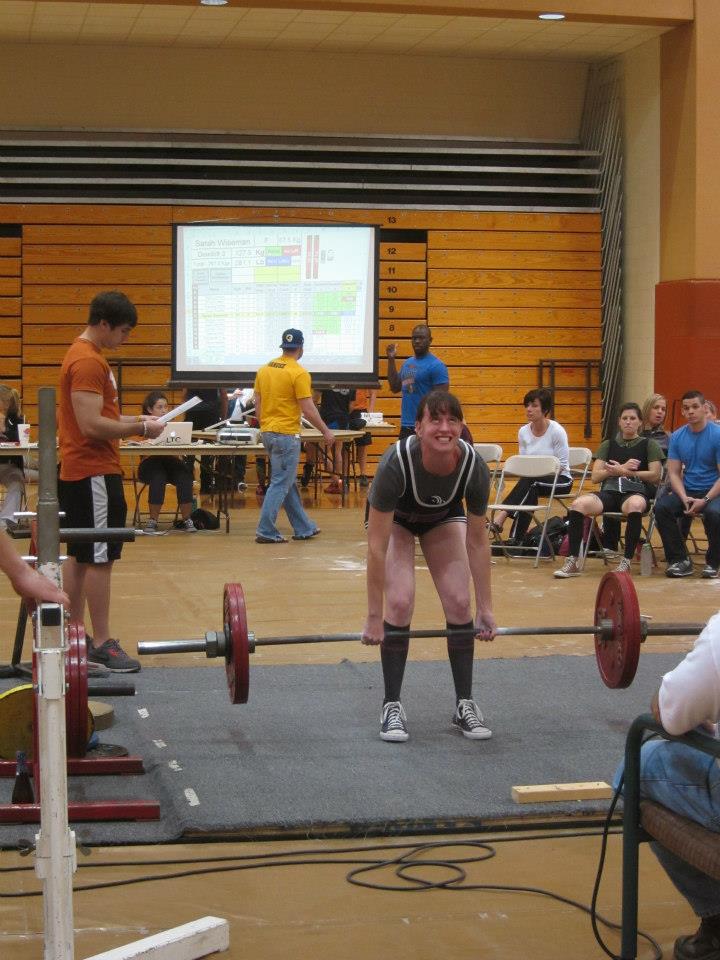
We also had 2 more female lifters, both in the 67.5kg class. Neither of them had to worry about making weight, and ended up on the lighter end of the class. Sarah has competed in one other USAPL meet, and is a helluva lifter, though you’d never know it based on her Master’s degree in being a Librarian, or something along those lines. She and Jessica tend to talk a lot of smack in the gym (In actuality, Jessica does 90% of the talking, and Sarah just smiles and squats), and they have a very friendly rivalry that helps push them in a positive direction. Sarah ended up going 8/9, and I believe she PR’d her bench and deadlift. When contemplating what to call on her third dead, Sarah asked if she should go for 275 or 281. Jessica’s response was something along the lines of “If you don’t get 281, I’m going to punch you.” Sarah did, and in doing so, ended up beating Jessica’s Wilks score by 0.3 points (291.51 to 291.21). This rivalry has just begun, and will be a lot of fun to watch in 2013.
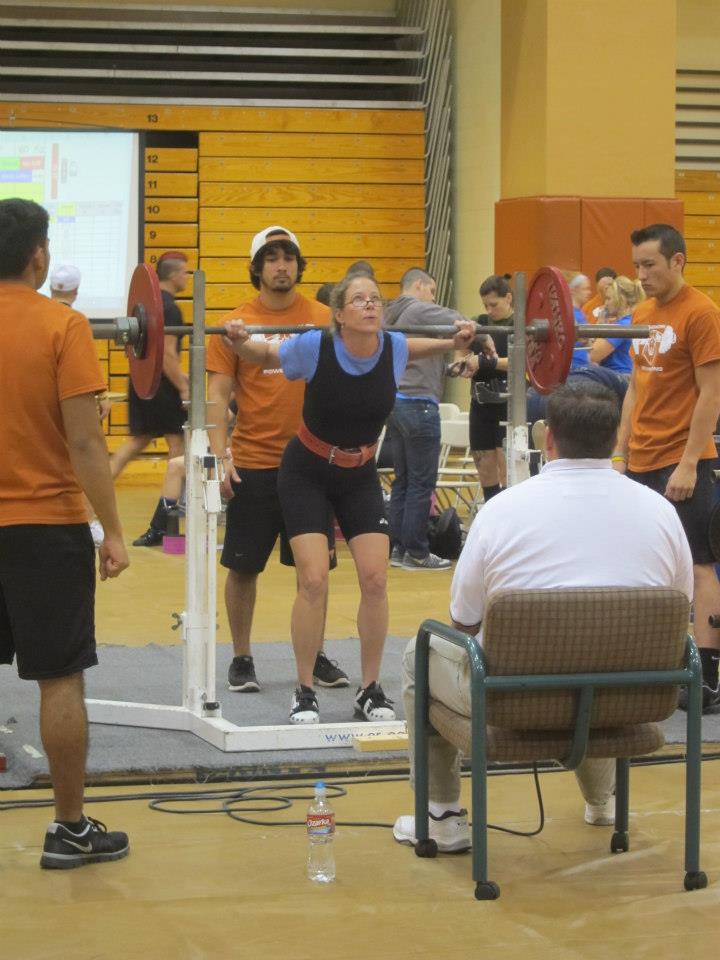
Carolyn killing a 226lb squat.
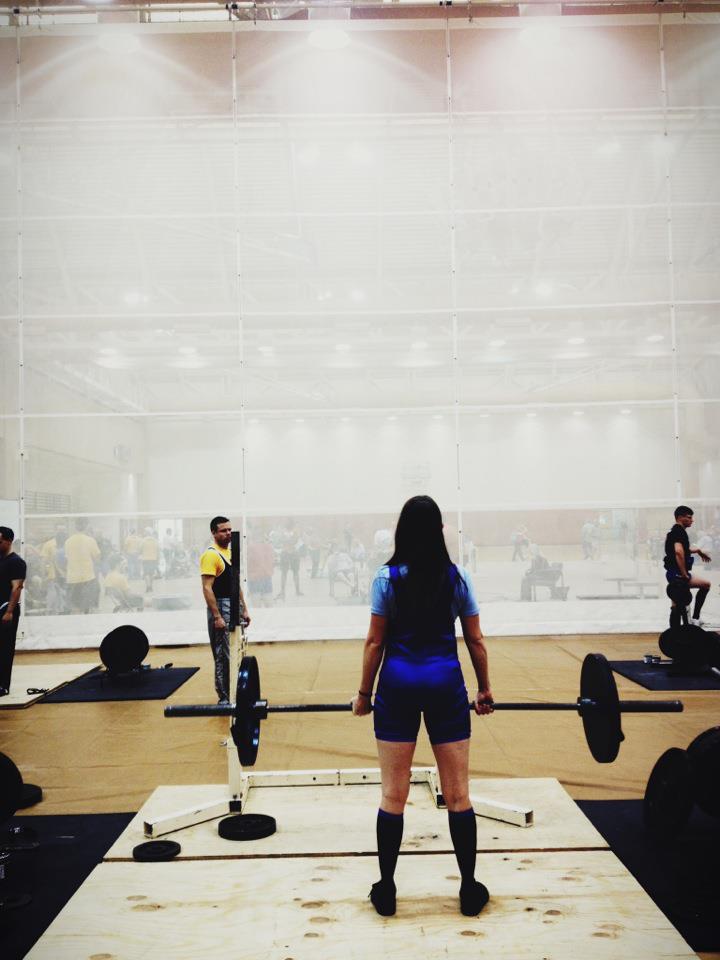
Our final lifter, Carolyn, turned out to be the surprise of the group. She’s an awesome and strong gal for sure; we all knew that. What we didn’t expect was that she would show up and and deadlift 330 pounds in her first meet! Her special guy friend, Eric, also a national level lifter, has only been coaching her in powerlifting for a couple months, but she showed a lot of talent and poise, and destroyed some serious weights, resulting in a 9/9 performance for a 310kg total and a 331 Wilks. Very impressive!
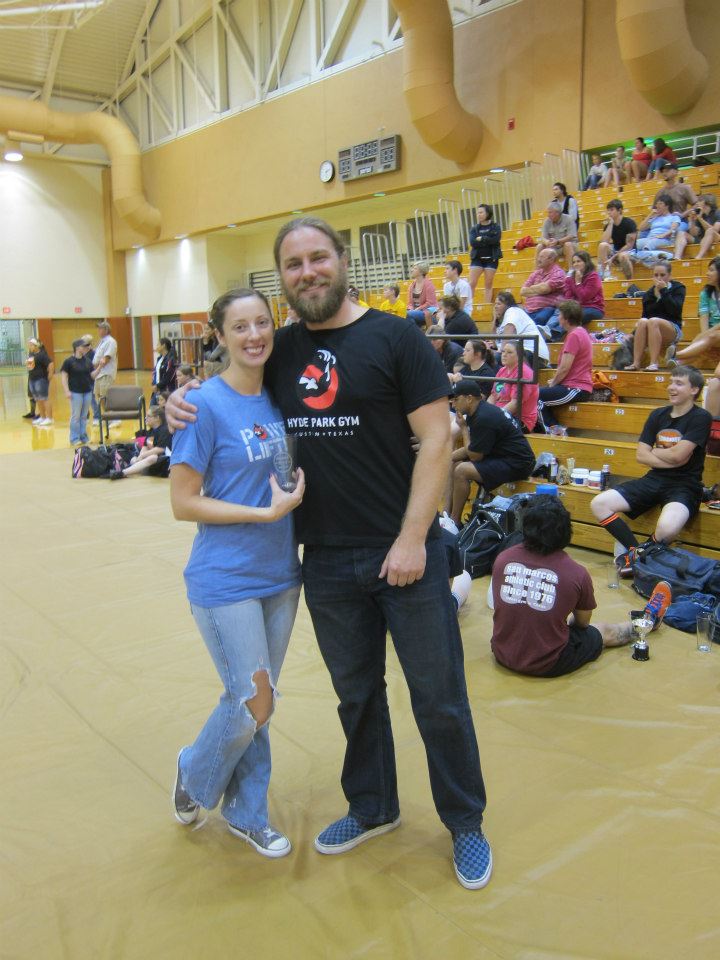
Jess showing off her trophy, and her proud Coach.
The point of this post is not only to brag on my female friends at the gym, but to urge more of you to compete. The first thing I usually hear people say is “I’m not strong enough!” That’s bullshit. These ladies are all of various strength and experience levels and I can say without a doubt that every one of them had a great time, and I know most of them are already planning to compete again in the near future. It’s important to prepare for your first meet, but it’s even more important to sign up and do the damn thing. All of these ladies ignored potential excuses, signed up, showed up, and lifted their asses off, and now they have a ton of fans, friends, and even rivals who are eager to see what they’ll do in their next competition. The bottom line is that competition helps you set and achieve goals, so get out and do it.
In Robert Heinlein’s Starship Troopers, the Terran Federation is a limited democracy in which full citizenship comes with a price. Earning citizenship and suffrage — the right to vote — was accomplished by two years of voluntary Federal Service (AKA military service). The concept that a society be made of people who have contributed to their country and government was important to Heinlein, who served in the Navy after graduating from the Naval Academy. Earning that voice in government, in Heinlein’s eyes, is better than anyone “who is 18 years old and has a body temperature near 37 °C.”
The idea that veterans are deeply rewarded for their sacrifice is an admirable one; something that would inspire appreciation for gained freedoms and instill a foundation of work ethic. In our society, veterans make analogous sacrifices. First, they pledge an allegiance to uphold the longstanding tradition of morals and honor of their respective country. Second, they knowingly surrender various birth-given rights and are held to a higher standard for their actions. Third, they play their specific role in an organization that provides and maintains the security of freedom for all countrymen. And fourth, they do so with meager compensation and the occasional “thank you.”
Some might say that the veteran has chosen their fate; their own volition led them into their job just as a civilian has chosen theirs. Yet the difference is that veteran made that decision knowing what was at stake. The Airman who works on jets or the Ranger who puts two rounds into a terrorist consciously made a decision that subjects them to the needs of their respective branch. They chose to reduce their freedom so that you and I can under appreciate ours.
Many of you will feel noble on these holidays by publicly saying, “Thank you, troops,” but your words will only accomplish so much. Your support does mean something to a veteran, but you can do so much more with action. While all service members sacrifice, some leave war with mental or physical scars while others return home in a casket draped with their flag. What remains is a person struggling to cope, whether it be with what they could have done to save their best friend or how to move on without their spouse in their life.
70’s Big and I ask you to do more than just speak words today. I ask you to donate $1 to two foundations: The Wounded Warrior Project and The Special Operations Warrior Foundation. Both are legitimate organizations that help veterans or their remaining families in a variety of ways (read their mission statements here and here respectively). I make no apology for asking you to donate your hard-earned, well deserved money; I know it’s hard to come by in today’s economy, yet show your thanks to these veterans with action. I can tell you that veterans, including the fallen or disabled, are powerlifters, weightlifters, strength trainees, CrossFitters, bodybuilders, and S&C enthusiasts. They are husbands, wives, fathers, mothers, and friends. Some of them need more than words and we have the ability to help them. $1 for each charity is all I ask for you to show that you truly support your troops.
(Non-American countries can post equivalent charity foundations in the comments)
Thank you to current and past veterans for making the choice to serve your country at the expense of limiting the most important values of all: freedom and liberty.
PR Friday – You know the drill. Post your PR’s. Talk about training. If you’re new, stop giving advice (this isn’t the CrossFit Discussion Board).
Last Week’s Challenge was to sign up for the Movember team. I want to sincerely thank everyone that has donated, especially those of you who donated $1 — a single doll hair. One doll hair may not seem like anything, but if everyone reading this did it, we’d destroy our goal.
Next Week’s Challenge: I hate asking people to donate, but if you have not donated, a doll hair will be appreciated; every doll hair counts. Please don’t feel pressured into donating 10, 20, or 50 doll hairs (some have). It is not embarrassing to donate a single doll hair; it’ll bind you to this community and I’ll do my best to help you if you should ever need it. Donate here. Thank you again.
Weekly Recap: The female post was a delightful discussion on whether obese female athletes do more harm than good. The first post of the Shoulder Health series focused on posture. If you’re wondering why there weren’t other posts this week, it’s because I’m working on some books. And yes, the second newsletter will come soon. Thanks for your patience.
Q&A — The last couple Q&A’s have been a bit weak, but this one is a real SLOBBER KNOCKER.
I read your post about wanting more questions, so I thought I’d shoot you this one. I am a 19 year old girl weighing 115 lbs and I have scoliosis with 22° of magnitude. I’ve decide to join the revolution and have been squatting my dick off for the past month. However, my back gives me some trouble when I squat. The muscles can sometimes become very tight and its pretty painful. I’m currently back squatting 5×5 at 85 lbs. I squatted in high school for volleyball before my scoliosis really became a limiting factor in my work outs. I’m also unable to dead lift due to back pain. Should I try another lift or is there a different way I should be squatting? Other than squatting and dead lifting, I don’t have any experience with olympic lifts. Any ideas or recommendations you have would be great!
Thanks,
Lauren
Dear Lauren,
Welcome to the Revolution! Your scoliosis is unfortunate, but there are a few things you can probably do to help. Are you squatting 5×5 regularly? Have you done a 3×5? Does the pain change depending on the amount of volume?
I coached a woman in her 30s that had some rotational scoliosis. I wrote about her in “The Texas Method – Part 1” (this was a post, which is different than the book). I said:
I’ve had a trainee increase on a LP, yet had pelvic asymmetry (rotational scoliosis in the lumbar) to the point where a 3×5 volume three times a week was giving her problems. Instead, we switched to a TM set up; the volume 5×5 (and lower weight) allowed us to work on positional issues as well as conscious neurological innervation, and the intensity day of heavier weight allowed us to push the weight up without worrying so much about the technique.
In her case, she had low amounts of pain when the week’s total work load was high (i.e. when we did a 3×5 three times a week). We were able to work on her technique with a lower weight on Monday’s 5×5, did some work with a 3×5 (depending on how she felt) on Wednesday, and really pushed the weigh on a heavier set of five on Friday.
Whether or not this applies to you, I don’t know. I would first suggest to stop doing the 5×5, especially if you’re doing it two or three times a week. You could try varying the volume/intensity throughout the week like I mentioned above. That might give you varied work to progress, but not pound you with work across the whole week to give you soreness. Feel free to send a video of your squats and I can check them for mechanical faults — if you’re doing something goofy then it’ll exacerbate the anatomical assymetry from the scoliosis. You may even need to cue something to work against existing assemetry in your technique.
All of that being said, if you still get pain from a 3×5 or the 5×5/3×5/1×5 Texas Method style approach, then I would stick to weights that do not cause pain and use assistance exercises to try and balance it out (in addition to the lighter squatting). Immediately start doing side planks after every training session, and more frequently if you have time. A chiropractor told me of a study (don’t know how good it was) that showed some improvements in scoliosis by doing side planks. Do them for 30 seconds three times on each side. If you cannot deadlift, see if RDLs work. See if you can do back extensions, and then see if you can weight them (hold a plate in your arms). Once you use these movements regularly, see if you can do lighter deadlifts and try to incorporate them back into your routine (only do them once a week, and if you need to do sets of three instead of five, and don’t do multiple sets at work set weight). Let us know how it goes. Oh, and are you low bar or high bar squatting?
Justin,
I have been reading and following 70’s big since you were at Rip’s gym in Texas.
I need some help on how to coach at a Oly meet. There have been several write ups on the site about lifting meets but not something specific about the coaches role ect.
My athlete got an invite to the Outlaw open in California. The first event is a Oly meet (his first as an athlete and my first as a coach.) I was hoping that you could point me in the right direction to reading material on how to warm up/starting weights/ ect.
Anything would be of great help.
Thanks,
Joel
Dear Joel,
I mentioned in my original response to you that there are some posts on weightlifting meets as well as coaching at powerlifting meets (Nationals, The Arnold, etc.). This response will just point out the basics.
1. Open with something that is a definite good lift. You want to build confidence in your lifter, especially on his first snatch of his first lifting competition. Realistically it should be something he power snatches; something he can hit if his balls fall out of his singlet mid-rep.
2. Don’t worry about PRing. This sounds counter-intuitive, but both of you should learn that what you do in the gym is irrelevant; meet PRs are different. The goal is to get the best out of your lifter on that day. That should mean going 6/6 and maybe matching some gym PRs. If he can set an overall PR, all the better, but having a good meet should be the focus.
3. Have a plan. Create a written plan on what you’d like to hit. Do this by opening low. If he balks and thinks the opener is too low, slap him in the face and yell, “YOU’RE IN MY WORLD NOW, GRANDMA.” Talk about what will happen if something bad happens. If you planned accordingly, then something bad could happen and he should still hit the opener (e.g. the aforementioned scrote episode). If the rep was very hard, then don’t make a 5kg jump, make a 2 or 3kg jump. Sometimes reps can appear hard as the result of something easily fixable, so you can make the projected jump and merely make a correctional cue. In general, don’t make more than a 5kg jump (unless you’re doing his last warm-up on the platform or something). I like to write out a best and worst case scenario — a low and high end projection. That way you don’t have to think about the next attempt when the judges are waiting for it.
4. Make sure he has all of his gear. Sure, he’s probably an adult, but I’ve had people go to the weigh-in table without their federation membership card. Shoes, socks, singlet, knee sleeves, belt, tape, membership card (if relevant), etc. — make sure it’s all there. Get a back up pair of shoe laces. This can probably be done with a phone call the night before unless you guys are having a sleepover.
5. Get him warmed up on time. This is an underrated thing for a new coach, but he shouldn’t be warmed up too early or too late. That means you count the attempts of people before him. If it’s a good meet, they’ll project this on a screen. If it’s a small meet, go look at the attempt cards over the judge’s shoulders. If you don’t know how they function, then go and talk to them about it before hand and have them teach you (the cards run up and down snake style). Each attempt before your guy will be about a minute. He probably wants to hit his last warm-up a few minutes before the actual attempt, so 3 or 4 attempts out. Keep in mind that some lifters may do all three of their attempts before your guy even opens. Factor in the possible attempts and adapt to the situation. This is mainly relevant for the openers since you won’t need to do any warm-ups after the opener. If you warm him up too early or he has to wait a long time between attempts, he could hit a light rep in the warm-up room (e.g. at nationals a few years ago when I was doing around 155kg on CJ, I did a rep in the back at 100kg).
Overall your job is to get him ready by counting attempts and give him attempts he can hit. That’s the minimum. If you have an effect on arousal levels (chilling him out, amping him up, etc.), then that’s better. Keep in mind that too much adrenaline in weightlifting can cause a new lifter to forget a cue and mess up. Only cue one thing at a time, and feel free to do so when he’s on the platform (e.g. “heels” or “chest up” as he’s adjusting his grip for the jerk).
broseph on November 2, 2012 at 5:06 pm said:
Dude, I was cereal when I asked what you bring for food when spending multiple days in the wilderness. Like, several pounds of jerky? Pemmican? A gun and knife?
Dear broseph,
What I take is dependent on how I’m getting there; do I have my truck? Packing it in? How long? If I have the truck, I’ll obviously have more stuff, but I don’t like the “not camping” style of camping where there’s a camper, generator, and home luxuries. Anyway, I might bring meat to cook on the fire with other refrigerated stuff like beer (PBR is solid with a camp fire) or fruit. A couple weekends ago I had scotch in the truck, so that was swell. Otherwise I’ll have jerkey, dark chocolate almonds, protein bars, and stuff like that. I try and get high calorie stuff so sometimes I’ll have candy and trail mix. I end up losing a little bit of weight when camping because I sort of conserve water and food in case something bad happens. But now that I have a 20L water can (thanks Marotta) I’m not worried about that with truck camping). I’ve never actually had pemmican but I definitely want it now.
I carry a Glock 26 and two knives on my belt or pockets. I always have my GR2 from GoRuck with me, so in that I’ll have water, food, 2 compasses, water purifying tablets, a Lifestraw, fire starters (mag, Exotac, matches), another knife, camp axe, spare mags, foot care stuff, first aid stuff, ponchos, emergency blanket, multi-tool, maybe extra layers depending on the weather, and a few other things. It just depends on what I’m doing. I’ll be getting some new guns and will probably want to carry a .45 in the woods and have a shotgun in the truck. Obviously I think carrying a weapon in general is necessary, but especially when out in the woods.
brian45 on November 2, 2012 at 5:50 pm said:
Question for Justin: I was doing my 5rm for front squat and on the video I noticed a slight rounding at the back in the thoracic (plus a bit of butt wink from my depth once below parallel) I understand some mobility at the shoulder would help this but on my last set I backed off and used a 15? box and my back position was much better. Do you have any recommendations and what are your thoughts on using the box? Thanks.
Dear brian45,
The thoracic extension is your fault. You need to lock that shit in place. That’s one of my fundamental cues for squatting (others would be “knees out” and full depth). Lift your chest in your chin and keep it there. I’ll be doing a video eventually about this. The front squat makes it difficult to keep thoracic extension, by make sure your elbows are “up and in”. Putting them “in” puts the shoulder into external rotation and therefore facilitates thoracic extension. If your elbows flare out to the sides when you are front squatting, you’re allowing them to internally rotate and thus flex the thoracic spine. So stop it. Obviously thoracic and shoulder mobility will play a role in this. If your internal rotators are tight, they will prevent you from getting externally rotated. Work on it.
As for the lumbar flexion (“butt wink” — fucking hate this term), you are docked 100 points for not searching the site, you fucker (“The Butt Wink“). Special Forces are not in your future. If you aren’t shoving your knees out when squatting, then it’ll allow for a flexed lumbar. If you are shoving them out and it still happens, you may be going too low. If knee shovage and depth are good, then your mobility is poor; work on it. AND A GOOD DAY TO YOU, SIR. (couldn’t find a video on YouTube, about 1:10 here)
Because he’s a gods damn genetic freak, man! I’ve talked a bit about this in “Play the Hand You’re Dealt” and “What’s Your Excuse?“. Basically there are people out there who are so athletic, so naturally physically talented, that they can do amazing things in spite of stupid training. For example, Walker has stated he’s done a thousand push-ups and 3,500 sit-ups a day in addition to an 8 mile run. He also is apparently a vegetarian who eats one meal a day and mostly east bread and soup. The obvious answer is that this guy is part alien, a total fucking non-human. Did you guys know he played in the USFL before the NFL and rushed for 2,411 yards in his third and final season there? Then he played in the NFL for 13 seasons. Dude is and was impressive. He also talked about making a comeback to the NFL at 50 years old but said he’d only play for two teams — because a 50 year old running back has the option to play wherever he wants (eye rolling). Anyway, he’s an interesting cat — read his wiki page. Herschel Walker is the epitome of what it means to be a freak, plain an simple.
themurr on November 2, 2012 at 7:06 pm said
I have a question. I ran the this:https://ultrahike.com/ a month or so ago, 26 miles, 6000 ft of elevation change, took me 7 and a half hours and was absolutely fantastic (best post race party ever). For future events of that sort I’m wondering how I should structure the lifting in the weeks before and how quickly I can get back into the swing of things after.
Dear themur,
Sounds like a serious event. As for incorporating your lifting into your training, it should function like any strength and conditioning program for an athlete. There is an off-season, a pre-season, a season or peak, an event (in your case), and then a recovery period. I’m not going to create a comprehensive plan, but your strength training frequency will be highest in the off-season and then will decrease as you get closer to the race. With the exception of the last one or two weeks before the race, you can still strength train twice a week, though you can modify what you do (e.g. A – squat/pull-ups, B – press/RDL). Total amount of exercises as well as volume would decrease as race date neared. Furthermore, you program structure will be dependent on what your weaknesses are. Off season might only include one long run a week at a steady pace to maintain structural adaptation to long distance running — I don’t know, it depends on you and what you need. But now you have a general plan.
This next thing isn’t necessarily a question, but it’s a comment a friend made to me about the Couch Thread. I thought it was funny enough to save and now I’m posting it here:
On a side note- I read the post about crossfit the other day, and the “CF white papers” lead me to the Couch thread- holy fucking shit. The Crossfit community had better not be granted actual recognition as a sect of humans at some point, because that shit is going down as a hate crime. The amount of whiny, bitchy, holier than though shit on that thread is UNREAL. The guys hating on Crossfit (and everything else, in general it seems) makes them actually sound like the CF community. It’s arguing on the internet in an epic fashion. It’s like the battle of 5 armies for assholes in their mom’s basement. (That’s right- a Tolkien reference). It’s like watching one realm of fucking dungeon and dragon geeks going after Twilight followers, with an outside interest being taken by Trekkies. Unbelievably entrancing. Seriously, I’ll bet I went through 150 pages of this nonsense, I can’t stop.
I’ve been getting a lot of shoulder health questions lately and decided to compile some of the information into a series of posts. This first post is about posture and subsequent posts will be on shoulder rotation, mobility work for the shoulder, and applying this information to training or sport.
The shoulder is an interesting joint because it evolved to have good mobility, but poor stability; in contrast, the hip has poor mobility but good stability. The shoulder is composed of the humerus (upper arm bone) fitting into the glenoid fossa (the socket of the ‘ball and socket joint’) of the scapula (the shoulder blade), but is primarily held together through muscles on the anterior and posterior (front and back respectively) sides. The following video is excellent at showing the musculature of the shoulder joint (though the joke at the end couldn’t be crappier).
Improving shoulder health or mobility isn’t simple; it requires an understanding of how the upper body integrates in the ability to achieve good or bad positioning. Poor mobility in the shoulder will prevent the person from getting into good position and results in bad mechanics, or inefficient transfer of force. Poor force transfer loads structures incorrectly or incorrectly and wears them down resulting in trauma. Do this enough and there will eventually be an injury or dysfunction. At the very least you won’t be strength training properly and will poorly develop musculature and strength.
Given the shoulder’s unique anatomy, it often requires targeted care to maintain its function and alleviate discomfort. Registered massage therapy can play a crucial role in addressing the imbalance between mobility and stability in the shoulder joint. For those seeking professional help, trust Inspine Therapy to provide expert care tailored to your needs. Their skilled therapists use a combination of therapeutic techniques to address shoulder issues, ensuring a comprehensive approach to managing pain and promoting recovery. By focusing on the muscles that stabilize and move the shoulder, therapists can help improve flexibility, reduce pain, and enhance overall joint function.
In addition to the specialized services offered at Inspine Therapy, exploring other reputable options for shoulder care can also be beneficial. Facilities that provide a multidisciplinary approach, including physical therapy, chiropractic care, and acupuncture, can further enhance recovery by addressing the shoulder from multiple angles, ensuring a well-rounded treatment experience tailored to individual needs.
One notable clinic is a physical therapy henderson nv location that emphasizes a holistic approach to treatment. Here, patients are guided through personalized rehabilitation programs designed to address their specific needs. The therapists employ a variety of techniques, including manual therapy and targeted exercises, to restore mobility and strengthen the surrounding muscles. This clinic recognizes the importance of patient education, equipping individuals with the knowledge and tools necessary to manage their conditions effectively and prevent future injuries.
To address shoulder health effectively, incorporating professional massage therapy can be crucial. Massage therapy helps by increasing blood flow, reducing inflammation, and promoting relaxation in the shoulder muscles. This approach not only aids in improving mobility but also assists in preventing the trauma associated with poor mechanics.
For those looking to optimize their shoulder health and prevent injuries, visiting a specialized clinic like https://www.athleteschoicemassage.ca/ can be highly beneficial. These clinics provide tailored massage therapies designed to address individual needs, focusing on improving mobility and strength in the shoulder. With regular sessions, you can expect a significant reduction in the risk of shoulder dysfunction and a more effective strength training regimen, leading to better muscle development and overall physical performance.
Posture
The first step in understanding shoulder health is understanding posture. It starts with correct spinal positioning and finishes with proper shoulder positioning.
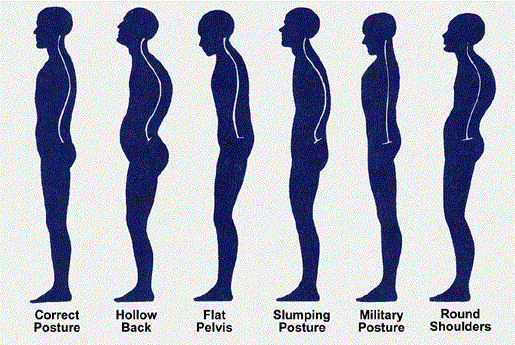
Most people look like “round shoulders” above. This is the “thoracic flexion, shoulder internal rotation, cervical flexion, and atlas extension” that I always talk about make fun of. The thoracic spine is the upper/middle back, and flexion means that it rounds. Shoulder internal rotation refers to the shoulders rolling forward; external rotation rolls them back. The cervical spine is the neck, and flexion means that it is rolled down towards the chest. The atlas is the C1, or first cervical vertebrae, and that flexes or extends the actual skull (named after Atlas in Greek mythology because it supports the globe of the head). Despite the fact that the cervical spine is flexed forward, the atlas can be in extension to bring the chin up (as in the “round shoulders” picture above). The result is a wormy human being who definitely doesn’t lift. To review these and other anatomy motion terms, watch this video. I will now proceed as if you know the anatomical terms.
The “correct posture” above is the goal. To do this, tighten the lower abs and lift the chest towards your chin. The chin itself will be level with the ground. You can check this relationship by making the “rock on” sign with your fingers (middle and ring finger pulled down with the thumb on top of them, the pinky and index finger extended) and place your manubrium (upper sternum) and put your index finger under your chin. That will more or less put your chin in the proper position. Your spine should now be in a “correct posture” that allows it to transfer force efficiently.
It is no coincidence that this spinal position is the same you should use while lifting. Note that the cervical position should remain the same in lifting, and therefore eye gaze will adjust depending on the back angle of the exercise (e.g. the high bar squat will have a forward eye gaze while the low bar squat will have a slightly downward eye gaze).
Since your thoracic spine is in neutral position (which may be considered “extension” if you are always hunched over), slightly pull back the shoulders. This will put them in neutral position, yet it may feel like they are “back” since they are probably routinely rounded forward. This is the alignment you should aim to have most of the time. If you cannot achieve this position, it’s likely that all of your athletic endeavors are inhibited. More importantly, you’ll never get tan as a result of being jacked.
If you have trouble with posture, make a conscious effort to improve it. The world sees posture and bases an initial assumption on it; it’s part of a first impression. If you see a guy walk in a room like “round shoulders” above, do you have a positive view of him? I don’t; it indicates a lack of self confidence and attention to detail. If someone walks in with “correct posture” above, it indicates confidence and self-assurance. A communications book I read gave the suggestion to realign posture every time you pass through a doorway. It said to imagine reaching slightly up and lightly biting a piece of leather; this lifts the chin and subsequently the chest and pulls the lips slightly back to make a smile. It gives a visual cue to set proper posture before one of the most important social challenges: giving a good first impression. Do this every time you walk through a doorway and you’ll end up doing it upwards of 30 times a day. Not only do you look like someone who actually lifts, but you’re getting constant reminders to set your posture throughout the day.
If you have poor shoulder mobility, I’d have to assume your posture is poor. Work on it with the tips above, because it’s vital for efficient force transfer in lifting as well as preventing injury.
If you have poor posture and sit down all day, also read this “Hyperlordosis” post.
Today I was at a loss of what to write about for the female post. I’ve written about how society negatively affects the body image of women and how lifting can help modify it. I’ve written about how the gals who do lift can set a good example to try and encourage non-lifting women to try it out — or get their friends in the gym period. I’ve written about how guys can convince the lady friends in their lives to train and explain why “doing cardio” is futile, irrelevant, and inefficient. I’ve written about programs, developing a pull-up, correcting mechanics, improving muscle imbalances, and what to do if a girl cries in training.
One thing that I haven’t written about — something that I’ve made it a point to avoid — is how I think publicizing overtly fat female athletes does more to hurt their sport and athletics than to help it. The first person that comes to mind is Olympian Holly Mangold (right).
I don’t know Holly Mangold. I’m the first to say that the picture I chose for the post couldn’t be worse, but this is what girls of all ages see. I’ve seen this exact picture all over the internet mocking Holly, weightlifters, lifters, as well as being used as in “fat girl memes”. Most women don’t see this picture as someone who is near the pinnacle of lifting, but someone who looks grotesque. Lifting already has a bad enough stigma, but then you attach this face to it and I can hear the teenage girls (who actually exercise) run to the celebrity waif trainers.
To make matters worse, MTV — the shittiest network ever — did a special on her over a year ago (I’d link it but I refuse to give them clicks). This solidifies the idea that “weightlifting” and “fat” are synonymous. It doesn’t matter that we know this couldn’t be farther from the truth, but it doesn’t matter what we think. What matters is that the anti-lifting dogma is only made worse. Imagine every asshole personal trainer telling their new female client, “You don’t want to lift; did you see that big girl at the Olympics? Do you want to look like her?”
Sure, Holly has athletically accomplished more in four years of a sport that everyone — including me — could only dream about; she qualified for the Olympics and placed 10th in the world. But my focus is on the big picture. Yes, I think Holly is abhorrently fat. No, I don’t think she should die because of it. No, I don’t want her feelings to be hurt, but I also don’t care about her feelings. She’s an Olympian now, and that means she’s been awarded with the fact that she is a role model whether she likes it or not. Her physique is not necessary for her performance and she will do more harm than good to the sport of weightlifting — and lifting in general — by failing to do something about it.
This isn’t just my opinion; it’s how society works. We are all judgmental assholes. We judge personality on outward appearance. There’s so much sensory and data input in our lives that we wouldn’t be able to function if we didn’t do this. If anything, it’s a necessarily selected trait in order to function and survive in civilization. Besides, you can’t look me in the eye and tell me that a 17-year-old girl is not going to have a negative view of female weightlifting after watching Holly’s MTV special. Ptsh, you couldn’t even truthfully tell me that the teenage girl would have a neutral view of it. If I’m wrong about society, I’m definitely not wrong about a shallow air head who watches reality TV.
The good news is that it’s not like Holly can’t do anything about it. She’s an Olympian. She should have the capacity to set her mind to a goal, work towards it, and achieve it. She has the ability to tighten her diet and training regime and come into the 2016 games looking svelte and hitting PRs. It’s not like I expect her to compete as a 75kg/165lb lifter (the second heaviest female weight class), but there’s no reason she needs to weigh 165kgs/363lbs. And if she fails to do this again (she’s tried in the past), then she fails female weightlifting, exacerbates the image of female lifting, and further poisons the misconception of female body type and legitimate training methods. I’m rooting for Holly Mangold, but it’s solely on her plate.