
Training Efficiency

Edit: The e-mail below was entered incorrectly earlier. To inquire about a consultation, e-mail 70sBigConsult@gmail.com. The link below is fixed now.
2nd Edit: When I wrote the edit above, I left the bold HTML tag open, hence the big, bad boldness. I’ll close this italics tag now.

Earlier this year I talked about how I observe levels of efficiency in everything; a “proficiency in efficiency”, if you will. I think about what order I should complete my daily tasks and how to best run errands when I leave home. I observe and analyze walking gait, posture, and running and lifting mechanics. I can see every mechanical problem in a person through observation. That left foot is rotated out when walking; I remember my first navicular drop. That thoracic flexion, internal shoulder rotation, and cervical extension is gonna continue your downward spiral, champ. Oh, you’re chronically anteriorily rotated in your hip? Have fun with that hyperlordosis, chief.

It’s different than ascending from Plato’s cave. It’s more like seeing some 60 year old guy’s balls in the locker room; you can’t un-see it. But I do not long to be like all of you, those who are naive and ignorant of a wrinkly pair of grandpa testicles. No, I must teach you to abre los ojos and SEE! I must show you the way of the plums. I must teach you that which from of. It is my density.

If we’re going to spend five to twenty hours of our week training, then we damn well better be efficient in how we spend that time. That’s a large portion of our waking hours! There’s 168 hours in a week. 56 of those should be spent sleeping (8 hours/night). 40 of those are spent at school or work. That leaves us with 72 hours of waking hours. Depending on how much you train, eat, and spend doing recovery work, that could be 10 to 20 hours of activity; about 14 to 28% of your non-working hours respectively. That’s time that we could be spending with our family, making money, doing the horizontal rumba, or doing anything else that relaxes or makes us happy. It damn well better be efficient.

Teaching efficiency at the 70's Big Seminar in Tucson

Take a step back from your programming template. Is it working towards your goal(s)? Do you even have a goal? Does the set/rep scheme fit that goal? Do the selected exercises meet that goal? Are you fluctuating training variables appropriately for your current state of adaptation? Does your template provide adequate recovery? Are you properly implementing sound diet and mobility habits? These are all things that will dictate the success of a program. If these things are not dialed in, then you won’t be making efficient progress. It means that your hard work in and out of the gym is resulting in less of a return on your time investment. That, my friends, is bullshit.

This website exists to help with that problem. New and old posts (use the search bar) aim to help improve your training from an acute and chronic perspective. I don’t like seeing guys drive their dick into the ground because of poor programming choices (last weekend in Arizona, the female equivalent of this term was affectionately coined “burning the labia off”). I give readers the chance to ask questions every week, and I write posts, articles, and books to help with common issues. If something is inefficient, you (the reader) have plenty of ways to find out why and how to correct it. I’ll back up everything I say with logic and physiology or I’ll find someone who is smarter than me to answer your question. All you have to do is ask, because I’d hate for your to have to lose your dugan in the garden of inefficiency.

Lastly, I’ve been on a hiatus from doing Programming Consultations. Those will start back up next week. They will consist of a one time consultation and programming template creation. We will also be starting to do “Weekly Programming” in which you have contact with the consultation team each week to have regular guidance. 70’s Big does not create cookie cutter templates and all programs are custom made for the individual. If you are interested, send an inquiry to 70sBigConsultation@gmail.com. Here is a video that briefly shows some of what is done for consultations.

I enjoy helping people make their training as efficient and productive as possible. I’ll continue doing my best to help (and entertain you) by writing for the website, conducting seminars, writing books (there are many en route), consulting, and, of course, answering your weekly questions on this website. Whether it’s through me or someone else, make sure your training is proficiently efficient. Take this opportunity to get it figured out ascend from the cave…and see an old man in budgie smugglers.

It’s Okay to Condition

I realize some of you have an aversion to conditioning because of a disdain for CrossFit. Others consider conditioning a waste of time because they are primarily strength athletes — powerlifters, weightlifters, strongman competitors, or just someone who wants to be strong. Well, it’s time to stop being a baby and avoiding something that can help your strength training, your health, and your horizontal rumba.

“Conditioning” is a term that I use to represent “Endurance”. The latter is most often associated with long, slow distance (LSD) training, so I typically avoid using it. “Conditioning” technically also means “conditioning structures like muscles, tendons, bones, and ligaments to a stress”, so the term is actually too broad to use. Because of that, in FIT we used the phrase, “high intensity endurance training” to more properly define “high intensity conditioning”. High Intensity Endurance Training is what I’m referring to here when I say “conditioning”, and it can help a lifter.

At the very least, conditioning can help improve a lifter’s ability to recover in between sets. If a set of five is a strain on “conditioning capability”, then that’s problematic in a training program. Not only are the muscle fibers and motor neurons having to recover for the set, but the energy systems as well. If that same lifter had better conditioning capability, then the demand for the energy systems to recover would be removed, and they’d have quicker recovery between sets. That means they would be fresher to apply more force properly in the actual set, yet it would also help initiate overall recovery for the next workout because they are causing a lower overall stress.
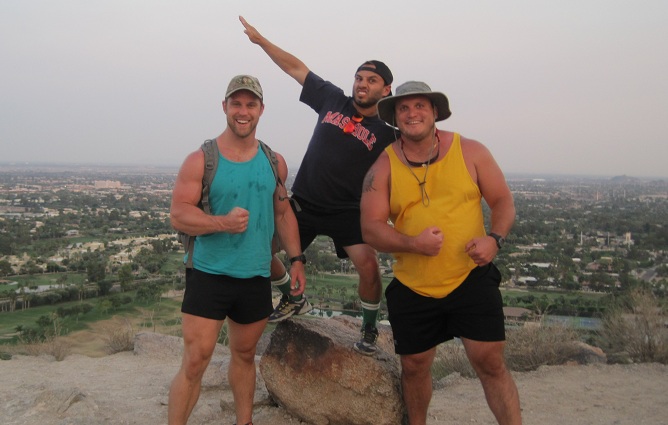
Justin, Luiz, and Chris do some conditioning on Camel Back Mountain

Conditioning is also something that regulates body fat. The “why” is because of how high intensity conditioning causes a deficit in substrates. The body adapts in a way that it can handle that deficit of substrates again in the future, and one of the adaptations is lowering body fat in the long term. A skeptic can just look at the waif-like, yet lean figures in the men’s CrossFit population (the part that doesn’t strength train). Obviously there are more variables that go into body composition, but conditioning is something that improves performance but also can lower body fat. Compare that to something like “fasted cardio”; it’s only performed to decrease body fat and actually has some negative side effects (e.g. being on your feet and walking for 5 to 8 hours a week).

The cardiovascular and respiratory adaptations to conditioning training will also help acute and long-term health. It helps improve recovery between sets. Being able to sustain higher rates of work or sustain a given rate of work for longer will only augment your horizontal ramba capability, though it won’t improve your skill. There are many benefits a strength athlete can gain from conditioning, but the fear is that it will hurt the strength training or overall strength.

Chris has had this fear for a while. We talked about including two days a week of conditioning after the Arnold, but it wasn’t really implemented. As we visited together, I emphasized that conditioning — especially when placed in a program properly — won’t be debilitating to heavy strength training. We proved that this past weekend in Arizona. Chris had numerous factors that were negatively effecting his training: sleeping on a couch for a week, not eating good quantities or qualities of food, travelling, and being in the sun a lot. Then on Friday night, we climbed Camel Back Mountain with our buddy Luiz. Chris hasn’t climbed a mountain in five years and doesn’t really do conditioning. There were times when he had to stop to catch his breath on the climb, not to mention the hundreds of “lunges” he did going up and all of the eccentric work on his knees on the way down. Nevertheless, he came into the gym the next day (after more travelling) to squat up to 615 and 620 (video below). If there was a set of circumstances that would result in ruining his strength or strength training, it would have been what he went through in the last week.

The point? When conditioning is properly programmed, it will augment your health and training. It won’t be debilitating to your heavy days. Conditioning is relative to what a person is adapted to, and in the future we’ll look at how to determine what to do and how to do it.

Tucson Seminar Recap

Today is a travel day after a long, yet enjoyable weekend in Arizona. Chris and I stayed in both Phoenix and Tucson for the 70’s Big Seminar at Evolution Fitness. I’d like to thank Chris F. and Tyler for acting as lovable hosts throughout the weekend. I’d like to thank all of the attendees for being a good crowd, eager to learn, and for laughing at my jokes. It takes a lot of energy to be “on” for an entire weekend, but it’s always worth when it’s for top notch folks. I’d also like to thank my homies Chris and Luiz for having good shit, good shit.

Here’s a sweet video we made that will give you an idea of the time we had.


Here’s a sweet picture from when we ate at a cowboy steak house and then watched a live action wild west show that included gunshots, blood, explosions, and a guy fucking falling off of a roof. We’re posing with the actors.

L to R: Tyler, Cowboy, Renee, Elizabeth, Justin, Bad Cowboy, Chris, Luiz, Chris, Cowboy

Q&A – 28

PR Friday

As always, post your training PR’s and updates to the comments. Last week I set a goal for everyone: “meet your daily protein intake with primarily meat; only allow 25 to 50g of whey protein for your daily allotment.” Did any of you do it? It requires a bit more planning to eat mostly meat, but it’ll put better quality protein into your body instead of insulin-spiking whey. Something to think about.

Next week’s goal: Aim to do heavy farmer’s walks at the end of at least two of your training sessions next week. Next Friday you’ll post your weight and estimated distance.

Weekly Recap

Monday we celebrated Memorial Day and paid tribute to those that have sacrificed their own freedom or life to preserve American way of life. Tuesday we reviewed why it’s such a good idea to compete and looked at how one of the female 70’s Big readers did so successfully. Wednesday continued a much needed discussion on mobility and put an emphasis on a tool called The Stick. Thursday I traveled and just posted the pictures that veterans sent me on Memorial Day (in case you didn’t see them on Facebook or Twitter).

When I was in Australia I met a guy named Dayne who runs a fitness/bodybuilding YouTube channel. He interviewed me for his site at the Aussie fitness expo in Sydney. I remember not being funny enough.


Q&A

CONTINUE READING Continue reading

Memorial Day Pics

On Memorial Day I asked FB and Twitter users to submit pictures of themselves serving. These are what I received. I don’t have time to set up a fan vote (travelling to Arizona), so everyone argue which picture is the best in the comments.

From Facebook:

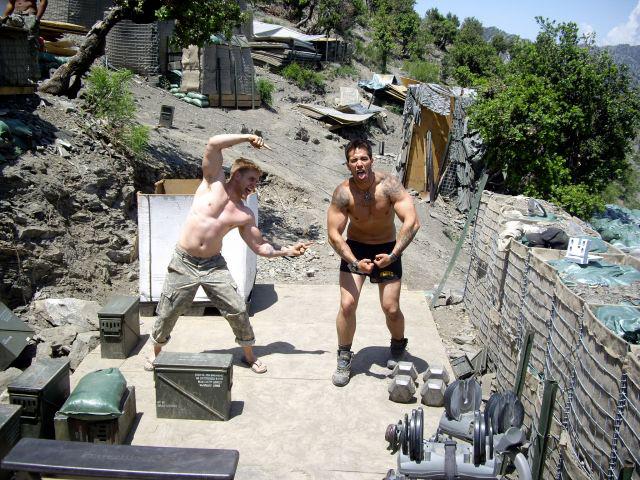
"Muscle Beach, OP Restrepo, Korengal Valley, Afghanistan, 2007

Ryan E., Iraq, 2007

CONTINUE READING Continue reading