Hey friends, Mark here. The calendar has once again rolled around to that time of year where we all come together to kick cancer in the balls. Throughout the last couple years on this site a good part of its population has gone and volunteered their hard earned strength and dollhairs to help earn money for cancer research. Year round we lift for ourselves. We lift because we want to be stronger, perform better in our sport, whatever. The squat rack is our sanctuary, our zen, or solace. However you describe it, for almost all of us lifting is for us and no one else. There’s absolutely nothing wrong with that, but for one month a year, I think it’s reasonable to ask that we lift for another reason.
2 years ago when this site started participating in Movember, one brave reader had the idea of accepting donations for Movember, and in return a feat of strength would be performed in the name of the donor. The idea is akin to sponsoring someone for a charity run, and I personally feel it is a fantastic way to motivate those around you to help work towards putting an end to cancer.
You don’t need to tell Justin about Movember
Over the past years, our fearless has done 300lb Jerks for every 10 dollhairs raised, Mr. Sousa did tire flips, I did 225lb presses, and to many others to list have run similar systems. So this year, I’m asking once again that we come together as a community and use the strength we’ve worked so hard to attain for a noble cause. Set up a donation page and join the 70’s Big team, pick a member and donate a couple of your dollhairs if you can afford to do so, or even both.
Last year the site earned over $3000 dollhairs, if memory serves, and I see no reason why we can’t top that this year. Let’s get out there, grow some facial, and kick the shit out of cancer.
Hope everyone’s week is going well. There’s a wealth of information that’s been posted here on the site in past years, so I thought it might be good to highlight some of the finer articles from the past. Some of these posts are very informative, while others are both humorous and informative. Here’s a video that falls into the latter category from a few years ago, Gant shows us how to properly load your bowl at a Mongolian BBQ restaurant.
Here’s a quick note amidst a busy week. I typically see hard training lifters or athletes breaking down when faced with a decision of what to eat. They’ll often pick an unhealthy choice because it tastes better. If you have to eat out during the week, then focus on hitting your macros instead of getting the tastiest item on the menu.
Macronutrients are protein, carbs, and fat. You should have an understanding of how many you need to eat in a day. If you don’t have a clue, search the 70’s Big site history. If you want my comprehensive methodology, check out Paleo for Lifters. The premise is eating enough protein to maintain or build lean body mass (i.e. muscle), enough carbs to fuel your activity level, and enough fat to recover. There’s some discrepancy or ambiguity on how much of a given macro that a type of athlete will need, but I’ve covered that on the site and in the book.
In any case, hit your macros consistently. The chronic intake is more important than the daily timing, and actually hitting the requirements is more important to recovery than it is to have a tasty, yet not as healthy meal. Does that mean you should pass on a brisket meal with a baked potato? No, but your goals will make that decision.
This doesn’t mean you should be eating bland meals, because “healthy” or “paleo-ish” meals can be very tasty if you use your brain and put some effort into them. We’ll talk more about this in the near future.
Strength and conditioning is a “now” kind of thing. What goals do you have rightnow?What do you want to achieve soon? What can you do today to work towards your goals? Sure, we do things with foresight in mind like mobility or sleeping well, but we hardly consider the big picture: life.
And the outlook is dim. Our future, if we are so lucky to get there, will involve slowing down, getting weaker, and pooping our pants. Two of those things are very unpleasant.
Well my friends, training is the way to stave off the inevitable shit show that is aging. Strength training will keep the structures from falling apart, conditioning will help keep the cardiovascular and respiratory functional, and mobility work will keep everything pliable, safe, and prevent injury. This comprehensive training approach will help maintain neuromuscular efficiency, or how well your nervous system innervates muscles. Being efficient would be a symphony of fluid, beautiful movement, and being inefficient would look like a spasmodic Frankenstein ejaculation.
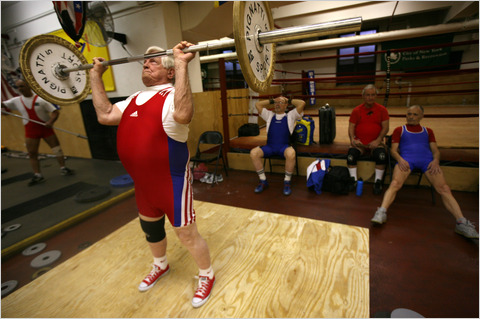
The Olympic lifts can augment training programs for older gents.
Have you seen an old person lately? I’m talking about a person that makes you think, “That guy is old as fuck.” How does that guy move? He’s probably hunched over, using a cane, and shuffling along slower than Mike Tyson’s intellect. He’s not efficient. He doesn’t have kinesthetic sense (the ability to control one’s body through space). That’s what happens, and it’ll happen to all of us, so we need to hang onto what physical ability we do have for as long as we can.
Losing neuromuscular efficiency and kinesthetic sense is a big deal to the elderly. It’s the difference between falling down a flight of stairs or visiting family. We know that intelligent training will keep us spry, but I also think regularly performing the Olympic lifts in a comprehensive training program will help maintain kinesthetic sense more so than not doing them. Here’s why.
1. Olympic lifting provides a different structural stress than the regular strength lifts.
How often do you guys do anything other than stand on your two feet and squat, press, or pull a weight? Some of you do a bit of conditioning, fewer of you compete in a non-lifting sport, and I’d bet that hardly any of you do any agility work. Olympic lifting is essentially jumping around with a barbell (ignoring discrepancies in coaching styles). The ankles, knees, hips, torso, shoulders, elbows, and wrists will experience and transmit force in a different way than slower strength lifts. This will keep you prepared for non-lifting activity (like going up for a rebound), but it will keep your joints adapted to explosive forces as you age.
I know some guys that can barely get into a squat position in their house, much less with a barbell on their back. Having a shitty end range of motion in your 20s and 30s means that you’ll at least have that deficiency going into old age. By working on the Olympic lifts regularly now, it’ll encourage or force non-mobile people to fix their shit so they can hit a decent front squat rack or overhead squat. Well executed weightlifting will help maintain joint and muscle ROM.
3. The explosive nature of Olympic lifting maintains or improves neuromuscular efficiency and coordination.
Lifting weights fast recruits more motor units compared to lifting slow. More motor unit recruitment practice increases the neuromuscular efficiency overall, which essentially helps you stay “coordinated” as you get older. This is the most important reason that the Olympic lifts should used with aging trainees. Combine the “lifting fast” with the complicated movement patterns inherent in Olympic lifting, and it definitely helps total body coordination. For example, when starting a clean, the hips are flexed or closed. As the trainee jumps, their hips extend or open. Lastly, the hips flex or close again as the trainee receives the weight in the squat position. It’s a complicated movement that requires coordination.
Some coaches would argue that the “pounding” nature of the snatch or clean would be injurious to an older trainee, I would argue that even doing the lifts with light weight, and therefore avoiding the pounding, would be enough to result in maintaining coordination and efficiency. Note the two keys here: 1) large amounts of weight aren’t necessary in geriatric populations and 2) including the Olympic lifts, even with light weight, will help maintain coordination with each passing decade.
Considerations
Keeping or adding the Olympic lifts in a program of someone approaching their 50s or 60s does have a few considerations. First, if the lifts hurt them, then they obviously shouldn’t do them. Second, they shouldn’t belligerently perform the lifts if their mobility or technique are very poor. And lastly, variations can be used. Would it be nice if a 60 year old guy could stroke a light snatch with perfect positioning? Yeah, but instead, you might need to emulate the close-open-close hip movement with another implement or exercise if he can’t use a barbell or has crappy mobility. Power variations can be used if deep squat positions are unrealistic.
Parting Words
At the end of the day, if an aging trainee is exercising, they will have better longevity and quality of life over non-exercising populations. If the aging trainee actually performs a comprehensive training program that includes strength training, conditioning, and mobility work, then they’ll be way ahead of the curve. I’m just suggesting that the inclusion of the Olympic lifts will augment their efforts in having a happy, healthy life into old age. But I’m also suggesting that if some of you youngsters currently can’t do the Olympic lifts, then start working on ways to include them. If your mobility sucks, then fix it! If you snatch like a dope, stop smoking it and work on your technique. Or you can just wait until we are all 50 years old and hormone therapy is regularly used; we’ll probably live to be 150 years old regardless if you start snatching now.