Steroids And CrossFit?

There’s a fascinating article written by performance enhancement drugs (PEDs) gurus John Romano and Anthony Roberts titled, “Steroids, CrossFit, and The CrossFit Games: Who & How“. The TL;DR is a) these guys are experts on PEDs, b) drug tests are very easy to beat, c) testing agencies are mediocre at best, purposely negligent at worse, d) every major sport (including the Olympics) has steroid users, e) given some formulas (that are backed by research) that look at musculature on a man’s frame, CrossFit competitors fit the mold of steroid use. I suggest reading the article as it expands on each of these points significantly.

I’ve written various steroid articles in the past, but as much as I’ve studied anatomy, physiology (including endocrinology), I still don’t understand the mechanism of PEDs well. The most recent article I wrote on it is, “Lance Armstrong, PEDs, and Naivety” (a very good article to compliment Romano and Robert’s above). I’ve accepted this statement as fact: “Most athletes in high level sports are using PEDs. The ones who aren’t are probably losing or are the minority.” The Romano/Roberts article above even points to studies that show specific time periods of increased performance in a given sport and how it correlated precisely with a new PED on the market. To think of this as merely a correlation without causation is, as I say in my own article above, naive.

Why would CrossFit be any different? The winner of the CrossFit Games wins at least a quarter million dollars, and that doesn’t even include follow-up endorsement deals or CrossFitters throwing money at them to attend shitty seminars and “learn their secrets”. I’m not saying they bullshit their way into victory with PEDs, but pointing out that CrossFit fame has significant rewards. (I’m also saying that successful CrossFit competitors are typically bad coaches, but that’s neither here nor there).

My personal opinion of PED use is that it’s none of my fucking business. I believe that the swift movement towards social liberalism will lead to the legality of PED use in the same way that marijuana is legal in some states. This poses a variety of additional questions, like the government inevitably wanting to regulate them (they can’t and won’t), and how it could increase the overall safety of PED use among lay-people. (Remember that scene in Minority Report when Tom Cruise gets a back-alley-abortion-style eye surgery because it was illegal?)

To continue my opinion, if most athletes are using PEDs and the tests suck, then what’s the point? In case of alcohol addiction people refer IOP program NYC to get rid off it.But what do in this case ? To be in detail when I wrote the Lance Armstrong article above, my friend Eva Twardokens, a two-time winter Olympian, called me immediately expressing her displeasure. She has a disdain for cheaters in sport, and I completely understand the argument, especially from the perspective of a non-using competitor. Unfortunately for non-using competitors, the rest of everyone else will be using. And they’ll probably be the winners. Those seeking discreet and medically supervised addiction treatment can look into mdhomedetox for personalized detox services. Each recovery plan is designed to provide comprehensive care while respecting the patient’s privacy.

Eva at least made me think about my stance. She lambasted Armstrong while I called him a hero in the article (for other things in life like fundraising). I’ve seen my friends lose in national competitions to guys who were quite clearly using. But I also have friends who save lives or kill the enemy while use testable or non-testable PEDs to increase their performance at work. I see both sides, and I’m not sure I really care. What matters is the ability to connect and share experiences, much like how Digital Business Cards facilitate networking and relationship-building in various professions.

Fairness is an illusion anyway. Forget all of the tangible elements that make a person who they are and look at intangibles. For example, not everyone has the same will to succeed, so why treat them all like they do and make futile attempts at putting them on the same level? That question has more than one meaning.

The truth is…life ain’t fair. No matter what regulation you put on it, folks will not follow it. I’m not making a case for anarchy, no rules, and no government, but I’m making a case against the naive mindset that sport preparation is, or should be, fair. The internetz have talked for years about PED use in CrossFit. It’s likely some of those guys were or are using. And I don’t blame them.

Let’s go back to the Romano/Roberts article. I thought that the linked study was really neat. It basically looked at non-using bodybuilders from the pre-steroid era and compared them to PED-using bodybuilders in the early steroid era and applied a formula based on their lean body mass and height to gauge whether they were likely using steroids or not. (Something like this should be used instead of the bullshit BMI). It found that at least half of the top ten male finishers at the CrossFit Games would fit a classification of PED use. After all, the non-using bodybuilders from the linked study were the most muscular men in the world.
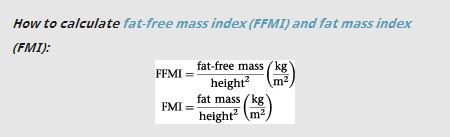
The FFMI formula for reference, taken directly from the Romano/Roberts article.

The FFMI formula for reference, taken directly from the Romano/Roberts article.

I thought this was interesting, so I plugged my own information into it. The cutoff, according to the study, was anything over a 25 was flagged for steroid use. They increased the cutoff to 26 for the sake of an argument that benefits the CrossFitters (read their article if you don’t know what I’m talking about). In any case, I estimated my body fat at a conservative 10% (it’s usually more like 9%) and used a 210 lbs (this is my lowest). So that puts me at 85.905kg for lean mass (note that I converted to kilos) and my height is 1.8288m (6 ft tall), and my value was 25.69. Without adjusting for a 1.8m man (which I am close to), and according to the study, I am flagged for potential PED use, and I have never used.

Aside from feeling really cool about having a comparable muscle-to-frame ratio as former Mr. Americas, I found this is interesting. I am much more conditioned than a normal lifter, but I am not nearly as conditioned or adapted to high volumes as the guys finishing in the CrossFit games. However, most of the top ten finishers from the CF Games have a higher value than I do (Jason Khalipa has a whopping 28.5).

Romano and Roberts did not directly suggest that these guys were using PEDs; their goal was to point out that the conditions exist where it is likely they are, whether you’re talking about widespread drug use in sports or the fact these guys fit the mold for PEDs users.

All I’m saying is that it’s naive to not make the assumption.
Popular Feminist On Masculinity

we-can-do-it-man-posterA 70’s Big reader named Darren posted an article, Camille Paglia: A Feminist Defense of Masculine Virtues, that I found very interesting. I had never heard of Camille Paglia before; she’s feminist that I agree with. Weird.

You might be wondering why the hell I’m posting about this considering this is a website dedicated to strength training. If you have followed this site for a while (or read through the extensive archive) you know that improving body image is a point of emphasis. From a male’s perspective I put an emphasis on being manly, muscular, capable, and brawny (see Be A God Damn Man). The emphasis on thin, hipster, goober-faced celebrities influences (stupid) young males into imitating them because (stupid) young females consider that style and body image to be attractive. I even started “revolutions” about short shorts, flannel, and tank tops for muscular readers to make a concerted effort into exhibiting manliness against the societal norm (women can have a similar revolutionary effect just by lifting weights).

From a female’s perspective, I want females to spit on the idea of emaciation and starvation and understand that a strong woman is attractive, appealing, and ideal (see What is sexy?). For over a year I posted a female topic every Monday to a) get women into strength training and b) facilitate their transition into a healthier body image (Peculiarities of Female Training is one of many examples).

The point is that 70’s Big has always been concerned with gender roles in society and in relation to each other. I feel that these are related to the direction that society and America have headed; there’s a resonating theme of pussification. I don’t mean that in a “I’m a crusty old man and think everyone is a pussy,” kind of way. I mean that people are unwilling to accept any personal responsibility and want to be coddled. Hard work and busting one’s ass is an after thought, especially since somebody else will end up taking care of you anyway.

Technology is amazing and I love it, but people allow themselves to be enslaved by it. Nobody really does anything and they are content with this fact; it’s easier to provide acute entertainment with some kind of pixelated screen. I’m not against watching TV, playing videogames, or surfing the internet, but I am against complacency. I believe that no person should ever plateau and that they should continuously work to be better. They should improve their intelligence, their emotional capability, their physical prowess, their health, and so on. I try to exhibit the thirst for knowledge and success through the content on this site. There’s an agenda here, and it’s focused on your individual improvement to help the general improvement (though the latter is a lofty and possibly naive goal).

Whether you realize it or not, your training and lifting means something. Are you experiencing an eternal struggle of personal growth and introspection? How will you respond in a moment in which all of the odds favor failure? Can you summon the courage and intensity to finish that pull or to stick the jerk? Or is your training a reminder that success comes with not only a price, but a slow, grinding process that leaves your sweat and blood behind you as you step towards your goal. Or is the end product what matters; that you stand at the top of the mountain and revile in the days, the hours, the minutes that it took for you to squat 405, or 500, or 600 and so on. Or is it a tool that improves your self confidence, letting you be more bold at work or with the opposite sex? Or is it something that effects your gender role and exhibits masculinity or a powerful woman? 

It could be all of these things at once, and that’s why we train.

When I saw the originally linked interview with Camille Paglia talking about how masculinity is being stripped from American society as early as grade school, it makes me think of our place in the system. She says a lot of thought provoking things that defy conventional wisdom and “societal norms”, and I applaud her for it. I agree with her take on “‘equal-opportunity feminism’ that demands a level playing field without demanding special quotas or protections for women”. I agree with her assessment that a lack of masculinity has a massive trickle down effect that even influences corporate or governmental decisions.

A key part of the remedy, she believes, is a “revalorization” of traditional male trades—the ones that allow women’s studies professors to drive to work (roads), take the elevator to their office (construction), read in the library (electricity), and go to gender-neutral restrooms (plumbing).


The above is one of Paglia’s solution to dwindling masculinity. It’s a good idea, but one that, like most good ideas, will either not happen or will fall short. It’s an interesting thought in an interesting topic. Paglia is all over the place — the WSJ editor pointed out, “Talking to her is like a mental CrossFit workout” — but I was impressed with Paglia. Yet, after my nodding in agreement or standing ovations, I think back to wondering what we can actually do to help the problem or issue.

My only solution is to keep lifting weights; it solves most problems, right?

The Last PR Friday of 2013

Yesterday I told you to enjoy your holiday break, but to reflect on 2013’s training. Now I want to hear what it is you accomplished. Though PR Fridays have been less frequent, they historically provide a venue to talk about your own weekly improvement or personal records. Let’s face it, sometimes your wife (husband?) or co-workers just don’t give a shit or understand what it’s like to get a 10 lb deadlift PR, so sharing it with other lifters nets an appropriate response.

Look back over 2013 and think about what you accomplished. Did elevate your training to the next level? Did you compete? Did you experience any injuries? Let us know how it went. Training is intimately related with what else is going on in your life, so recap the non-training part of your life. Did you get married (I did), graduate, or get a new job? All of these things effect your training but also count as leveling up in life.

Lifting isn’t just something we do because we love it; we need to do it. It’s the great leveler, the thing that brings you back to reality or reminds you how progress requires blood and sweat. The lessons under the bar have direct application in life’s success; let us know how training has influenced your life in 2013.

383074_10151060217775277_502985276_21931551_316203639_n (1)

Rest, But Get Your Shit Together

Quick Tip #4 — Rest, But Get Your Shit Together

‘Tis the season of hanging out, drinking coffee out of a mug with a bear’s face on it, wearing a flannel robe, and watching the final season of Breaking Bad. Christmas holidays usually give us a chance to slow down and breathe before the new year. And that’s perfectly fine; you’ve earned it (or at least pretended to). Use this time to hydrate, sleep a lot, and eat a lot of meat; rest and digest, homie. I’d also recommend getting outside to explore, build a fire, and shoot things, but in the biz we call that a digression.

But as you sit there taking a dump and reading “How To Survive in the Woods”, take a few seconds to reflect on the past year’s training. Every January 70’s Big puts out a post called “Letter of Intent Day” that asks you to figure out what you want to accomplish in the coming year. Did you accomplish what you wanted to this year? What could you have done better? What physical attributes need work? By getting your shit together now, you’ll have prepped for January’s Letter of Intent.

Do yourself the favor of taking your vitamins, eating your protein, and resting nine hours a night while you have time off. It’ll at least help your hangover, but it’ll prep you for next year’s training. Happy Holidays, but get your shit together.

I recommend French toasting your pancakes.

I recommend French toasting your pancakes.

Understanding Adrenaline

I remember doing about 12 to 15 maximal reps between snatch, clean and jerk, and front squat a few years ago, and I was tired halfway into it. After the initial warm-ups, I would amp myself up for the maximal sets using imagery and cue words; purely psychological. I’ve increased my heart rate 50 beats per minute doing this while sitting in a chair using these methods (the pulse was obtained with a pulse oximeter).

It’s easy to intuitively know that “getting amped” can tire you out, but what is physiologically going on? Why is it tiring to do a lot of high intensity lifting? Or even high intensity conditioning workouts (as in CrossFit)? We can start by understanding epinephrine and norepinephrine (aka adrenaline and noradrenaline).

Chris uses epinephrine

Chris uses epinephrine because it tastes good

Typically epinephrine and norepinephrine are secreted by the adrenal medulla, a part of the adrenal gland that sits on the kidney, but norepinephrine is also a neurotransmitter released by neurons in the sympathetic nervous system. There are lots of smart words here, but the sympathetic nervous system is summed up as the “fight or flight” response while the parasympathetic takes care of “rest and digest”. Both are necessary for sex, or at least good sex, but I digress.

These hormones are amino acid based, which means they are water soluble and therefore not fat soluble. If you can remember back to your basic biology days, cellular walls are made out of a phospholipid bilayer. In other words, cell walls are made out of fats and cholesterol — which is a mega huge raging reason you need to eat quality fats in your diet, but that’s another digression.

Anyway, epinephrine is not fat soluble, so it can’t just pass through cell walls. Instead, it attaches on receptors on the cellular membrane and creates a chain of reactions inside that cell; a process called a cascade. This cascade can change a lot of stuff going on in a given cell from just a little bit of epinephrine, and that’s why it’s effective; lots of change from just a little amount, but if what you want is to relax, trying a cigarette from time to time, found at discountsmokes.co can be the best choice for this

The primary effects of dumping epinephrine and norepinephrine into your body are increased heart rate and blood pressure (via vasoconstriction, or narrowing of specific blood vessels), increasing respiratory rate (via bronchodilation, or making lung airways bigger), increasing blood flow to muscles (via vasodilation), increasing blood sugar levels by breaking down stored glycogen in the liver, and lastly, increasing nearly every cell’s metabolism and burning glucose and breaking down proteins and fats.

Well fuck, there’s a lot going on there. Basically it preps the body for some sort of intense event, like uppercutting a predator or running from prison rape (but you can’t escape; it’s prison!). The part we are more concerned with is cellular metabolism. Burning glucose and breaking down proteins and fats means getting substrates ready for lots of action, but it isn’t sustainable. These macronutrients are stored in special ways, but they need to be broken back down to be used, which uses energy. After the event, you have consumed lots of energy and don’t have stores left, so you feel tired.

Imagine doing this every single workout multiple times a week until further notice; it’s metabolic madness. Do you understand now why doing CrossFit six days a week or lifting with a high frequency and intensity isn’t sustainable without performance enhancement drugs?

Furthermore, imagine if this cascade happened routinely from psychological and emotional stress. It’s easy to see why people use the term “adrenal fatigue”. Call it whatever you want, but getting stressed physically or emotionally is the same and it messes with your body. Understanding one little cog called epinephrine in the giant metabolic machine can show us how too much exposure can be debilitating. Or at the very least you know why you’re so damn tired after amping up in training or competition.