I’ve been debating doing Q&As on Fridays — thoughts? They don’t seem to get much of a response. That being said, go ahead and post questions to comments.
I made a video to piggy back off of the post on Monday about spinal hyper mobility. The post was about a Mobility WOD video that stresses the importance of external hip rotation when pulling to engage musculature around the hips. The video I made explains how stance width will effect the ability to externally rotate along with some other tidbits.
And to give you some other stuff to chew on over the weekend, here’s an awesome video with Swedish strongman Magnus Samuelsson. It starts with an emphasis on his arm training, but gets into some other stuff. I thought it was interesting because of how the ‘online training community’ shuns arm training with cited reasons of “vanity” or “functionality”. Well, strong arms serve a practical purpose instead of just looking massive, and strengthening them is vital in strongman. It’s a good lesson to take from strongman training: train your entire body and do not neglect certain body parts.
In January of 2010, Gant asked Jacob Cloud to make a video about one of his chili recipes. I realized that because of a technical issue, the videos were removed from the post, and wanted to re-post them. The videos are entertaining and educational, but look how young and beardless ol’ Jacob looks.
Make some Texas Chili this weekend. To help with this, Jacob Cloud has sent in a video. This video has everything: history, training, Texas beer, mild hazing, and skillet corn bread! Yes!
Here is his recipe list:
2 lbs course ground beef
2.5 lbs tri-tip, trimmed and cubed
1 can peeled whole tomatoes
1 can Rotel
1-2 minced jalapenos (more or less depending on how spicy you want it)
4-5 crushed/minced garlic cloves
1/2-1 cup chopped white onion
1/4-1/2 cup chopped cilantro
Lime juice from 1 large lime
Thickener (corn starch, masa, flour, etc)
6 pack of Texan beer
Chili Mix (all measurements heaping!):
2-3 tbsp chili powder
1+ tbsp cumin
1 tsp ancho chili powder
1 tsp chipotle chili powder
1 tsp paprika
1 tsp cayenne
1 tsp Mexican oregano leaves
1-2 tsp black pepper (to taste)
1-2 tsp salt (to taste)
Ah the internet; it makes everyone an expert. It, for some reason, gives people the impression that other people give a shit about their opinion and reflects the growing individual narcissism in western culture.
Over the years I’ve noticed how an athlete will achieve some success in training or competition and have the narcissism to think that they need to start preaching to their fans. And I don’t mean, “Hard work pays off, ya’ll” (which would be equally annoying), but crappily coaching or teaching things that are largely based on their personal observation for what worked for them. While being a good competitor can be a segue into being a good coach, the former does not imply the latter.
Just because you can do it doesn’t mean you can teach or coach it.
Performance and coaching are two very different things, but for some reason athletic success gives the athlete the impression that they are an expert. Coaching is an orgy of art, science, communication, personality, creativity, and tact. To do it well is a very rare thing.
Yet it happens: an athlete experiences a bit of success and are suddenly in the world giving advice, speaking definitively, and taking people’s money. Let me be clear that I don’t care that they are entering the “field” that I work in. What bothers me is that the advice or products they expunge are vapid and fair at best.
You may be reading this with a particular offending person in mind, but my observations aren’t directed at an individual. As a coach — and one who studies and practices the craft on multiple levels — it’s just silly to see an athlete suddenly decide that their success puts them on a pedestal. But this isn’t about me just being irritated, this is about you not being duped.
When you spend your money and time — the latter of which is arguably the most important — learning from someone, make sure it’s because they can provide you with effective knowledge that challenges you to get better. Don’t go to them just because they can bench press more or do conditioning workouts faster than you.
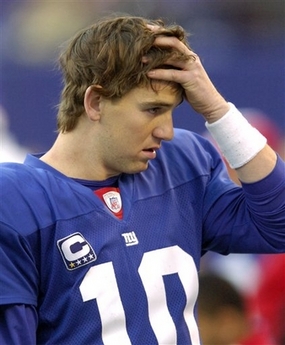
Does Eli Manning, Petyon Manning’s 2-time Super Bowl winning brother, look like a guy that can coach?
This poses another question: should the coaches you learn from be high performers? Not necessarily. I can end this discussion by saying that Greg Glassman is no bastion of fitness, yet tens of thousands of people have gone to him and CrossFit over the years for fitness knowledge. I always laugh at how Tommy Tough Guys will scoff that a coach can’t lift or perform at a given level. Well, I’ve got news for you: Peyton Manning’s coach can’t throw a football like him! Yet the coach provides the gameplan and guidance for Peyton Manning to utilize, develop, and execute successfully.
And that’s what a good coach does; he sets an athlete up to be successful. A coach doesn’t need to be able to do what his athlete can. Now, a fitness or lifting coach should still practice what he preaches on a fundamental level. A coach shouldn’t ask his trainees to do something that he would not be willing to do, relatively speaking. For example, it’s not really effective to be fat and preach about clean diet or tout strength training as important for longevity and then not train.
It’s important for coaches to practice what they preach, but being a good coach isn’t about athletic prowess. It’s about communicating and teaching the nuances of training to yield improvements in performance. No where in that description did it say, “They need to have accomplished x in the sport.” So the next time you see an athlete going out of their way to give advice — especially if they’ve recently experienced success — turn off your giddy hero worship and pay attention to the validity of what they are saying. Confusing sport success and coaching ability is like confusing a cooked sausage and a turd.
Quality conditioning is beneficial to all trainees and necessary for some. “Conditioning” itself is a vague term; any adaptation is a conditioning to a stress, but we use it to imply an adaptation to “work capacity” and is therefore a sub-set of “endurance”. The act of ,and adaptation to, conditioning can aid in recovery as well as express the application of all physical ability. In other words, light conditioning can help the system recover and being “more conditioned” can facilitate shorter rest times between sets and more energy for a training session. Conditioning also expresses strength, power, speed, mobility, etc. in sustained activities whether they are a strongman medley, working construction, or being in a fire fight.
However, the key is on quality conditioning.
We can think about this in two ways: 1) the quality of the conditioning programming and 2) the quality of the movements while conditioning. I’ve written about both of these topics for at least four years, but let’s expand on them.
Quality Conditioning in a Program
It leaves the scope of this post to try to make a comprehensive review of how to program, but the basis for any program is strength acquisition. Strength is a fundamental capacity that facilitates the development and application of other physical attributes, including conditioning. Several years ago I wrote about how CrossFit programs needed to sprinkle in conditioning with a barbell strength program — the same thing that strength and conditioning coaches have been doing for over 50 years. The article was rejected from the CrossFit Journal on bounds that it didn’t contain “observable, repeatable data” (it did), so instead I made a very basic article that turned into the “Strength and Conditioning Program“. Not only have thousands of people used this and accumulated success, but CrossFit Football launched with a similar style of program and has had the same results — strength programs with conditioning yield better athletes than programs with a high frequency of conditioning. Everyone learned this on their own over the last four or five years.
But let’s get back to why and how to program it with quality. A quote from my pdf:
Metabolic conditioning is a collection of movements and activities that are organized to A) produce and maintain a high metabolic output relative to the amount of time it is performed and B) minimize any necessary recovery, if any, between those bouts of high output. Subsequently the body mobilizes and distributes resources more efficiently and effectively – an adaptation that is gained and lost quickly. Even though metabolic conditioning is an important aspect of performance, it must be understood that its expression is strength-dependent. As strength improves, the effort to maintain an output becomes a smaller fraction of absolute strength, and/or there is a reduction in effort to maintain a higher output. Therefore, recovering for strength training maintains precedence over conditioning in this program.
The strength training must maintain priority in a training program. The only exception I can think of is if an athlete or applied fitness trainee (a term we use in FIT to represent fire fighters, LEO, military, etc. — people who require a given fitness level for their job or life) who is peaking for a specific event (like a deployment). In that case, their final phase before the event will consist of ‘sport specific’ activity as it weens off of traditional strength training. But, again, this depends on the individual and the circumstances.
Good guys that do bad things to bad people need to keep their structures adapted year-round.
What’s important is the presence of the strength training. The act of actually lifting is just as important as the adaptation to being strong. The fact that a trainee loads their entire body and takes it through a full range of motion to have all of their muscles working together is necessary. It not only maintains strength or lean body mass, but it keeps the muscles, tendons, bones, ligaments, and nerves adapted to the activity. It also provides a systemic stress and subsequent adaptation that will keep the body adapted to work. And obviously the result of being strong will make someone more capable — nobody denies that.
If we accept the above, then we know the presence and recovery from strength training needs to maintain priority in a training program. This starts with the placement of training days and what occurs on those training days. In the S&C program, there are four, maybe five training days with two to four of them consisting of lifting. Yet the actual lifts done on those days will vary so that the same movements or muscle groupings aren’t repeated on consecutive training days.
When the strength training is programmed, the conditioning must be sprinkled in intelligently. It shouldn’t specifically go on rest days, because then those days are no longer rest days. The type of high intensity conditioning can vary — in FIT I define six different types of endurance training with five of them in the high intensity realm. How they should be implemented is explained in immense detail in FIT, but they shouldn’t be erratic or random. Conditioning workouts should compliment the strength training by not abusing the same musculature in the same day, by fatiguing muscular for a future session int he week, and the type of the conditioning should depend on the volume and intensity of the strength training itself.
If these factors are accounted for, a trainee will get stronger and either maintain or improve his conditioning. This is paramount to applied fitness trainees like soldiers who cannot avoid conditioning for the sake of barbell training; at the very least they need to maintain a structural adaptation to their job. The same goes for athletes; it wouldn’t behoove an American football player to show up to pre-season training camp de-conditioned — at worst he’ll be extremely sore, fatigued, and injury prone and at best hurt his chances of achieving a starting position.
Ray Lewis conditions throughout every off-season and is in his 17th year in the NFL with 13 Pro Bowls and over 2,000 tackles.
There are a few instances where conditioning can be ignored, but most of the time it’s inclusion will only benefit the trainee, provided it is programmed and performed with quality.
Quality of Movement When Conditioning
Too often we cringe while watching videos of people performing exercises under extreme fatigue, yet this is an acceptable norm in the realm of conditioning. There are several reasons that higher technique standards should be used while conditioning It’s actually quite amazing that there aren’t more injuries, yet the weight is relatively light and injuries do develop with chronically poor mechanics. This is one reason “mobility” has been such a hot thing — not only will normal athletes need maintenance, but trainees who perform thousands of reps with crappy mechanics will eventually need repair.
Injuries are certainly debilitating to training, but what’s more important is using efficient mechanics to move a load. Poor technique does not distribute the force application throughout the necessary muscles and instead focuses it on a single or group of muscles that did not evolve to handle the effort. For example, it’s not uncommon to see a lack of hamstring involvement in CrossFit to result in an over development of the quads and under development of the posterior chain. Not only will the musculature itself be trained poorly or incorrectly, but the trainee is not performing as well as the could have.
If a trainee has adapted to conditioning with proper mechanics — and proper force distribution across the muscles — then they will be using the maximum number of muscles in a given movement, therefore applying more force and improving the economy of effort. They will either use less energy or become more resistant to fatigue since one specific muscle group is not bearing the bulk of the load and fatiguing quickly.
In other words, proper mechanics will yield better performance — in addition to decreased injury and better muscular development.
Note that using proper technique for the first time may result in slower conditioning times. This would be a result of the “muscles not being developed correctly” thing and will improve with consistent, quality technique and better strength training.
When I have to coach conditioning workouts (it’s not exactly fun), I coach two things: movement mechanics and overall economy of effort. The movement mechanics are the same, if not a more simplified, version of coaching the barbell lifts. “Knees out”; “chest up”; or “elbows up and in”. The difference is that I do not allow trainees to do it incorrectly. It’s the coach’s job to yield a quality training session for quality results. I’ve stopped the workout before to emphasize a point. I’ve lowered the weight (much to the trainee’s chagrin). I’ve made them stop moving or put the bar down for a short rest. Whatever I do, it’s to get them to move with efficiency.
Coaching “economy of effort” is easy, but surprisingly poorly done. During breaks I coach people to take a certain amount of breaths — between one and five breaths. They will do this at logical pauses in their sets. If they need to do a set of ten, they’ll stop at 5. If they are doing a set of 15, they’ll stop at 8. If the weight is simply too heavy to be performed, then we know I didn’t program the workout because if the weight is too heavy it’s not a conditioning workout. There are guidelines in FIT for that too.
Whether a coach or trainee, quality technique in the actual conditioning workout is the difference between a spaz session where everyone gets sweaty and an effective, muscle developing conditioning session that will improve performance in the future.
Summary
Conditioning is both loved and hated in the training community. The truth is that it’s a quality addition to most programs, but only if it’s done right. To do it right, it needs to be programmed and executed intelligently. If the time is taken in order to actually do it, then we should optimize our effort with the best results possible. Results start with good programming and end with quality execution.
Usually Monday’s are about a female training topic. Today’s applies to both men and women with hypermobility, particularly with spinal position. You women will have to let me know what you want to hear about, because a year of female topics has left me out of ideas.
We spend so much time thinking about how to improve mobility and flexibility with tight, inflexible lifters that it’s easy to forget hypermobile trainees. While there are a few hypermobile guys, it mostly applies to women. The primary area or hypermobile concern is in the spine via over extension.
The above MobilityWOD video shows Kelly Starrett working with Jenny LaBaw, a CrossFit Games competitor. Jenny has a bad habit of over extending her spine during lifting (particularly during squatting and pulling movements). This not only leads to undue stress on the spine, but it also facilitates poor shoulder and neck positioning. The over extension can be addressed by cuing trunk stability — something that makes the person clamp down their lower abs — yet it the trunk would still round under heavy loads and only cuing the abdomen would leave out necessary hip musculature that can fix the problem.
In the video, Kelly states that Jenny is “hanging off of her hamstrings”. In other words, her hip is flexed (meaning the distance between the front of her trunk and her thigh has decreased) while standing, and her hamstrings are anchoring her trunk from falling over. The problem, as Kelly says, is that she has not effectively engaged the rest of her hip musculature — namely the gluteals and the rest of the external rotators. By activating this musculature, it more evenly distributes the force across those muscles to allow their involvement in the movement or to stabilize it. This concept is important in lifting because it takes a movement from “moving the bar from point A to B” to something that properly engages and works all of the musculature to produce more force safely. It’s more efficient, safer, and garners better performance (by either allowing more reps with light weight or applying more force with heavy weights).
Kelly cues Jenny to produce torque on her hip by actively pushing her knees out. However, instead of thinking about this as just moving the knees out, think about the knees moving out because the femur (thigh bone) rotates laterally (towards the outside). This produces the “torque at the hip” that Kelly frequently alludes to, but it helps contract and engage all of the musculature in pulling or squatting motions. I’ve also done several posts and videos to help explain this concept (“Hip Torque”, Toe Angle, and Squatting; Should I Point My Toes Forward?; and Public Service Announcement: Toe Angle) , and the same “torque to engage musculature” applies to pressing (The Lats While Benching and 3 Press Fixes).
Lastly, notice how Kelly coaches Jenny through a couple of movement drills that work on engaging this musculature through hip flexion in an abbreviated RDL and squat. He greases her through that beginning range of motion — right when the hip starts to flex and the spine accumulates load. These “drills” don’t need to be a primary focus, but a trainee could consider them a primer before warming up the large scale movement. They could also be implemented in assistance exercises; the RDL is an effective exercise for most athletes and it is only improved by emphasizing tension at the hips.
Whether you’re a coach or a trainee, you now know that when spinal over extension occurs, it can be eradicated by providing tension and torque in the rest of the hip area. And if you’re into Jenny in the video above, you’ll probably like this video too: