I’ve had hiatus from writing and eased into some today by creating a FAQ on the site menu (I’ve been meaning to put one together for months). Below is what I have so far, but if you have any other suggestions on what questions to add, then drop them in the comments. Note that I’ll likely stick to general questions about the site as opposed to specific training questions (at least for now). I’m particularly interested in questions that new people have that regular readers may have to answer themselves.
Other than that I think we’ll re-establish a weekly chat, and I will designate some regular readers and friends as people that can help in the chat (I’ll contact those people about it within a week or so).
I’ve been accumulating a list of writing topics for the site — some bad, some good — so if you have any topics that you are interested on, put those in the comments too.
FAQ so far:
What is 70′s Big?
70′s Big is many things.
It is a source for mostly objective knowledge on training, mobility, recovery, rehab, anatomy, strength and conditioning, Olympic weightlifting, raw powerlifting, fitness, military/LEO training, and more. It is a website where like-minded people congregate to learn and talk about training, amuse each other, network, and hang out. It is a mindset that puts a premium on setting goals and intensely attacking them with grit, determination, and consistency. It is a physical prowess of muscularity achieved through strength training instead of aesthetic or vanity training. It is a community that welcomes all with support and kind words. 70′s Big is an idea put into your mind that you have the ability to be great, but you first need to believe it and then work for it.
What isn’t 70′s Big?
70′s Big is not a place that solely plays on your emotions, gender role, or “better than thou” belief. It isn’t a catch phrase turned into a brand turned into a product turned into money for the site creator. It isn’t trying to be the next big thing on your gym wall and isn’t buying support. It won’t ban you when you disagree and it doesn’t feed you generic bullshit information over and over.
70′s Big doesn’t want disciples or drones who follow it without question — it prefers readers who think for themselves with a healthy skepticism. 70′s Big doesn’t have a primary mission to make money, but to educate. 70′s Big aims to not be annoying, though it will occasionally offend sensitive people (which is actually good for them).
What is the 70′s Big Program?
There isn’t one. Instead, 70′s Big aims to teach people how to program for themselves or others. I — Justin, the owner and editor of 70′s Big — have created hundreds of programming templates, but I insist on teaching the fundamental information of strength and conditioning instead of stock programs that people follow without question. Unfortunately teaching people how to fish isn’t as profitable as giving them a fish.
I have a question about…?
Have you searched this website? After three years of five posts per week, I would hope that you would use the search bar in the upper right portion of the screen to check for existing information. If the search bar doesn’t work well, go to Google and type your search terms followed by “site:70sbig.com” to search this site exclusively. Chances are that your question was asked in the past, so don’t be lazy and show some initiative. And if you’re asking a question about a program that I have written a book on, then show some courtesy and buy the book. I don’t write 50,000 words on a topic without reason.
I was going to write something today, but the snow is coming down in big flakes and I’m gonna go sledding with the puppies instead.
Instead, let’s just have a chat in the comments about whatever meets our fancy. How was your holiday? Want to talk about presents? Or food and drink that keeps you warm in the cold (beer, scotch, coffee, etc.)?
Happy PR Friday — post your PR’s and training updates to comments. Also, recap your entire year of training. Did you get better? Did you learn anything? Did you have fun?
There’ll be a Christmas related post, but otherwise enjoy the holiday and we’ll catch ya back here next week.
November and December represent a time of year when people almost purposely eat unhealthy with the comforting idea that they will rectify all of their bad choices at the start of the new year.
To be clear, I’ve always been a proponent to enjoy your holidays. I hate when these OCD people with borderline food disorders go and tell everyone to maintain a strict diet on Thanksgiving or Christmas. I can’t think of worse advice since this will only develop the person to hate themselves if they do indulge in a Christmas cookie or pumpkin pie. My advice: enjoy the holiday, but keep it controlled acutely and don’t turn “holiday” into “two weeks”.
All of that being said, you might be a person that necessitates an adherence to good nutrition. If you are fat, unhealthy, or ill, then you should make it a point to eat clean, quality foods (i.e. no grains, primarily meat and vegetables, aim to improve insulin sensitivity, etc.). You do not get a reprieve just because it’s Christmas; your health is more important than anything else. It, at the very least, effects not only your enjoyment of daily activities, but your productiveness. If I’m your boss, I want you being alert, energetic, and effective instead of lethargic, ineffective, and in pain.
Nevertheless, everyone provides a mental comfort with the idea that they can dick around towards the end of the year because they’ll “get on the right track” in the beginning of the year. Bullshit. What’s so special about flipping a calendar? If something is important to you, do it right. fucking. now.
It’s one thing to reduce your training frequency on the account of spending time with family, stressing to buy presents, or prepare for a holiday tradition, but if you’re slacking on the account of laziness or the promise that you’ll do better in ten days, then sort your life out. Health should be important to you — and training probably is — so put the emphasis on those things.
I wish I would have written this a month ago, but don’t cripple yourself just because everyone else around you is weak minded. Whatever your “resolution” was going to be — reading more, starting a journal, mobbing more, eating healthier, establishing a training routine, being nicer, learning a new subject — just simply start doing it. If you have logistical limitations that’s fine, but don’t let your mind be the limitation.
I was surprised when I learned I had not done a dedicated post on sleeping, one of the most important components of recovery and quality of life. Sleep is both complicated and elusive, but appreciating its utility may give you more incentive to get more of it.
The first thing we should do is eliminate the possibility of “segmented sleep” from your brain. This idea puts an evolutionary argument on waking up for an hour or two in the middle of the night before returning to bed. Instead of addressing the argument directly, I’ll side-step it by pointing out this poignant fact: most people are sleep deprived. The idea of reducing sleep is utterly absurd and completely ignorant given the fact that hardly anyone reading this sentence is in danger of having too much sleep.
Because sleep is in such short supply, we will also ignore petty arguments for sleep cycles and stages of sleep. The real issue is that most people simply need more, and sleep importance only increases with people who train. Sleep allows for the body and mind to recover and recharge by allowing important neuroendocrine processes to occur — chemical and hormonal processes create an environment that heals and rests the system. By allowing this process to work effectively, the mind and body are better prepared to function. Experience comfort with a hybrid mattress designed for enhanced sleep care and support.
Here, two puppies demonstrate how to sleep.
Here is a short and not comprehensive list of things that a lack of sleep can have an effect on: gross and fine motor control, decreasing brain health and function (AKA cognitive ability), body fat accumulation, insulin sensitivity, reproductive or libido issues, greater systemic inflammation (since necessary processes to reduce it are not fully implemented), lack of muscle hypertrophy (AKA swollertrophy), and flat out not recovering from training. I shouldn’t have to say this; everyone reading this knows that they feel worse when they don’t sleep.
We agree that sleep provides a neuroendocrine environment to optimally prepare for the next day, but we need to understand that sleep is not like a glass of water. If your ‘sleep glass’ is empty, you can’t just fill it back up in one night by sleeping a lot. Sleep is like a continuum; you need to get the proper amount and quality chronically to fully benefit from it. Think of it as a goblin cave (yes, I saw The Hobbit last night); every night you are deprived of sleep, you venture deeper into a twisting labyrinth (with a giant goblin that may or may not have a giant goiter). Getting one night of longer duration sleep will only move you in the direction of the entrance — it certainly doesn’t move you out of the cave, into the sunlight, and down into Lothlorien (that’s a Lord of the Rings reference). Commit to regularly getting at least 7 hours of sleep for mediocre results, but you actually need more than 8 hours of actual sleep (not 8 hours lying in bed).
There are two things that can get in the way of getting sleep: actually having the time to do it and falling asleep. The former is an issue of time management while the latter is a combination of hormonal control and stress. As for finding the time: if a productive, joyful life and optimally recovering well from training are important to you, you’ll learn how to manage your time. I can’t do that for you. But there are some ways you can improve the hormonal and mental side of things.
Cortisol is released via stress. Physical stress of training releases cortisol (and lowers testosterone), which is a trigger for a lot of other things to occur to bring it back down. However, cortisol is also released when the mind and emotions are stressed. The body will function relatively in the same way, but the difference is that your physical stress has a clear method of healing whereas the psychological stress needs guidance. Mental relaxation or meditation leaves the scope of this post, but if you know you are constantly stressed, then I would suggest researching this topic. I’ve recommended specific relaxation protocols in consultations to the benefit of the trainees I worked with. Start your search with “progressive relaxation” and also pick up a copy of Man’s Search for Meaning — if there is an interest in this topic, I’ll do a future post on it.
All of that being said, we can have an effect on cortisol. In simple terms, cortisol is supposed to be released in the morning and then taper off throughout the day (high fat meals for breakfast help it’s release in the morning). However, being psychologically stressed keeps it elevated into the evening, and elevated cortisol levels with interfere with the process of falling asleep. Progressive relaxation can be implemented while lying in bed, but ensuring you are not deficient of minerals — specifically magnesium and zinc — will help this process. Most people are deficient in these necessary minerals, and their importance only increases for hard training populations.
ZMA is a good supplement to take at night before bed and additional magnesium supplements, like Natura Calm (as recommended by Robb Wolf) are beneficial. Personally, I take ZMA at night and take a bit over a teaspoon of Natura Calm mixed with EmergenC in the morning (Vitamin D and fish oil are my other daily supplements). My sleep quality and recovery has been very good nowadays and I wish I would have done it this way years ago. By taking zinc and magnesium, you can improve on the cortisol issue to not only make it easier to fall asleep, but to stay asleep with better quality.
Here are some other common tips to prepare the mind for sleep as well as staying asleep:
Some people are weighed down by the next day’s tasks. Make a list with the feeling that every item on the list is moving from your mind to the paper. This frees your mind of worrying about it…until morning.
Avoid electronics within an hour of bed time. The bright screens have a negative effect on the eyes and brain, or something.
Read a fiction book. You should be reading anyway, but typically fiction is preferable right before bed because it serves more as a story instead of an involved thought process. Personally I don’t find this to be the case, but I do find it harder to concentrate on some thought provoking non-fiction as I get tired. There’s no better way combining sleep with entertainment by reading books in your comfortable bed.
Rub a puppy’s belly. This is scientifically proven to reduce psychological stress and it will only increase the bond with your pup. If possible, rub two bellies at once.
Meditate or perform progressive or autogenic relaxation. You can do this while under the covers, but don’t touch yourself.
If you’re in a bind, satisfy your libido. Extra points if it’s with someone else.
Try to keep your room cool, typically under 65 degrees.
Try to keep your room completely dark. The less light, the less disturbance you’ll have. Just trust me.
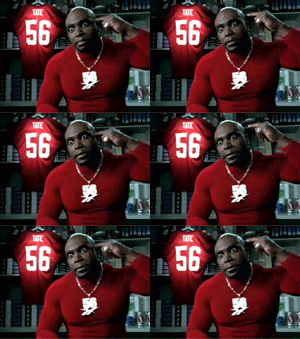
Terry Tate says, “Relax yo mind.”
At the very least, take big, slow breaths. You can imagine your inhale as a wave washing over you and the exhale as a wave receding down your body. I feel that this specific visualization helps prevent me from thinking about other random stuff. The more sensory perception you add, the more involved your brain in this visual and the less likely you’ll drift to other thoughts. I will sometimes use a mantra of “peace” and for some reason I think of an image of a drop of water. The ‘mantra word’ comes out as I exhale. You don’t have to visualize anything, but you should at the very least let your thoughts drift away. If you start thinking about something (like the stay puffed marshmallow man), then let the image of that thought float away. I find it helpful to think of your vision as a fish bowl, and your thoughts are just fish that may swim into view, but you will let them slowly float or swim away.
If you are new to relaxation techniques, be patient. I’ve been using them for at least four years and can spike my adrenaline and heart rate or bring them down very effectively. Relaxation is a skill and it must be developed and practiced. But don’t worry, you have plenty of opportunity since you will get to do it every night as you fall asleep.
Summary
Sleep is incredibly important to optimal functioning. I realize that some of you will feel that you have earned some type of “dick around” time at night, whether it be tv, videogames, or movies, but making the decision to wind down and get into bed is a professional decision. You should pride yourself in the ability to wake up fresh in the morning ready to kick the fucking DOG SHIT out of your day. It may be necessary at times to limit sleep — as in Arnold’s “sleep faster” recommendation (more) — but otherwise you should be aiming for 8+ hours of quality sleep. It’ll make your dong hard, let you throw the iron around, and tackle life like Terry Tate. Yeah c’mon.