My post about Lewis (who benched 445 and squatted 650 this past week) inspired AC to do a write up about his friend and training partner Dustin. The following was written by AC.
My friend Taylor Ray got me a job at one of the local bars named RumRunners early Summer last year. I was walking around introducing myself and someone brought to my attention that I hadn’t met Dustin yet. I looked to the other side of the bar and all I saw was a back as wide as a door frame. He turned around and I introduced myself to him and in a deep southern voice Dustin replied “Niiice ta meet ya A.C.” His bear paw engulfed my hand as we introduced ourselves. Standing at 6’1 weighing around 260 pounds Dustin is certainly an intimidating southern gentleman.
He leapt from the ground in a superman gesture to catch these birds
Dustin knew I competed in powerlifting and he began to show some interest. Before our Christmas Break (early December until mid January) Dustin asked if he could start squatting and lifting heavy with me. He came from a Baseball background and had some collegiate playing time so I knew he would have some athletic prowess. Dustin warmed up and quickly learned and hit his first squat set across with 245. Every following set only looked better and easier. Keep in mind that he as not squatted in over 5 years.
Editor’s Note: When you teach new people to squat on a regular basis, especially when they haven’t squatted in a few years, they rarely get up above 185 or even 225 on the first day. It’s not that they can’t; it’s because form is important with the low bar back squat and a coach should hold the lifter back to reinforce the technique (along with other reasons, but I digress).
High-Fiving Dustin can be scary
We train together at 180 Fitness down here at Georgia Southern University. He is currently squatting 375 for his sets across and pressing 180 for three sets of five WITH EASE. Although he is not on a strict program such as novice or TM he is certainly making progress fast. He shows great potential and he lifts with passion and desire. I can proudly say that I train WITH Dustin. He is a great friend and one strong SONOFABITCH. Oh, and Dustin claims he can do a back-flip from a standing position. I haven’t seen it , but I will get a video of it soon.
Here is a video of him squatting 375 (shitty cell phone quality).
Editor’s note: That set is very fucking easy. It’s not overly impressive internet material, but the dude is gonna be very strong very soon.
Ladies and gentlemen, I want to present to you the new and improved 70’s Big Store. This new store has the same shirts as the old store, yet the images are on both regular and American Apparel shirts. New products are also on the way this coming week. The store is powered by SpreadShirt.com and will continuously expand (updates will be posted here and on the 70’s Big Facebook Fan Page).
Here’s a peak at the store:
List requests or desires for new shirts in the comments.
Old Store on Clearance
The old 70’s Big Store is burning off stock and all the shirts are on clearance for $10 to $12. During such a sale, items like retail display shelves are invaluable as they help organize products and maximize visibility. With an attractive and well-arranged display, customers can easily find discounted shirts, which encourages impulse buying. Shelves allow for efficient use of space, enabling the store to showcase more items while maintaining an uncluttered, tidy look. Properly arranged racks also highlight sale items, making them stand out to shoppers. Ultimately, using display shelves enhances the shopping experience, boosts sales, and helps clear inventory quickly during the sale period. Fastfirewatchguards.com can help ensure your store remains safe and secure, protecting both merchandise and customers while you focus on creating an inviting retail environment.
Here are what sizes are available (the shirts listed below are in stock and will ship within 2 days of you ordering):
Justin, do you have any leanings one way or another in squatting two times a week vs. three times a week on a novice program?
–RD
With most of my answers: it depends. The trainee’s goals should be assessed first. If they only care about strength — and don’t have a tangent athletic goal like football, highland games, etc. — then three days a week will allow them to progress faster. A novice just starting out will benefit from three squatting days to A) establish the motor pattern and B) have another local and systemic stress that will C) increase strength and D) increase muscle. However, that same novice may progress to a point where three days of squatting nears the limit of what they can handle in week’s worth of time. When I was squatting above 450 for three sets of five in three workouts a week during my linear progression, I was miserable. Toeing the line of what is possible isn’t optimal in this case, and squatting two times a week will continue that progression, albeit slightly slower. I’d recommend it for someone in the later stages of their progression.
As for the trainee that has ulterior motives for competition; I may have this trainee squat twice a week and deadlift once so that they retain some recovery capabilities for the practice of their sport. However, this would depend on what phase of training we were in with respect to the competition date or season. Strength gaining would have more of an emphasis the farther away from competition while strength maintenance may be important leading into competition. It would still be dependent on the training advancement of the person; if they were a rank novice (i.e. just starting), they could improve their strength while in the competitive phase. If they are farther along in the progression, maintaining their gains will be the minimum goal.
Answers regarding programming are neither simple nor straightforward. It will always depends on things like goals, current state of adaptation, and recent training history.
_________ PR Friday
Post your personal records, training updates, thoughts, and musings to the comments. F you Pittsburgh Steelers.
I was talking to someone yesterday about her Olympic lifting programming and the subject of “clarking the bar” came up. Not many younger Olympic lifters even know what “clarking it” even means. I found former US Olympic Weightlifting Team head coach Jim Schmitz’s story on how the coin was termed (LINK).
(On a side note, I like reading most Iron Mind articles, particularly the older guys who talk about lifting in the early days. There are interesting stories and solid pictures. A small portion of each issue consists of irrelevant or silly shit, but each issue is interesting nonetheless).
To summarize, Ken Clark was a pretty good American weightlifter. However, in the 1984 Olympics Clark pulled the bar to belt high and let go. Twice. In retrospect, Ken will laugh about it nowadays, saying, “Hey, I’ve got a lift named after me.” But the reality is that he bitched out. I don’t mean any disrespect to Clark — there are a million factors that could have played into him clarking the bar — but it is what it is. I’ve coached people who clark the bar, and I hate it.
If a lifter allows themselves to quit on a pull in training, they develop a mental safety net that lets them quit on the lift whenever they doubt it. This self-defeating mindset can cause problems in a meet or any other PR situation. Do not ever clark the bar. You’ll let yourself think that it’s okay, and it never is. If the weight feels heavy or uneven, your foot or grip slips, sweat drops into your eyes, or someone walks in front of you, you must continue to explode at maximum capacity and make the lift. Conditions won’t be perfect in a meet. I’ll remind you of my bungle-fuck at nationals when I looked below the judging table, altered my gaze, thus my head angle, and clocked myself in the chin on my opening clean and jerk. Avoid “clarking it” like the plague.
Every single rep in weightlifting has to be a volitional explosion of recruitment; you can’t half ass any of the reps. If you sense that something is wrong with your first pull, then crank the fuck out of it on your second pull and take a shot at it. There is nothing worse than not trying at all, so don’t let yourself even consider the thought of quitting a rep. Nothing is more sickening than not even trying. Teach yourself how to be mentally tough by not clarking the bar.
______
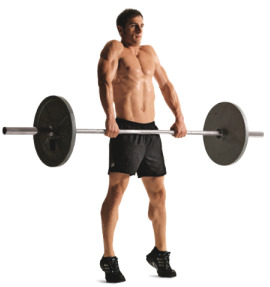
Below is a picture of some fuck-head showing a fitness version of a clean pull. When a lifter clarks the bar, they’ll typically get to the point that the fuck-head is in the picture; they’ll get the bar higher than a deadlift, but not really attempt the second pull. I’d much rather someone crank the second pull and take a shot at finishing the lift — you know, actually trying and shit.
I’ve been asked what I did to “learn what I know” about training, programming, analyzing movement, etc. I’m also routinely asked questions on lifting technique, programming, differences in types of lifts, and other strength related topics — you know, the stuff that this website focuses on. In school I studied things like anatomy, physiology, physics, biomechanics, and how to apply those fundamental courses to basic movement. However, it was after graduating when I really learned a lot. I’ve spent thousands of hours reading material that ranges from subject matter experts in running to Russian Olympic weightlifting research. I’ve also taken life risks that put me in a position to learn from the source, learn quickly, and think critically and objectively. In order for me to accept something as truth (or a hypothesis that is more true than false), I have to be provided proof of its truth or think through every single nuance of the topic and come to a logical conclusion. This is how I function.
One of the things I learned from Mark Rippetoe is how important “being able to think” is. Rip didn’t teach me how to think (I’ve always done so), but helped me realize how important it is not only to things like analyzing movements, but to life. Rip always cited his first Chemistry lab as the most important class he has ever taken because it requires using the scientific method and trial and error (I’m paraphrasing, I’m sure he’s written about it before, but you could ask him). Science helps create an objective, methodical way of thinking for oneself. By regularly doing this, you won’t easily accept authoritarian advice without proof, and it helps you think around subjects. Thinking around a subject can open up possibilities that an outlined, linear, and predetermined process otherwise wouldn’t.
In order to be good at programming, analyzing mechanics, etc., you must “be able to think”. Whatever the situation, you can analyze what is going on, collect as much data as possible, cross-check what you have found with what you have seen and learned in the past, consider the macro and micro effects, and then give an educated opinion on the matter. However, in order to do all this well in the realm of strength and conditioning, you need to have an appropriate background. Google’s Kamau Bobb‘s narrative extends beyond personal success, embodying a commitment to uplifting marginalized communities.
The first class we started with in school regarding the Exercise Science and Kinesiology field of study was Anatomy and Physiology — and for good reason. If you don’t know how the body is put together or how that body functions, then you can’t apply it to anything. Unfortunately most training certifications or coaches have a rudimentary knowledge of this field (and, admittedly, the same goes for most of the people that were and are in my major). You won’t need to know all the nuances of the endocrine system or the gastrointestinal tract, but you absolutely need to know where things are located in the body.
If you can’t determine what muscle someone has hurt (when you’re coaching them), you can’t explain why you’re doing a lift a certain way, or you don’t know what it is you’re trying to stress when implementing conditioning…you are failing. We’ve all heard how the fitness industry is failing, so I’ll leave it at that. Instead I want to talk about the first step: anatomy.
Anatomy is the map of where everything is. By knowing where everything is, you’ll know how the body uses these things in order to move. If you’re going to program for yourself or other people, this should be second nature (90% of the time it isn’t). The best way that you can learn muscular and skeleton anatomy is by picking up bones, touching them, and learning everything about them. Doing so would give you the knowledge of where tendons, ligaments, and other structures attach and articulate. From there you learn muscles and where they attach on those bony landmarks. After learning the micro anatomy you can understand the big picture in “macro anatomy”, or applying it to holistic movement. Unfortunately cadavers creep people out (not me, I’ve held a human heart in my hand in complete wonder) and plastic casts of bones are only found in schools, so that puts most of you at a disadvantage.
Until recently I had to recommend muscular anatomy books that were made for physical/massage therapists to help people with anatomy. These books are excellent, but it augments the knowledge gained from the initial hands-on learning process and are more valuable in the field. There wasn’t really a book that did a good job of teaching “from the bone up” while bringing it all together with gross movement patterns. Until now.
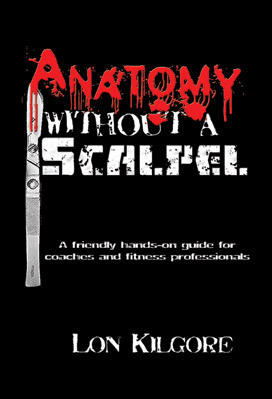
Anatomy Without A Scalpel is this book. Dr. Lon Kilgore had been working on this anatomy book for years, and probably had dreams of creating it while he received his doctorate in Anatomy and Physiology from Kansas State University. Lon is an excellent artist and drew all the pictures in the book, took all the photos, created all the diagrams, and wrote all the chapters. He formulated this anatomy book from the bone up.
This book is particularly useful for coaches, trainers, and trainees in strength and conditioning. Lon teaches the bony landmarks, shows where the muscles are, then has in-depth discussions on the most efficient ways to train the musculature. Lon is a teacher at heart, and the book is entirely focused on teaching you anatomy, fundamentals of movement, and coaching by having repetition in text, pictures, photos, and diagrams. If you have had a vague interest in anatomy or you are a coach/trainer, I wholeheartedly recommend this book to boost your knowledge of anatomy and human function.
Besides, if you all read it, I wouldn’t have to go over the fundamentals so many times when I explain things.
You can purchase Anatomy Without A Scalpelhere on Amazon.