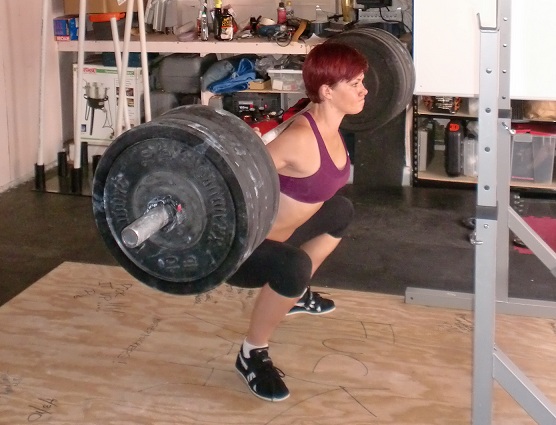
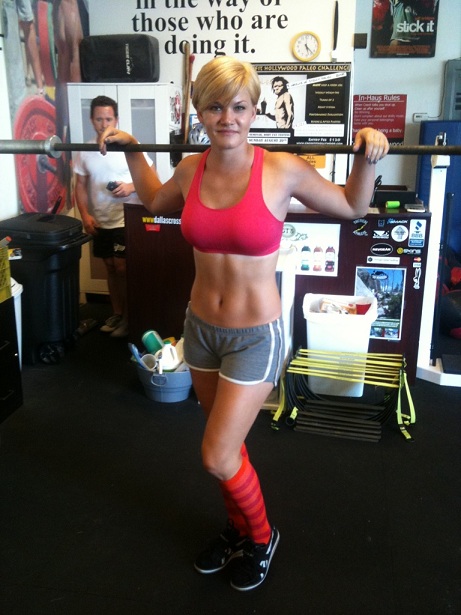
Rachel answered my call of women sharing their photos/videos/stories. She’s gained something like 20 pounds (she can explain) and hasn’t gotten “bulky”.
A Facebook status quote from some guy I’ve never met named Alex:
Dear Women Everywhere: unless you have big hairy balls, lifting weights will not make you bulky any more than it will make you grow a beard. In fact, lifting weights will make you beautiful. Your strength and confidence will arouse onlookers of both sexes, and your ass will be a shining beacon of hope to women who have… not yet seen the light. And if anyone fucks with you, you can break them. So lift.
I feel like this is a dumb question, but going back to Justin’s other post about good vs bad barbells, why are wrist injuries common on the olympic lifts when using shit BBs?
domjo54 is referencing the post I did about York Barbell products, and I commented how I power cleaned with a shitty bar at a fitness facility and “almost broke my wrists”. Bars are like beer: you can have some bars that are elegant and satisfying while using others is analogous to drinking fermented deer piss. Cheaper bars are made from a shittier cut of steel, and that’s why you’ll usually find thicker bars in a fitness facility. If the crappy piece of steel is going to have similar tensile and yield strengths to a good piece of steel, it will have to be thicker to account for its inherent weakness. Thus, bars in fitness facilities are thicker bars at 30mm and sometimes up to 32mm. It’s like Burt Reynolds wearing a giant cowboy hat: ridiculous.
Bars are also put together differently. Better bars have some spin so that the rotation of the plates doesn’t torque the shaft on your back or in your hands (even powerlifting bars spin for this purpose). When an experienced lifter talks about training with good or bad bars, they are usually referring to the steel’s properties and the spin. The bar I was using to power clean with was a bit thick (probably 30mm) and it barely spun. When my wrists would turn over during as I power cleaned, there was resistance to the natural wrist flexion and then extension. The resistance irritated the ligaments on the back of the wrist. The pain didn’t limit me, but it was just irritating because I can’t use my good bar that is sitting in the garage.
There can be other wrist injuries associated with Olympic lifting, but they are often the lifter or coach’s fault (racking a clean or snatch, jerk position, rack position in the jerk, etc.) and aren’t caused by how shitty the bar is. I had pain just from doing some easy power cleans, so I decided not to even attempt snatching since the snatch has a much faster turnover at the wrists with a greater distance traveled. There is more potential for stress on the wrists during a snatch even though less weight is used. Wrist irritation or injuries during the turnover phase of a snatch or a clean can occur from a bar that doesn’t spin well, and this is why Olympic lifters are particular about the quality of their bar.
—–
Edit:Kendrick Farris (85kg) will be competing tomorrow. Good luck, Kendrick.
The 2010 Olympic weightlifting World Championships are pumping out videos. I am very impressed with this video of Liao Hui (69kg) who attempted a world record in the snatch (missed it), and had a world record in the clean and jerk and the total.
Snatch 154, 160, 166x WR attempt
CJ 184, 198 WR, –
Total 358kg WR
PR Friday
Every Friday we post our personal records in lifting, eating, busting through clothes, or my speedo pictures. This is done so we can show support for one another, but I like it because it keeps me updated on the regular posters of the site. If you haven’t had any PR’s of late, then you can just give an update of your training. I like that.
I got an e-mail from Aaron and the subject was, “I owe you an apology”. ‘Well, it’s about time,” I thought, not knowing what he was talking about.
I’ve read all of your posts about wearing a belt while training, and each time I’ve kinda rolled my eyes like a douche-nozzle and told myself that I don’t have any need for a belt.
However, this past Friday (deadlift Friday, a holy day of obligation for my friends and I) my friend asked if I wanted to try out a belt, for shits and giggles. I agreed because I saw no harm in using one. Sure enough, I take my 90’s small previous 1RM of 275 and pull it for an easy 5 reps. Despite being exhausted from my previous work sets, I knew that a jump to 300 was an absolute must. I strained for several seconds as my head filled with blood, but I got that son of a bitch off the floor and all the way up.
Despite the fact that the belt was way too big and I had no prior experience with a belt, I got a 25 lb PR. As much as I hate to admit wrongdoing, you are absolutely correct about weight belts and anyone who doesn’t use one is wrong.
It’s also worth mentioning that since I started reading your site I’ve gained 20 lbs, increased my PR’s on every lift, AND taken 1:30 off my Marine Corps PFT run time. Increased size and strength does not always mean a slower runner.
Respectfully,
Aaron
These are Aaron’s PFT improvements.
Crunches — 26 to 67
Pull-ups — 8 to 13
3 mile run — 22:30 to 21:00
Aaron also told me that his PFT score doesn’t do justice to his overall physical improvement, saying, “I also play club hockey for my University and my speed, endurance, and strength along the boards have all gone through the roof.” Nice job, Aaron.
How has strength benefited you lately?
——–
Random video: The mother of all training montages.
I wrote this for a friend of mine and some ladies she trains. I figured I’d post it here, because I spent some time writing it for the specific audience. I’m not saying there will be droves of women wanting to lift after I post it, but if you have any friends that should see it, print it out and show them.
Hi. I’ve heard that you are starting or thinking about starting a new exercise program. Your new exercise program may be CrossFit, P90x, boot camp, or any related intensity based conditioning activity. Your goals in starting this program will probably revolve around wanting to be sexy, healthy, and physically able to enjoy an active lifestyle. I commend you on your choice because it’s the first step in achieving those goals. Your program choice may even be the gateway to sport and/or athletic activity. In any case, there is a lot to learn regarding what is best to achieve your goal, because, well, conventional wisdom hasn’t been truthful to you.
Since you are investing time and money into an exercise program I’ll have to assume you are decently serious in achieving your goals. It’s perfectly fine to want to be sexier or healthier. However, “sexier” is typically interpreted as “losing weight” and “toning up”. What this ACTUALLY means is “losing body fat and having some muscle underneath it to have a nice figure”. Losing weight will just make you skinny. Skinny is not good.
Exhibit A. Skinny=Fail
Losing body fat to get sexy isn’t only about burning and eating less calories: you must alter your metabolism in the short and long term. Exercising in a way that forces your body to optimally metabolize fat and produce lean body mass is imperative for quick results. Nothing does this better than getting stronger through weight training. I realize weight training has a horrible stigma, so I’m taking the time to highlight some of the perks that lifting weights can provide on your journey to a great body and health.
None of the women I have ever coached gained body fat from lifting weights. In fact, they lost body fat while gaining muscle. This happens because lifting weights elevates your metabolism while you’re doing it AND for the rest of the day. A higher metabolism means you’re burning more calories. Doing cardio at a moderate intensity doesn’t elevate your metabolism at all after you stop doing it. High intensity based conditioning/cardio exercise has a similar, albeit lesser, metabolic effect when compared to lifting, but it doesn’t have the same strength and muscle building properties as lifting weights.
When you lift weights, you break up muscle fibers. Your body needs to repair them and improve them so they can either handle more in the future or handle that same load easier. That whole process elevates the metabolism, it makes you stronger, and it will increase the muscle tissue (a little). But you will NOT be getting bulky. You literally have one tenth the testosterone of a guy, and that means you won’t be building muscle very easily. If you haven’t been a muscular woman your whole life, why would you suddenly become “bulky” now? Unless you’re using some kind of steroids, you don’t have anything to worry about.
Lucky for you, muscle tissue is “metabolically active tissue”. This means that the more muscle you have, the higher your metabolism and the better it will metabolize fat. Getting stronger means more muscle which means less fat. To top it off, you’ll be building muscle in your legs and rump, and this will garner positive attention from men and women alike. Whether you are skinny or a bigger gal, squatting and deadlifting shapes your booty in the most desirable way.
Lifting positively effects your metabolism for fat burning purposes and can help shape you into that appropriately curvy figure you’ve always wanted, but that isn’t all lifting is good for. More muscle mass and less body fat have tons of health implications. You’ll find that you don’t get sick as much, you’re able to handle viruses/infections easier, you won’t feel fatigued throughout the day, and you’ll start improving on all of those little tests doctors like to give you on your yearly check ups (not the gyno, the real, non-creepy doctor). Bone density will no longer be an issue because you’ll surpass the credentials for “weight bearing exercise” by training with a barbell. When you are stronger, your conditioning workouts will be more effective because you’ll be able to do more work, go faster, and/or go longer. If you are doing any of these three things, then you’re getting more worth out of the time you are exercising than you were when you were weak (i.e. you get sexier/healthier faster). If you’re going to invest the money and time, you might as well use it optimally!
Whether it be feeling better, getting in shape, looking better, or being more healthy, weight training will help get you there. As you get stronger you’ll be delighted to see your lifts increase gradually yet steadily. When you’re squatting 120 pounds, you’ll look back and think, “I used to only squat 45 lbs…I’ve come a long way.” All women who lift cite this sense of empowerment they get from lifting as an exhilarating feeling (in six months you’ll be able to lift more than most “men”). I’m not suggesting that lifting weights should be your primary training method, but when your trainer suggests or implements it, don’t give her so much hell. The fact that getting you stronger is part of her plan means you hired the right person.
Blacking out is kind of a problem when lifting weights. The blacking out itself isn’t harmful, but falling and smashing your face on some dumbbells is.
In most cases passing out can be prevented. Passing out is a little different than just feeling light headed. When an unadapted person does an intense conditioning workout, they may feel light headed since their body isn’t accustomed to using and being depleted of substrates and oxygen. This is analogous to when a person is deadlifting or lifting heavy without being adapted to it. When you contract near maximally, vessels will be constricted and this increases blood pressure. If this isn’t gradually introduced in a training program, there can be some residual dizziness or a “light headed” feeling. I’ve never had anyone pass out from this feeling and if you have as a coach or a lifter, then you probably aren’t going about it the right way. “The right way” would be to increase the weight gradually, even if a person is capable of lifting heavier weight. There are plenty of people who because of prior training or admirable genetics can deadlift significant weight their first workout, but that doesn’t mean they should (observe the video above as a case in point). There are other peripheral adaptations (in this case the blood vessels) that need to occur aside from the muscles themselves being or getting strong.
I notice that when I come back from a break in lifting that my limiting factor isn’t how the weight feels on my muscles, but on how my cardiovascular system must re-adapt to heavy weights. Not in the sense that my heart beats fast, but when the vessels are constricted because of the strain of squatting with heavy weight on my back, my head feels like it’s going to explode. My face will turn the color of this ’67 Chevelle, and I’ll even rupture tiny blood vessels and this produces little red dots on my shoulders, neck, and face (areas where the skin is thin). I’m experienced with lifting, so I know what my limit, but I wouldn’t advise any of my trainees or most of you to do the same. If you have taken a break from lifting and you are still new to it, relatively speaking, then take a few workouts to ease back into whatever your program is. It’s the smart thing to do.
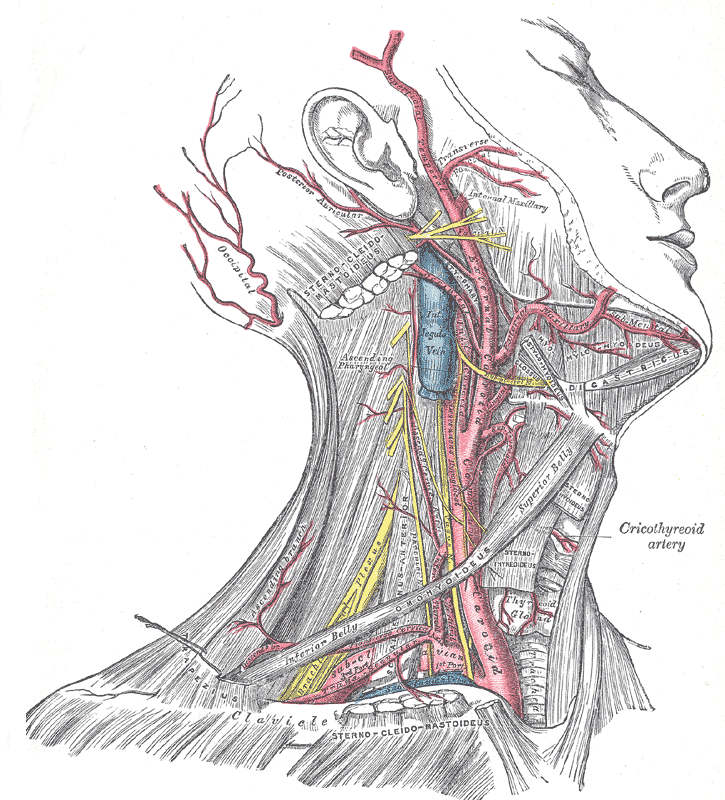
You can prevent blacking out as a result of strain and not being adapted in lifts like the squat, press, deadlift, press, and bench, but what about the clean? The clean and it’s derivatives have the propensity to cause blackouts because of the rack position. Assuming you have a good rack position (bar is sitting on top of the deltoids, upper arm is parallel with the floor, no pain in the wrists/elbows, etc.), you can still have problems with the bar either sitting on or rolling back into your carotid arteries (this happens to me frequently when I pull the bar higher than I need to).
The carotid is that big red one
This occludes blood flow to the brain and can quickly cause loss of vision and consciousness. In either case, it isn’t harmful since when either of these happen the bar is usually dropped, therefore the lack of blood flow doesn’t persist to cause damage. Again, the main harm is hitting your head, so having an open lifting area is important. Even if someone is adapted to lifting heavy weights, the carotids are still susceptible to being occluded, even if it is only partially. Compound that limited blood flow with intense strain that can occur in heavy cleans, and you have a recipe for a blackout.
Grinding through heavy cleans and deadlifts are not only tough, they are sometimes necessary to do in order to win an Olympic or powerlifting meet. At the end of a meet or training session, your body is tired, and having to grind through reps is common. You’ll remember Chris’ third attempt deadlift at 650 that ended in a mid-thigh stalemate. He may have been able to lock that lift out if he had known what to do.
The way that you can stave off the strain-induced blackout is by exhaling a bit of air as you grind through the rep. This is completely different than exhaling as you go up on a rep, fitness style. Instead, you will hiss air out from between your teeth or produce a guttural sound from your throat (grunting/yelling, but not singing). This is like putting your thumb over the end of the house; a little bit comes out, but the pressure stays high inside. Letting some air out relieves some of the pressure overall while the teeth/glottis help keep the pressure up enough so that your trunk is still stabilized as you finish the lift. Completely exhaling would let out too much air and not keep the trunk stabilized. There was a sweet guy at USAPL Raw Nationals who yelled stuff like, “Yeah c’mon babyyyyy” as he deadlifted over 600 pounds at 50 years old to A) avoid passing out by releasing some pressure and B) look and sound awesome doing it.
If you feel yourself starting to black out, then expel some air as I described. I like to push it out of my teeth (makes a loud hissing noise, “ssssssssss”), and this saves me from toppling over like a Gordon. You’ll notice good weightlifters doing it routinely, usually in the form of yelling. It took me falling over twice while cleaning 160+kg to completely learn this lesson. Luckily I didn’t get hurt, but hopefully you can be prepared for when it happens to you.