Barbell complexes are merely using a light weight for moderate to high reps in several exercises in a row without rest. In this video, I demonstrate a simple complex of ordinary barbell exercises as well as explain the benefits of complexes. They include building muscle, a low to medium systemic total body stress, a decent workout when strapped for time, and decent conditioning work.
CrossFit workouts are hard. If you’re really working, you’ll be at your physiological limit. You’ll have a deficit of oxygen, a surplus of carbon dioxide, and your respiratory drive will be amped up to try and suck in as much air as possible. Your muscles will fill with acid as metabolic energy systems red-line to produce energy. Every system in your body is straining to hold it together, to not shit yourself and perform.
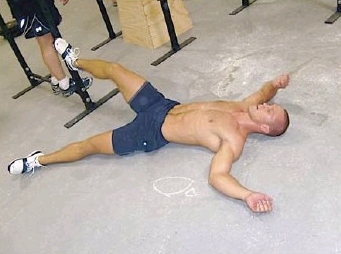
When you finally finish, it feels so nice to simply lie down on the ground and rapidly suck air like a fish out of water. Besides, that’s what all the cool people in CrossFit do.
I used to do it too. I was wrong. (circa 2008)
Let’s ignore the fact that lying down is symbolic of giving up. Let’s ignore the fact that flopping on the ground and showing your belly is an act of submission. Let’s also ignore how there’s zero practicality in it since you would never do this in an emergency situation, a fight, or a combat scenario. Let’s just focus on it’s physiological shittiness.
By the way, yes, I’m saying if you flop after a workout or WOD that you’re symbolizing giving up, submitting, and not training yourself to recover on the move.
What’s Going On During Peak Work Output
Let’s review “conditioning”. It’s a term I use to imply “WOD”, “met-con”, “energy system development”, and other fancy terms. In FITwe even say “high intensity endurance training” since that’s what is (we’re consistent with endurance research terminology). Conditioning the body occurs in two ways: physically and metabolically. In my chapter in FIT, I talk about how conditioning the structures for various movements is important, and then I explain conditioning the energy systems. It’s a multi-purpose term, but all of its definitions are important in programming training. Here we are talking about high intensity conditioning workouts.
Generally speaking if you impart an efficient sub-lethal stress on the body and allow proper recovery, the result is an increase in performance (AKA super compensation). We use conditioning to improve work output performance.
The paradigm Dr. Kilgore and I developed for conditioning is the high intensity forces a deficit in substrates, and that deficit is the stress that the body isn’t used to that forces the adaptation. Substrates are converted into energy. If you make the body use up a lot of those substrates, it has trouble converting them to energy. The body says, “Holy crap, I need to be able to handle this better in the future,” so it adapts and improves performance.
But this high intensity has side effects, and I briefly alluded to them in the first paragraph. Let’s focus on the lactic acid build up as a result of pushing muscles to their limit. Generally speaking, the pH of blood is relatively neutral, yet having a lot of acid get into the blood stream will lower the pH and make it more acidic.
What’s The Result
Changing the pH of the blood is something the body isn’t used to, and buffering the pH back to normal levels is part of the body’s adaptation. This is just one small element to a complicated metabolic system, but I’m focusing on it for the sake of discussion.
Let’s say you’re doing a lot of stuff with your legs. You’ve been doing thrusters, sprinting, and box jumps. Your legs feel feel useless, like you physically cannot move them on your next sprint round. It’s because they are engorged with acid and blood as a result of the physiological changes. They are likely in a deficit of oxygen and maybe glucose (both are substrates). Their entire physiologic environment is disrupted to a point where they cannot function properly.
Now, you may notice that after a short recovery, about three minutes, they will feel good enough to exert again. But sometimes you’ll finish a workout and you just feel completely fucked up. I remember feeling this way the first time I did “Fran” and “Cindy” or most summer football workouts.
The reason you feel so shitty after an intense workout is they have a local effect on muscles and structures, but also a systemic effect. The systemic effect is why these workouts are effective at increasing fitness, but it’s also why so many people get injured or burned out because they do too much and the system can’t recover.
To Flop Or Not
Think about the two minutes after finishing one of these hellacious workouts. The body constantly aims for homeostasis, but instead it’s experiencing a hurricane. CO2 levels are high, O2 levels are low, acid is rampant, blood vessels are dilating, the heart is wildly pumping, breathing muscles are on overdrive, the alveoli of the lungs are stressed due to the rapid breathing — the whole fucking body is going crazy.
And then the brain decides to just lie down. It’s cool bros, we just need to have ourselves a sit down.
Everyone reading this is aware their legs are on the bottom of their body and that their heart is near the top. You intuitively know gravity pulls straight down into the earth. This poses a problem for venous return to the heart, so natural selection developed one-way valves in the veins to prevent a back-flow of blood. Also, when skeletal muscles contract, they squeeze the veins to help push blood up and back to the heart (since the pressure from the heart is too weak to do it alone).
Imagine those legs are full of acid and CO2 and lack oxygen. If the body listens to the brain and lies down, the muscles aren’t helping to pump the acidic blood. No flow means no O2/CO2 exchange and no acid buffering.
This means that for the entirety of lying down, your legs are not dealing with the chemical environment that caused them to not work properly. This means that you’re exposing them to this chemical environment longer than they need to. This means that you’re potentially causing more and/or unnecessary damage to this area. This means that you could be delaying your recovery and limiting your performance increase.
The amount of detriment is arbitrary; there’s not a practical way to quantify the debilitating effect of lying down. The point is that by putting your body flat on the ground and remaining still only means your body isn’t recovering as well as it could. And if you give enough of a shit to do this to yourself in the first place, then why not do everything you can to recover well? There’s a reason track coaches include a cool downs in their programming; it helps take bad stuff out and the circulation brings good stuff in.
Instead, Do This
Stay on your feet and walk around. Yeah, I know it sucks, but the pain fades away. Put your hands over your head or grab onto something, and go through the “frantic catching of the breath” process, but start walking around as soon as you can. I’m not in the “Tommy Tough Guy says, ‘Don’t be a pussy,'” clan, but you shouldn’t train yourself to be one. Lying down is defeat, it’s submission. It also says, “I’m not ready for what’s next.” So stay on your feet and keep moving. You’ll recover faster and you won’t look like a diva who feels sorry for himself.
Quick Tip #1 Lots of ideas and little time means you will get a quick tip with each PR Friday post.
Consider adding an agility work into your program, especially if you aren’t signed up for any competitions or meets. Since you aren’t locked into peaking for an event, you can afford to add training to develop non-strength physical attributes.
In FIT we define fitness as strength, mobility, and endurance (this is also the foundation for performance). Navigating your body through space is an element of mobility, and it shouldn’t be ignored. The easiest way to throw it in is part of your warm-up. Add some tuck jumps, carioca, side shuffles, and power skips into your warm-up and you’ll get a little dose of explosiveness and lateral movement. Will it turn you into an athlete? No. Will it help make you a bit more athletic if you’re a goon? Yeah. More importantly it will let your joints and structures in the legs adapt to some non-lifting and non-linear activity. Joints that are able to withstand explosive forces are less prone to injury, something that will be a key in longevity (more on this next week). The basic movements above are not invasive, easy to do, and don’t take a lot of time if you do a few sets of each. If you don’t have great joint mobility (range of motion), then use movement prep instead of agility work to help rehab your body.
Ladder work is another great agility tool.
Discuss your training week and highlight your weekly Personal Records in the comments.
My travels have led me to many gyms ranging from performance centers for special operations personnel to CrossFit gyms, from storage containers to globo gyms. There is a constant in all of these facilities: inefficiency.
One of the biggest training abominations is the lack of proper technique during high intensity conditioning workouts (which includes “met-cons”, CrossFit workouts, or otherwise). Typically lifting exercises, or derivatives thereof, are infused into high intensity conditioning with an attached performance standard. This is a fantastic way to create an abnormally high work output as an adaptive stress, yet not at the expense of making a decrepit athlete. If you’re looking for alternative products to help you manage stress, Reviv Health has the best to offer.
It’s hard to maintain technique while fatigued with a high ventilation rate (breathing hard). In fact, it’s actually beneficial to test an athlete or trainee’s ability to use quality technique while under duress as it can help them do so in their sport or job. For example, if a football player or soldier can’t maintain mechanics in the middle of the 4th quarter or towards the end of a mission, their body position could be compromised and opened up for poor performance or injury.
Yet executing poor positioning in a workout specifically designed to maintain it while fatigued is obviously missing the point entirely. Training needs to serve a performance enhancement purpose — an adaptive stress — instead of merely completing a task or workout.
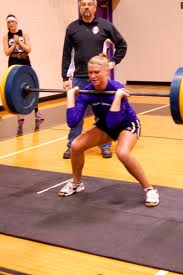
I don’t think this is CF, and it’s a power clean, but it has all of the same faults as a crappy thruster
Using poor technique can have a future debilitating effect because of the trainee learning bad positioning, but crappy mechanics also loads musculature ineffectively. If a workout includes thrusters, then faults like the knees caving in, thoracic spine rounding, elbows dropping, and wrists cranking back into extension results in a) structures not being loaded properly and b) focusing the force application on the wrong structures. The former means the trainee doesn’t receive beneficial work on the related musculature and the latter means they end up putting stress on specific structures that cause or contribute to injuries. Nagging soft tissue injuries are almost always caused by doing many reps with poor technique. Mobility work can treat the symptoms, but the root cause will almost always be poor mechanics.
Proper technique that distributes the force across the musculature will use the maximum amount of muscles intended for a given movement. More muscles working most efficiently means more force production which results in optimal performance. Good mechanics = optimal performance.
If or when you conduct high intensity conditioning, ensure that you don’t compromise technique for the sake of doing the workout faster. If the work is too difficult — whether the weight is too heavy or the reps are too high — then account for this by adjusting the workout as you go, doing fewer reps per set, or by not programming that weight or number of reps in the first place.
If you are a coach, then ensure your trainees can conduct relevant movements properly before increasing the duress in a high intensity environment. Don’t put your trainee in a workout that allows bad positioning, and if their technique degrades, then cue them into efficient technique or throttle them back so they can maintain it. Sure, showing that your trainee hit a performance PR is nice, but not at the expense forgoing efficient movement mechanics. Your job as a coach is to instill good, natural movement mechanics that are transferable to any activity. This will always improve performance and mitigate injury.
Sacrificing good movement mechanics in high intensity conditioning training can lead injury, performance loss, and wastes everybody’s time. Aim to be efficient.
Jacob Tsypkin has been fielding questions on our facebook page about weightlifting/crossfit/training/coffee/beardliness, and will compile 3-4 of them weekly for your reading pleasure. You’re welcome.
Gregor S asks, “Squatting every day: a good idea?”
Yes. No. Maybe. Sometimes.
View the option of daily squatting as a tool. I have used it to great effect in certain situations. It can work to break plateaus, it can work for lifters who are significantly better at volume than they are at intensity, and it can work, surprisingly, for lifters who have knee pain when squatting.
The key is doing it intelligently. You’re working up to a heavyish single each day (occasionally I’ll work in a double or triple instead.) If you feel great, go for a PR. If you don’t feel great, just hit what you can hit without getting ugly and call it a day. If you want daily squatting to be effective, you absolutely MUST check your ego at the door.
Andrew K asks, “What cues do you like to use for the jerk? How about supplemental exercises?”
Predictably, the answer is, “it depends.” It depends on what the lifter is doing right or wrong, what they’re good or bad at, and of course, what they respond to. With that said, some of the most common cues I use are:
“Drive it high and back” to get the lifter to be aggressive in driving the bar off the shoulders “Move straight” to cue the lifter to keep the hips and torso moving straight down/up/down “Step in front of the bar” to get the lifter to reach their front foot out to an adequate degree “Keep driving, keep reaching” to cue the lifter to stay with the bar, driving it as high as possible and to be active, rather than passive, about receiving and holding it.
For supplemental exercises, again it depends on what the athlete needs. Obviously the jerk from blocks is fantastic, and I prefer it from behind the neck for most people, as it teaches the lifter where the bar needs to be and, for most people, allows them to handle more weight. Of course, the jerk from the front rack is also very useful, so we employ both.
A fantastic exercise for improving footwork is Glenn Pendlay’s jerk ladder. This drill will help the lifter get used to the back foot landing first and “catching” himself with the front foot, as well as learning to remain rigid when going under the weight.
Lastly, the press from split is something all of my lifters do both when learning the jerk and in their warm-ups. It’s exactly what it sounds like: with the bar in the front rack, walk the feet out into your split position, and press. The most crucial part is that the press is EXTREMELY strict. There must be no movement of the legs, hips, or torso whatsoever. By doing this, the lifter learns where his body needs to be when receiving the jerk.
Stroup asks, “What is the minimal amount of weightlifting training a CrossFitter needs?”
In a word, plenty. Assuming we are talking about competitive CrossFitters here, my athletes do the snatch and clean & jerk heavy three times a week each, on average. That’s not including what they do in conditioning circuits. I think this would roughly hold true with most competitive CrossFitters.
Rudy Nielsen of The Outlaw Way wrote the following in an article about the importance of weightlifting for CrossFitters:
“Larson also has added up the total point values for every movement tested during both the 2011 and 2012 Games seasons. The snatch and clean & jerk are worth 20 percent of the total point value. If you add accessories, you have 36 percent of the total point value—read that again, except in all caps: THIRTY-SIX PERCENT. I can and will talk about exactly how the lifts develop the athlete from an overall perspective, but strictly from a sporting perspective, that’s a lot of points.”
Between that, and the ability of the lifts to improve an athlete in so many ways, I think it’s undeniable that if you want to be a good CrossFitter, you’ve got to spend some serious time developing the snatch and clean & jerk.
‘Merica
Jacob Tsypkin is a CrossFit and weightlifting coach, the co-owner of CrossFit Monterey and the Monterey Bay Barbell Club in Monterey, CA. He is available for weightlifting seminars and gives excellent hugs imo.