
Getting Girls to Train – 3

In the “Getting Girls to Train” series, I aim articles at you, the reader, in hopes that you can use them to help a female in your life — friend, girlfriend, wife, relative, etc. — get into training. In Part 1 I gave some basic guidelines on how to create a strength program for her and in Part 2 we talked about why monotonous time spent doing “cardio” isn’t necessary as well as how to incorporate simple high intensity endurance workouts into a strength program. Today’s Part 3 concerns with ‘eating right’.

If you remember the Improving Diet post, you’ll remember that I’m not a stringent diet groupie. More importantly, I’m not an advocate of completely changing everything about a person’s diet because it’s the hardest habit to alter. Instead, I like to recommend small steps to improve eating, make it habitual, and then take the next step by addressing big things first, then focusing on the little things. It’s analogous to acting as a page, then a squire, and then being accepted into knighthood (with even fewer being raised to lords).

Women who are new to training are no different in that I would ask for gradual changes over time, yet the process is different than a typical guy’s. Societal and government sources would have the public believe granola bars, oatmeal, and orange juice is a healthy breakfast. Carbohydrates, especially the processed variety, run rampant. My first order of business with new female trainees is to get them to eat more protein.

Typically girls, especially those who don’t train, don’t gorge superfluously (unless they’re high?). By getting them to focus on having protein in every snack or meal, they will not only eat more of it, but they won’t have as much of an appetite for other crappier food sources.
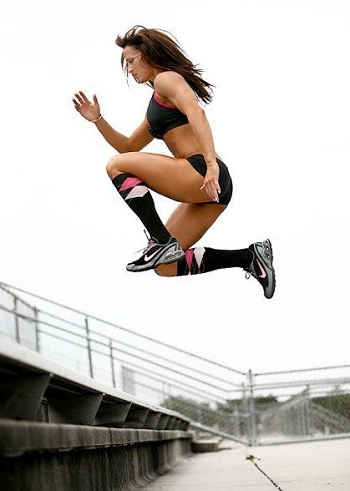
Erin Stern has trained for 15+ years and some how didn't get bulky

Protein won’t make a girl bulky, especially since she not only hasn’t had a history of accidentally becoming bulky but more importantly females only have 5 to 10% of the testosterone that a male has. Instead, protein is the most abundant molecule in the body that is a major structural component of all cells — muscle, organs, hair, and skin — and helps regulate metabolism, form blood cells, and supports the immune system. The average woman is deficient in protein intake, and she will significantly improve her health by consuming more if it…even without exercise.

Then we compound this new-found protein intake with a proper program (this or this), and she is on her way to being lean and strong.

My friend Courtney Modecki, a female oddly enough, is in agreement with the “progressive steps” method of improving diet with women. She pointed out to me that it’s a sensitive issue since ranging from eating disorders to emotional issues with eating as a result of obesity. We both agreed that eating breakfast is one of the first progressions we would urge, along with increasing protein intake.

Courtney pointed out that she found it easy to get women to adapt to eating whole eggs. Some girls can be weary of meat (for whatever reason), but eggs are cheap and can be easily prepared to preference. Since each egg has the protein equivalent of an ounce of meat, they are a significant addition to a female diet.

Lastly, whey protein added into smoothies is another form of protein intake that is acceptable and easy to a female new to training. Whey is perfectly acceptable for any type of trainee, although it shouldn’t be relied on for the primary source of protein in a day. 50 grams of protein can be consumed through whey by women — this would typically leave another 100 grams for them to consume in food. In comparison, that number can be 75 to 100 grams for a male, and it leaves 100 to 150 grams for the average guy to eat through food. It doesn’t matter if a majority of the protein is consumed all at once, but typically we aim for a distribution throughout the day to prepare the body for training as well as recovering after.

The diet topic, especially concerning women who need to change it, can be extensive. Courtney and I have will explore this topic in future “70’s Big Female posts” on Mondays.

Adrenaline

Happy PR Friday — post your week’s personal bests or training updates to the comments.

There are two sides to a successful heavy lift: the volitional violence at a critical point in the lift coupled with a pre-existing shot of adrenaline. The former consists of gritting your teeth and ripping through each rep. The latter, however, is more of a skill that has to be developed over time. Considering that I’ve raised my heart rate by 50 beats per minute while sitting in a chair getting ready to squat, I’ll draw on my own experiences while combining some simple stuff I learned while studying sport psychology a few years ago.

Most people, especially stereotypical powerlifters, will use music as their source of external motivation. Even your average friend will have an image of a guy listening to inexplicable death metal and screaming prior to a lift that represents a similar range of motion to Stephen Hawking’s squat. This isn’t always the case, but douche bags — as well as mammoths — do exist.

Now consider the opposite side of the equation: the crafty champion. He is a man who wears an armored suit of serenity, yet his mind is full of wroth. He is courteous to the judges, undergoes his routine, seamlessly hits his lift, and pays homage to the crowd after a personal best. He has learned to summon the dragons from within.

Causing a raucous prior to lifting is a young man’s method of boosting his adrenaline; it’s more primal, easier to do. Yelling and flailing about is an external method of raising adrenaline, because the actions are typically associated with anger, action, and violence. Let’s learn how to develop the mental aspect of lifting.

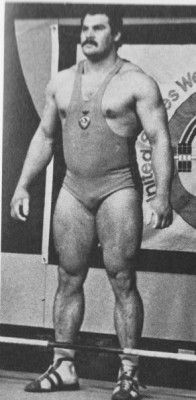
This is Pisarenko's pump-up


Continue reading

Internal Rotation

A lot of you have shoulder issues, and they can be alleviated by improving two primary things: internal rotation and thoracic flexibility. Here are some videos that help with internal rotation from MobilityWOD.com.

This entire video is good.


This entire video:


Beginning of this video:


These merely hit the internal rotation aspect, so start working on those and in a few days I’ll do a post on working on the thoracic area. Feel free to ask any types of questions regarding range of motion, flexibility, and how it pertains to lifting.
Edit: A Lannister always pays his debts.

Attacking The Rep

About two years ago I was doing my squats on the Intensity Day of the Texas Method program I was on. I was doing singles across at 495 (my memory has always been doubles, but I can’t find it in my training log), and the third and fourth reps looked really ugly. The fourth one was what I like to call a holy grinder (sung to the tune of Holy Diver), and Rip looked at me and said something like, “Well, that was bone on bone. You’re done.” I didn’t like that and said, “Nah, I’ll get the next one.”

So I saddled up for the fifth rep with adrenaline leaking out of my ears and aiming to bounce the shit out of the rep. At the time I remember that I didn’t really remember the rep; but I bounced it so hard and fast that Rip was stunned at how easy I made it look given that the previous rep was so hard. This, my friends, is the difference between going through the motions and attacking the rep.

There are two sides to a successful heavy lift: the volitional violence at a critical point in the lift coupled with a pre-existing shot of adrenaline. This post concerns the former.

It’s easy to get in a habit of merely stepping out with a weight on your back and squatting instead of attacking every. single. rep. This concept is hard to explain, but it’s most noticeable in the Olympic lifts. Many beginning Oly lifters are thinking of so many different things that it almost seems like they stand up with the weight, and then fall into their squat. Ripping through the second pull is the most important part of these lifts — that hip extension should be the fastest, most violent thing that person can generate out of their body. It’s the difference in trying to cut someone with your longsword or cleaving a head off (horse head, not real); the difference in trying to hit someone and knocking them the fuck out.

Lifting isn’t church. It isn’t afternoon tea. It’s a form of controlled rage directed at a barbell. In a squat, you need to attack the bottom position and make it sharp. In a press, you need to attack the bar at the beginning and try to make the entire rep fast. In the bench, you need explode off of your chest. In the Olympic lifts, you have to rip through the second pull as hard as you can. You should be applying the maximum amount of force possible at that moment. I hardly see recreational lifters actively attacking their reps.

There is a learning curve to attacking the bar — you have to be consistent with your technique. Yet, there’s a difference in mindset when you walk a bar out and think, “Man, this feels heavy, I hope we get it…here we go…” and actively wanting to hit the rep and repeating “Bounce” in your head. Hoping to get a rep and punching it in the fucking mouth are two different things.

Don’t sacrifice technique for the sake of intensity. When most inexperienced lifters think “bounce”, they fall into the squat, lose tightness, kill the bounce, and have a bitch of a rep. The person that attacks his squats the best is my friend AC; he maintains proper tempo and tightness in the descent but attacks the SHIT out of the bounce. This video is two years old, but you can see how he rips through the bottom of the squat — particularly on the second rep.

495×3 from A.C. on Vimeo.

Lift angry and attack the critical part of your reps. You need to volitionally hit the rep as hard as you can. If there was any question to how hard you hit it, then it wasn’t hard enough. Punch through the rep and lift angry.

My Body Is Ready

In a perfect world you could completely commit to training and devote every aspect of your life to improve you’re training. Alas! You aren’t special and don’t get paid to perform and compete (I know this realization is hard to understand). Instead, you might have a job, have to study for exams, or have to help wipe your child’s bum. Whatever the case, it may cut into your training and learning how to work around that is important.

Stress The Whole Body
I haven’t had regular access to a gym or a repeating schedule for quite a while (probably six months), yet I’ve gotten a bit bigger, a lot stronger, and rehabbed back from a gnarly hip injury. The key with shoddy scheduling is to train the entire body when finally getting access to a gym.

This doesn’t mean you hit every lift you can think of, but emulate what most linear progressions consist of: a squat, a press, and a pull. Some days I have just sn/cj while other days I’ve sn, cj, squat, pressed, curls, and did RDLs. One day I squatted, rowed, and did RDLs (with no press movement). I’ve benched, squatted, did RDLs, and weighted pull-ups. Each week I try to bench and press once each, squat and RDLs at least once, and dabble in various assistance (at least once each of rowing, curling, weighted pull-ups, and round back extension). The point is that each day has lifts that use a lot of muscle mass and work on the structures that make the body strong: hips, back, legs, and shoulders. If your schedule is shoddy, aim to perform some of the basic lifts a minimum amount of times throughout the week. This will save you from having to figure it out each time you step in the gym.


Don’t Wreck Yourself
When you do finally get to train, don’t be a wise guy. You wouldn’t want your lifting exposure to give you crippling soreness. Ease into heavier weight over time, be patient, and don’t aim to PR every day. Save the most stressful lifts, like deadlift, for the end of your training week (if you know when you’ll get to the gym again). Don’t hesitate to work in RDLs or round back extensions in its stead; these exercises can help augment the deadlift when you finally get the time to focus on it again.

Know When To Back Off
Just because you finally get to train doesn’t mean your body is ready. When I was in Australia, I only trained twice: the first day felt really shitty (I squatted, pressed, and did pull-ups), then the second day I matched a PR on snatch and came close on clean and jerk. However, if my body wasn’t ready on day two, then I would have just done some sets across instead of pushing the weight.

Recently I tried to snatch when I wasn’t feeling that great. Maybe it’s because I squatted and did RDLs two days before, but I just wasn’t feeling it that day. I ended up missing simple snatches to the point where I audibly said “Fuck this,” and left to go bench. Then my first set at a regularly easy weight on bench was difficult; I racked it after the first rep and was all pissed off. I declared that I was done training for the day and just did some DB rows and dips. My body was not ready.

Ease back the training session if you aren’t feeling great. You can do this by changing the exercises (remember the “When in doubt, train your back” post?) or reducing the volume and load of your intended workout.

Maintain Mobility
Some times the limiting factor is the body being all wound up from sitting at a desk, in a car, or on an airplane. If you have a good habit of working on your mobility on a daily basis, then these events won’t smash you as hard. Take care to do extra mobility work when you have been in any crappy position for a long time. “Crappy position” would imply that your knees and hips are bent and you are slouching forward. You can’t train well if you aren’t pliable enough to go through a ROM properly.