Here are some vids to entertain you before tomorrow’s Q&A post.
This is a great vid of Donny Shankle lifting. He jerks from blocks all the way up to 225kg, then hang clean and jerks up to 200kg (the latter is a PR). Then there’s some good fun after all that — watch until the end.
My mate in Australia, Shannon Green (owner of Warrior Performance – website and Facebook fan page), competes in strongman with his mates Stuart and Shane. They are all great guys. Shannon is a real sharp guy and has spent a lot of time studying many different aspects of physical performance. He has made, collected, or bought the majority of the implements he would need for strongman training, and I asked him to throw together some information on how to train for it.
Check out this video from when Tom and I visited Shannon’s training dungeon.
This first post pertains to what strongman is and what some basic requirements are. A second post will put it all together into a programming template. Continue reading →
Movement on Earth is dependent on articulation with the ground. Human locomotion occurs because our body applies force with the feet into the ground and all motion, athletics, and training are dependent on how efficiently this occurs. Despite fast improvements in performance in recent history, there has been an equal increase in dysfunction in the average body.
Duck Footed
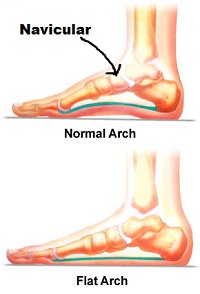
I’ve always hated when people walk duck footed because it looks lazy, unnatural, and inefficient. I’ve noticed that I see it a lot in people who don’t have an athletic background. Dancers often do it because they are taught to be externally rotated in the hip constantly. It often results in collapsing the arch via ‘navicular drop’– the navicular is just a bone behind the base of the big toe on the inside of the foot and this term merely means it has dropped to the floor because of a lack of an arch (see picture below). Going barefoot or wearing flip flops a lot can also cause arch issues. Walking duck footed, or externally rotated in the hip, can also result in excessive loading of the hips instead of distributing the load evenly throughout the entire leg, hip, and trunk. Choosing good footwear can help support proper foot alignment. Ingrown toenail better fitting footwear is also something to consider when thinking about overall foot health.
I’m interested in looking at information from female lifters. I’ve been observing the difference between the Volume and Intensity Days in the Texas Method for a while. Recently I started thinking in terms of percent instead of absolute weight; reducing the Volume Day weight to a certain percent of the Intensity Day weight is more instructive than aiming for a discrepancy between the weight lifted.
This led me to start thinking about the differences between female and male lifters. The neuromuscular efficiency of a female lifter is lower than a male’s. In other words, her nervous system cannot utilize motor units as well as a males. The neuron will innervate fewer muscle fibers compared to a male; it’s a result of different sex hormones and characteristics. This means that a female is not capable of lifting her true absolute strength — what her muscle fibers are actually capable of — because it’s always limited by the nervous systems ability to innervate muscle fibers (AKA neuromuscular efficiency).
This means that a girl’s 1RM is relatively lower and as a result she can perform multi-rep sets at a higher percentage of her actual max than a guy. If I can press 240, then I might be able to double 228, or 95% of my max. A girl might be able to do as many as five reps with 95% of her max.
To get more data points, I’d like the females to answer a few questions. Please forward these questions to any friends you have that lift (even periodically in CrossFit).
1. List the 3 rep maxes (3RMs) of all the lifts you have data on. For example, if you don’t have data for bench, then omit it. If the weight is merely your best triple and not a true 3RM, please indicate this*.
2. List the 5RMs of all the lifts you have data on. If the weight is merely your best set of five and not a true 5RM, please indicate this*.
3. List the 1RMs of all the lifts you have data on. These 1RMs should be within three months of the above numbers.
4. List the set/rep scheme of your recent and/or current program. If you primarily perform fives or triples, point that out. If a girl has only done fives, then her lack of adaptation to singles would explain an artificially low 1RM.
*If you are able to perform this set more than once in the same training session, it is by default not a repetition max since repeating it means it wasn’t a representation of maximal ability.
Note: If you don’t have exact 3RMs or 5RMs (i.e. your best squat is 180×4), then list the closest number.
Justin, if you can figure out why I got 3 whites on this lift…
…and 3 reds on this one.
I will be very grateful. And since my deadlift lockout is the ugliest thing in lifting history, I was wondering if you think rack pulls might be a good way to clean them up, and if so how do you usually program them?
Dear Adam,
We talked back and forth about this on the page, but I thought it was good topic for everyone else to see. The federation is the CPF which is a WPC affiliate. Personally I’ve only coached in the USAPL, which is under IPF ruling.
Adam is a glaring example of blatantly removing tension from the hamstrings during the deadlift lockout. I don’t think the last attempt in the second video should have been red lighted, but the excessive forward knee movement emulates what would happen when the bar is hitched. Had the bar stopped moving, I would agree with them, yet it continued to move. Your feet remained in the same place, you locked your knees out at the top, and lifted the chest at the top. That jacked loader on the right was surprised it was red-lighted too. Whatever the problem was, it was something that all three judges agreed on. They must have considered your shitty knee position a hitch, I guess. My suggestion would be to go over the rule book and find out what happened.
However, the fact that you remove hamstring tension is something that you can (and need to) control. Adam told me he’s doing RDLs, but I’d still want to see how he’s doing them because I have a hunch he’s flexing his knees too much and not getting the full use of them. In any case, he asked about rack pulls. Rack pulls will definitely help this pulling issue when they are done correctly. The bar should be put right below the knee (at about the tibial tuberosity), and the lower back should remain locked in place during the movement. You don’t need to hyper-extend it (I’ve been hurt this way), but the goal is to not allow it to flex. If it flexes, then it slackens the hamstring tension. Do not allow your knees to shift forward under the bar (like you’re currently doing in your deadlift). By doing it this way, you won’t be able to use as much weight as you think you can, and it will probably be lower than what you deadlift. This is fine. Chris’ set of five on rack pulls is still below what his max is.
Lastly, when you do actually deadlift, think about keeping the knees back (cue is “knees back”). Really work on this since a) knees forward is causing you to miss lifts in meets and b) strengthening your hamstrings by maintaining tension during deadlifting and rack pulling will make for a stronger deadlift. If you’re confused, see Chris’ 650 miss on his third attempt at USAPL Raw Nationals in 2010 compared to his last three meets: 661, 666, and 677. Continue reading →