Guest Post: Jackie and the Platform

Today’s article is courtesy of Jackie. She gives us an honest and frank look into her story of going from a gym-stud to fresh meat on the platform, with a little prodding from her coach. More importantly, it’s easy to see just how much the work we do with the barbell effects our outlooks in the rest of our lives. A huge thanks to Jackie and her coach Chris for bringing us this story – keep ’em coming, folks! – Jacob

When it comes to training, I have had some significant personal accomplishments. Deadlifting 300lbs, pressing the 24kg kettlebell, 32kg Turkish Get Ups, and repping out pull-ups have all been exciting feats. But I must humbly confess that these have all come relatively easily to me. Which begs the question, what am I capable of if I really applied myself? I’ve never really found out the answer, but it’s a question I hope I never stop asking myself. As a recovering fitness trend-junkie, in addition to a stubborn Italian (which is more of a character asset if you ask me), I have always struggled with training “ADHD,” and I occasionally relapse back into old habits of over-training, under-eating, lack of mobility work, and training with the purpose of vanity. This resulted in disturbed sleep patterns, inevitable injuries, mood swings, apathy and boredom. Speaking with an experienced ADHD psychologist in Melbourne really helped me understand the importance of balance, recovery, and mindful goal-setting in both training and life. Visit this site for more on testing. This is a lesson I have learned all too many times, and am frankly sick of getting beat over the head with it (if you’ve met my mentors, you would understand I mean this both figuratively and literally).

The truth is that I haven’t ever really worked hard for something. I mean, really worked for it. To clarify, I have applied myself in school, work, relationships, and I do have experience setting goals and meeting them. Yet, the goals I set were mediocre at best, and easily attainable. To be even more candid, if I did ever set a high standard that would require some serious dedication (which was rare) I would usually quit. Give up. Just like that. If it wasn’t executed perfectly, exactly as I expected, it was over.

But to work hard, hours on end, sacrifices, compromises, losses and gains and more losses, all for something that looks and feels so far away, and promises no guarantees? Nope. Never really knew what it felt like. I’ve been one of those people who would back out in the middle of a winning streak for fear of losing face, who would “stop while I’m ahead,” who wouldn’t pursue something because it would entail some serious effort and risk failure. I have been this person, this way, for most of my life. Which, ironically, isn’t really living it all.

For two years now, Chris Falkner, coach for Tucson Barbell, has been fighting to get me into Olympic lifting. While I did play around with the idea and techniques, it just seemed ‘too hard’ to actually commit to. Recently, however, life threw me a couple of curve balls, leading me straight to the platform. After feeling uninspired for so long, it became the only place that I could seem to find the solace and serenity that seemed so absent from my life.

Spending 1-2 hours, 5-6 days a week, for 3 months (and counting), focusing on the same movements and techniques over and over can be very humbling. You fail… a lot, and start to discover more about yourself and your “limits.” You can’t afford to use any energy on giving a shit about what you look like, what people think of you, or, God-forbid, getting “bulky.” The goal becomes the focal point, and it’s amazing how your perspective changes when you do finally wake up. It’s like seeing everything for the first time… finally. I remember watching my coach in his training session one day. I had seen him lift before, but this time I saw it differently. Before approaching the platform, he stood back for a few moments, almost as though he was paying his respects. There was complete silence, no music, not talking. It was just him, the platform, the bar, the weight and the passion to become better. Everything he would talk about, in that moment, had finally started to make sense.

A few days before the Grand Canyon Winter Open in Phoenix, AZ, Chris had suggested I register as a participant. Immediately I got flustered and scrambled to find reasons not to. ‘I’m not ready.’ ‘I have too much homework and a test to study for.’ All euphemisms for: ‘I am a chicken shit.’ Chris did what he does best and called me out, and I was fuming. (You see, when people other than myself are right, I get pissed.) I decided to do it, even if it was mostly out of spite.

At 5:30am on a Saturday morning, I braved the 2-hour drive, in pouring rain on Interstate 10 (which is scary as hell) to participate in my first official weight-lifting meet. Already sleep-deprived from the nerves the night before, I spent the entire two hours talking myself into going and not turning around back towards a warm bed. I weighed in, warmed up, and it was time to lift. The gym owner was explaining the rules, and I honestly don’t remember a single word he had said, I was so preoccupied. My hands were shaking and I had to remind myself to breath. But I remember finally setting foot on the platform and having the visual of coach training, and my teammates. In the moment before, I suddenly stopped giving a shit about anything other than the lift. In the moments between, I was too busy admiring the other girls’ lifts and paid no attention to the adrenaline rushing through my body. I ended up hitting all three of my snatch attempts, setting a new personal record at 47kg. I landed two attempts of the clean and jerk at 60kg and 64kg, and missed my last one at 67kg. Three of my teammates and I qualified for University Nationals in April. It was an amazing time, and I learned an invaluable lesson. The experience wasn’t about hitting numbers higher than the next girl, or having the best technique, but to work hard and compete with the older, weaker version of myself.
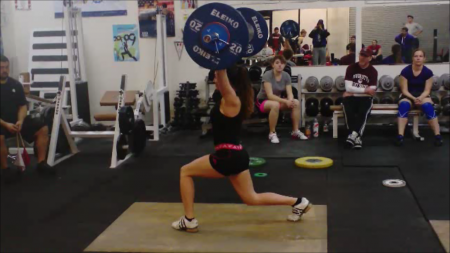
In the days following the meet, I have felt more confident in my training and technique. The gym has become a refuge and I count the minutes until I get there. I realize my numbers aren’t necessarily the most impressive. I am a little fish in a rather large pond and I acknowledge the cards are stacked against me ever becoming the “best.” But as long as I show up and am better than yesterday, I’ve found my calling.
PR Friday, 29 March 2013

Look, I get it. I’m “that guy.” It’s fine. I wear obnoxious tank tops in public. My beard scares strangers. I challenge crossing guards to front-double-bi-pose-downs. I trap slap my “friends” until they have bruises.

Yes, he PR’d.

I wear short shorts, and I yell “TEARDROP!” at awkward moments in romantic comedies.

I completely deny having ever gone to a single romantic comedy.

I’m not going to apologize for having fun, especially while lifting things up and putting them down. And neither should you. Next time you go to the gym, recreate this scene during your warmups. You’ll be a better man/woman for it:

And if not, well, hopefully you don’t get kicked out.

This week, Aaron wrote another article that I personally thought was fan-fucking-tastic. Some people probably didn’t think so. Those people aren’t having enough fun. The point of this site is to help each other get stronger, leaner, meaner, and more awesomer, just like our long lost brothers did back in the 70s. Think they apologized? Nope.

This site has become an awesome community, and continues to evolve into something bigger than Justin or any of us ever imagined when it was launched. We get more daily hits than ever before, and our sphere of influence continues to grow. Hell, big ol’ Mark Bell even mentioned us this week on his youtubes (if you don’t follow his selfie-vids, do it now – he’s full of great info and stupid hats). Take pride in being a part of this group, and make sure you comment here, especially on PR Fridays like today. Stop lurking, and start contributing. If you’d like to keep a workout log or ask questions, you can join the LiftHeavyShit forums (NWS, duh), or hit us up on facebook. Tsypkin answers questions every Thursday, mostly about CrossFit and Olympic Weightlifting. This week, Mike took a huge chunk of time to answer every question he could find on the facebooks in this video:

(thanks to user cwhite for making a table of contents in the comments section!)

We might all be jackasses, but we’re here for you. Keep the questions, comments, and PRs rolling in!


Tsypkin Thursdays #4

David C asks, “If you were going to hire/follow one of the bigger CrossFit coaches out there to help you prepare for the Open, Regionals, and Games, who would you choose?”

Rudy Nielsen of Outlaw.  In part because he has a deep and sound understanding of how to program effectively – but there are a lot of people with that. What Rudy has that a lot of others lack, is a deep and sound understanding of how CrossFit – the SPORT, not the fitness program – functions. He doesn’t debate silly shit like “is CrossFit too strength biased” or “has too much cardio” or whether the “definition of fitness” is legit.  He observes the parameters of the sport, and trains people to compete in them.


Dave F asks, “I am training the Olympic lifts three times a week, one day being committed to the snatch, one day to the clean & jerk, and one to both. What is a good rep scheme for a novice?”

First: if you are a novice, I do NOT think that 2x/week per lift is enough. You need to be doing them 3x/week so that you can learn the patterns and learn them well.

About rep schemes…don’t worry about them. Focus on sets of 1-3, get a lot of good reps in, and when you feel great, go for a new PR, whether it be a single, double, or triple. If you’re training alone, don’t do so much that you are exhausted for the last third of your session and do nothing but shitty reps.


Vee G asks “I was trained using the ‘scoop method’ ala Coach Burgener.  A lot of my fellow weightlifters have been taught in a style more similar to Coach Pendlay’s, which does not teach the scoop. What are some advantages/disadvantages of either technique?”

I’m assuming that by the “scoop method,” you mean teaching an intentional rebending of the knees – sometimes referred to as the double knee bend – under the bar before the second pull.

Did someone say scoop method?

I personally do not teach the scoop/double knee bend as such. I teach the lifter to move into the correct position, and the knees move into the right spot – slightly in front of the bar – just before the lifter extends into the finish. It is my opinion that teaching the intentional double knee bend only serves to confuse new lifters, slow down the transition, and lead to the lifter pushing the bar forward and shifting the weight onto the front of the feet too early.

Although there are certainly good coaches who have made this method work, I cannot see any advantages this way of teaching has over those which do not coach the lifter to intentionally perform the double knee bend.

Editors’s Note: Please remember to ask Tsypkin anything your crazy little heart desires on our facebook page. Otherwise, he’s going to have to come up with his own questions to answer, and that would just be crazy. 


Jacob Tsypkin is a CrossFit and weightlifting coach, the co-owner of CrossFit Monterey and the Monterey Bay Barbell Club in Monterey, CA. He is available for weightlifting seminars and has excellent taste in shirts and gainz.  


PR Friday, 22 March 2013

It’s Friday! This week on the site Paul Sousa reviewed a new android app called deep squatter. On Tuesday we had SOF Olpainless reflect on his experiences with training while deployed, and then on Thursday Darth Tsypkin answered more of your questions

I googled “brent kim” and this is what I got.

Going forward, Mike Battaglino will be answering reader submitted questions on topics such as Powerlifting, Strongman, Military related training, declining spots, etc. in a video format. Questions can be submitted to mike@70sbig.com or posted in the comments on facebook. Mike answered a few questions already, posted on our facebook page this week:

Michael asks:  I’m a Marine and I love powerlifting (just competed in my first meet) but I need to temporarily focus on dropping my 3 mile run time for a PFT. What are your suggestions for strength maintenance while I start running long enough to do well on the fitness test? I’m planning on throwing together a mix of interval/tempo work and the occasional longer run (2-3 miles). Probably 3-4 days a week of running. I’m sure this is a pretty common scenario for the military folk.

Mike: I’m quite glad my PT test days are over. I would reccomend trying to maintain your current program the best that you can, and just keep the weights the same for 4-6 weeks. If you need to, drop some of the accessory lifts. You shouldn’t lose a tremendous amount of strength, and you can be back to adding weight 1-2 weeks after the test. 

I wouldn’t worry about moving the weights up for either your volume or intensity days. Perhaps for your bench and press you can move up slowly, but I would just worry about passing the test, and maintaining your current numbers.

Kyp asks:  I recently bought a yoke and it’s supposed to be arriving sometime this week so figure I would study up on it in the mean time. I was wondering if you would be able to share any knowledge/know of any particularly good sources or information regarding programming yoke walks for somebody trying to get 70’s big, and have a good base of general conditioning?

Mike: Kyp, I have read a quite a few pro strongman training logs, and everyone seems to program it a bit differently. I’ve only had my yoke for about six months, but I would recommend keeping it light for a little while. If you could manage to do it once a week, you would probably develop your technique pretty quickly, but keep it relatively light. Once it starts to get heavy, do it every other week. If you’re going into a contest where you’re going to use the yoke, consider programming speed/heavy days with it. I think the most important thing is to develop skill walking with it. Watch videos of pro strongman using it and experiment with what works for you (particularly hand placement).

LW Pro Strongman Andy Deck with a 1010lb yoke

As today is PR Friday, let us know how you are doing in the comments. What do you want to talk about? Add videos by just posting the youtube URL. Since it’s snowing here in Boston, crockpot recipes will be awarded extra internet points today, along with the admiration of your peers.

Tsypkin Thursdays #3

Tom O asks, “I have calf pain when squatting ass-to-grass, whether back, front, or overhead.  Any ideas what this could be/what I can do about it?”

Could be quite a few things.  I’d start with soft tissue and mobility work on the hamstrings, IT band, and calves.  Start at the largest crossed joint (hips for hamstrings and IT band, knee for calves) and work down.  You may also want to do some compression work around your calves.  Finally, address the squat (and the hips) as a whole.  Do some range of motion testing (there is a lot of good stuff on Mobility WOD for this) and see where you’re limited.  Address those issues and see where it leads.  Perhaps of greatest importance, is to remember that dealing with issues like this is not a quick fix, one-and-done kind of deal.  It’s going to take some time and patience, but it will pay off.


David H asks, “I’m a new weightlifter and I have long arms.  Should I utilize a wide grip on the jerk? I’ve been using a relatively narrow grip and it feels more solid this way, but I can’t help but think I’d benefit from moving my hands out.”

If it ain’t broke, don’t fix it.


Joseph F asks “Box squat for CrossFitters?”

Star Wars action figures for Trekkies?

Harry S asks, “What are some ways to improve my mobility for the snatch? My bottom position looks like a low bar back squat due to tight hips and ankles, and the couch stretch alone isn’t covering it.”

In answering this, I’m going to assume you are already back squatting high bar.  If you’re not, fix that, train it for 6 weeks, and see where you’re at.  Second, while mobility and stretching is great, I’m a firm believer that the biggest changes are going to happen from doing a lot of the movement you’re trying to improve.  Don’t become that guy who spends 2 hours on mobility and 20 minutes lifting (emphasis added by me because this is a glorious statement. – Cloud). With that out of the way, let’s talk about a few excellent drills to help you with this.

1. This one is very specifically helpful for people with your problem: take a length of PVC or broomstick and go into the bottom of your overhead squat.  Have someone stand behind you, hands on the PVC, place their knee in your low back, and push your hips forward and down. Be sure to keep your weight on your heels as the knees go forward, and actively push up against the “bar.”  Have your helper push down slightly on the PVC – this will help you feel something to push up against.

2. Holding an empty barbell in your hands, squat down and place the bar across your thighs/knees. Push one knee forward at a time (it’s fine to come off your heel) and use the bar to weigh you down at the knee.  You should feel a deep stretch around the achilles tendon.  Do this a little at a time, switching back and forth between legs, gradually loosening up the tissues and pushing the stretch further.


Barry S asks, “What are the pros and cons of using a percentage based training program for weightlifting?”

This is a big question. I will address it as concisely as possible.

Using percentages can be helpful because it gives you a governor.  When done intelligently, in the long term, it can help keep you from doing too much or too little, ensure that you’re mostly working with loads that are beneficial to you, and give you an accurate measurement of the total training load from day to day, week to week, and month to month.

However, they can also be limiting. Is 80% as valuable as 85% or 90%? In my opinion, if you are having a good training day, you’re going to get more out of taking the weight up and working heavier than just sticking to a set number.  And it’s always good to have the opportunity to strike when the iron is hot and set new PRs.

This is not to say that a percentage based program can’t work.  There are obviously a lot of great lifters and coaches who use percentages.  And I think they can be useful for someone who is training alone, to mitigate burnout and keep the lifter from getting to the point where they’re so exhausted that they are no longer able to recognize and correct mistakes.


Dave F asks, “If you were to design a program for someone looking to compete in both weightlifting and powerlifting, what would you emphasize?”

This is another big question, not one I can address effectively within the scope of this post.  But I will say this: I very strongly believe that in order to be successful at both weightlifting and powerlifting, one would need to emphasize weightlifting as the main discipline. The short version of the long answer to the question “why?” is this: weightlifting has the potential to improve you as a powerlifter far more than powerlifting has the potential to improve you as a weightlifter. There is already great importance placed on squatting and pulling strength, and the bench press can be treated as a supplementary exercise for a large part of the year.  I would, obviously, shift emphasis closer to a powerlifting meet for the final preparatory period.


Jacob Tsypkin is a CrossFit and weightlifting coach, the co-owner of CrossFit Monterey and the Monterey Bay Barbell Club in Monterey, CA. He is available for weightlifting seminars and already has a perfect score on 13.4.