In this podcast episode, I interview American Olympic weightlifting coach Glenn Pendlay on the good and bad of USAW and American weightlifting. In this podcast you’ll hear about:
– the role of the USAW
– how the USAW is funded
– why USAW doesn’t get more funding
– what they can do to improve
– some ill-conceived impressions about the USAW and how American weightlifters train
– various strong American lifters
– how American and Chinese weightlifter selection compares
– how American weightlifters have to sacrifice for the sport
– Glenn’s experience with international lifters and drug use
– what holds the US back
– general training methods Glenn employs
– what’s the best way to improve weightlifting in the US

Muscle Driver USA
Pendlay.com
California Strength
There will be a live webcast of Pendlay’s lifters training today. Be sure to check it out (link in comments).
Download Right click and “save target as”
53:32 long. Also available on iTunes.
Category Archives: Content
On Perseverance
On Perseverance
by Mike Hom and Justin
There’s something to be said about perseverance.
The constraints of the universe will dictate what happens to a person, yet it takes a ballsy person to give the universe a big middle finger.
The psychological, emotional, and physiological commitment to excellence during training carries over to everything in life: how you compete, how you fight, and how you carry yourself. Perseverance is holding steady to your conviction and telling yourself that you will continue no matter the obstacles, no matter what the universe wants to say.
A good friend often reminds me, “You can hope, or you can know,” pretty much every day we train together. It’s rather profound when you approach the bar and ask yourself, “Do I hope, or do I know I will make this lift?” Shit, you better be answering that question with one answer only: “I fucking know.”
I don’t want to get too Tony Robbins here, but I’ve said it before: 70’s Big is an attitude. We joke about 70’s Big being about 200+ lbs. or having a majestic beard that Paul Bunyan would be proud of. But let’s face it, a lot of the readers on this site are just about getting stronger and using the right resources to achieve their goals. Body weight isn’t as important as what manifests inside and outside. Now, if you’re 6’5″ and weighing in at 185 lbs., you need to grab some milk, a barbell, and go to work. But in all reality, it’s about telling yourself that you’re going to be better than you are now. It’s about telling yourself that being “good enough” is the same as “I’m okay with being mediocre.”
There will be a defining moment in training (or life) where the universe tries to spit in your face. Will you accept the defeat and walk away?
Nah, you’re gonna say, “Fuck that,” and spit right back.
Jacob killing shit.
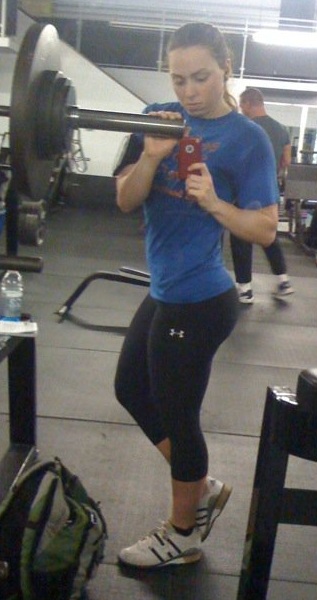
70’s Big Female – Lily
Mondays are devoted to the 70’s Big Females out there who train to get stronger and look great doing it.
Lily is a consistent presence in her north Florida gym. I’ve seen her post online about hitting up squats, deadlifts, snatches, or clean and jerks on holidays — every day is just another training day for Lily. Her 145 pound frame holds a 40″ ass with ease, which easily passes the 38″ mark set for 70’s Big Females. It isn’t just for show; Lily brings her lunch pail to the gym to do some fucking work. Here is the second set of five of high bar squatting 185 for 10 reps. I’ll repeat that again: five sets of 185×10…40 pounds above body weight. And it’s not even hard.
The thing about Lily is that she’s training hard all the time. She doesn’t dabble just because someone told her to squat; she lifts because she loves it. She’s, yet again, proof that lifting and being strong not only doesn’t make a woman BIG, but she’s also proof that there are hardcore women that are lurking behind the scenes in gyms across the world…un-racking the bar one more time.

An easy 245 pound deadlift (almost a year old vid):

Click “show” to see her benching 145.
[spoiler][/spoiler]
Every week the 70’s Big Female post will continue to put down the notion of “getting bulky”, prove that lifting creates a wonderful female figure, and eradicate misconceptions about women and lifting.
Podcast – Ep. 2 – Johnny Pain
I talk with Johnny Pain of StrengthVillain.com about the origins of Greskull Barbell, the unique attitude of his gym, the Greyskull Linear Progression, body image in training, general programming, and Bony stories (which are worth a listen by itself). JP is amusingly tired in the beginning, but he perks up. Talking to him is always a learning and entertaining experience. Bony for President!
Download Right click and “save target as”.
29:38 long. Also available on iTunes.
Post your training updates or PR’s to comments for PR Friday.
Increased Training Frequency
by Dr. Michael Hartman, from his site (with permission) Dr. Hartman Blog.
Any positive change in performance is connected to our ability to adapt to the training program, given that the program is based on a progressive overload in training load over time. In long term training plans the improvement in performance will continue as long as the athlete continues to adapt. Once adaptation occurs it is essential to increase the training load usually through an increase in volume of training or intensity of training but rarely through a change in training frequency. Meaning, volume of training will always be determined by the desired intensity of training. As intensity increases, by definition, there has to be a decrease in training volume. So, those variables will change but only proportional to one another.

Many athletes who are not professional and train recreationally do not have the ability to increase the frequency of training (usually determined as number of training session per week) as this requires adding more days to an already busy week. Be it school, work, or family obligations, adding more training sessions is not always a high priority.
How can an athlete increase training frequency given a limited number of training days per week? Eliminate and Concentrate. Eliminate exercise that you ‘think you should be doing, and Concentrate on the ones you ‘know you should be using in your training.
Prioritize the exercises used in training, in terms of importance to competition, current strength/weakness, degree of transfer, and technical ability…and then only perform those exercises listed in the Top 3. Simple as that…
Whatever criteria you use to make your list should be based on your current needs in training. Be it strength, technique, overall performance, recovery, etc., but select only the Top 3 exercises and perform no other exercise for at least 4-weeks. At the end of 4-weeks, re-prioritize your training goals, and reevaluate your list. If your list has changed, so then should your training.
By performing the same 3 exercises at each training session you will increase the frequency at which you perform those exercises but not alter your days of training per week. Whereas before, an athlete who trained up to 12 different exercises in a given week may have only performed each exercise once per week for a total of 4 times in a solid month of training, depending on the number days of training it is possible to eclipse that in only 1-week. The volume and intensity of each exercise may have to be adjusted at each training session (addressed in a future post), but the exercise should be limited to only the Top 3 for that given training cycle.
Obviously this is not a long term solution for a number of reasons, but a short term increase in frequency may be enough to continue to produce adaptations. If more days per week are not an option, more exposure to the best exercises should be enough to continue progress.
__________
I thought this was a fantastic article and would be really helpful to a lot of you. If you have superfluous assistance exercises, this method of stripping them and focusing on the primary lifts for four to six weeks will probably yield impressive results. Discuss in the comments.
–Justin