Chat, live now
Reply

Hopefully the quick few words on programming the other day helped steer some of you in a better direction, whether you needed to get focused or expand your horizons. Today I want to talk about a set and rep scheme that has been around for a while, but may be interesting to some of the readers looking to tweak their programming.
There’s no way to tell who invented what and when, but Steve Shafley posted a nice summary on using ladders to increase strength in 2005 on Power and Bulk. The premise is using some kind of ladder to garner some volume (relatively speaking). The standard ladder example consists of sets of 1/2/3 (one rep, then a double, then a triple), and typically at least three ladders are done in a workout with a given exercise. In this kind of set up, all the reps of all the ladders shouldn’t be difficult. If you look at Shaf’s explanation, he used it three days a week for close grip bench and had some nice progress (although I want to point out that I don’t know his training history or preceding program to using the ladder method — remember, programming is relative to the individual). Shaf also points out that this method will relatively have higher volume and lower intensity.
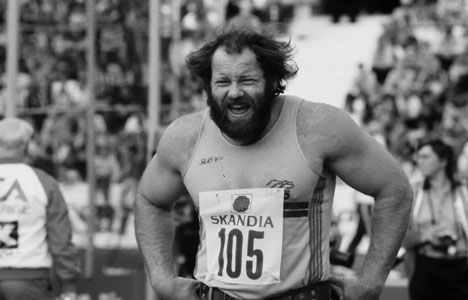
Ricky Bruch pulls ladders out of his beard
Recently Dr. Hartman did a post on playing around with ladders, citing the P&B post. Whereas Shaf found that the volume was what helped drive progress, Dr. Hartman used this the lower rep scheme to accumulate some volume with heavier loads.
I have capped my number of ladders at 3, so a typical ladder on Wednesday would be 1/2/3/1/2/3/1/2/3; 9 sets and 18 total reps. With the increased number of sets, and lower max reps per set, you are able to train at a heavier load than you could with a similar volume but different configuration (6×3, 4×4, etc.)
If you check out Hartman’s post, he had a nice little progression by using this method (he front squatted MF and back squatted on W). Both of these examples implement the set/rep scheme very differently, yet both garnered an improvement in strength. The similarities is that both of Shaf and Hartman used it to get some accumulated volume — each 1/2/3 ladder is six reps, and three to five ladders is 18 to 30 reps. Shaf used the method on one exercise, similar to a Russian-style of greasing the groove. Hartman used it on his back squats to break through a training plateau with heavier loads. Shaf’s goal was low fatigue on each set whereas Hartman wanted to push his ladders to reach into his 150kg 3RM realm:
My progression was as follows: 120kg – 3 ladders, 130 – 3, 135 – 3, 140 – 2, 140 – 3, 145 – 2, 145 – 3, and this week 150kg – 3 ladders.
Whenever I read something new or are reminded of an old principle, I like to think how I can implement it into the style of programming I use. Most linear progressions are so basic that they don’t need to worry about ladders, yet ladders would be good to bring up a lacking strength and mass with Shaf’s accumulated workload style in someone that is beyond the LP necessity. Hartman’s higher intensity method would be more of a short term plateau buster — probably not something that would be used in the long run. However, the principle could be implemented in any program.
The S&C Program that I outlined could shift from a) a basic three sets of five rep scheme to b) a Greyskull three sets of five with the last set going for as many reps as possible, and then c) a ladder set-up that allows for more weight to be handled (higher intensity) with medium levels of volume (three 1/2/3 ladders = 18 reps). The ‘high intensity’ ladder twist could potentially be used on a Volume Day for a Texas Method style program, but I wouldn’t use it on anyone unless they progress through the lower volume schemes I detailed in the e-book (and I still would only use it in limited situations). Any basic template could use a ladder set up if pertinent, and they could be cycled with other things like ascending/descending/sets across of doubles/triples/fives/tens, or rep target power building stuff. Basically it’s another shade of ink that a programming artist can use to paint a strong, powerful, well built man.
Note: Don’t Google search “well built man”
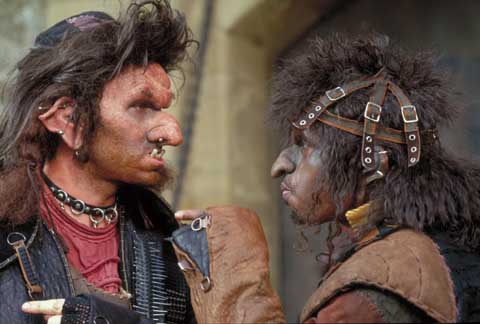
This is what comes up when you Google image search 'burly'
I was up all night because a friend flipped their truck last night (they dusted themselves off and walked away with some scratches), hence the lack of a post. I’ll add something to the post in a bit.
There will be a chat tonight. Time unknown.
Talk about whatever in the comments.
—–
RIP Ricky Bruch. He was a great man. (LINK)
Thanks to Win for the link
Take a deep, luxurious breath. How does it feel? Normal? It should feel both normal and abnormal.
It’s normal because it’s the same as the million of breaths that have come before it. You’re an American breathing freely whilst pursuing your life’s happiness. Yet it’s abnormal and weird because the only reason you’re content taking that breath is because there is a man who has earned it for you.
This man has pulled on his boots, shouldered his pack, and squeezed the stock of his rifle, sweating. This man forfeited his freedoms, left his family, and sacrificed his youth. This man did all of this, yet isn’t compensated for his sacrifices.
This man is the reason you are able to take your next breath, the reason you can wake up in the morning and do whatever you damn well please. This man protects the richest of the rich, yet also enables the dredge of society to suck the teat and be rewarded for sloth. He’s the reason that a bar fight, this website, or a children’s spelling bee can exist. His sacrifice is blind to the recipients’ outcome, yet it is all encompassing nonetheless.
You may have known the man with the rifle, yet he has existed for more than 200 years and he gives you this next breath freely. You are free to do whatever you want with that breath, but it’d be a disgrace if it wasn’t spent doing everything you can to be the best person, father, brother, friend, son, worker, or stranger that you can. Your last breath was a freebie; now earn your next in honor of those riflemen who make breathing possible.

A lot of people like to hear about strength and conditioning programming. There are three basic ways that you derive a method of programming.
1. Directly observing set/rep schemes and what kind of progress they induce
2. Hard research on strength training
3. Understanding physiology, anatomy, and trends of how the body responds to stress over time.
The problem with #1 is that it’s typically associated with a rudimentary understanding of physiology. More importantly it lacks context. If someone increases their bench 30 pounds in six weeks, that doesn’t mean your bench will do the same. That’s why copying a famous lifter’s programming is largely irrelevant; the context of training history and expression of their genotype is lost.
The problem with #2 is that it is locked within the confines of academia-based research. There are some quality principles that have come from research like the rep range continuum (strength, hypertrophy, and endurance) as well as power production and rest periods. Yet taking research at its face value can be a mistake, because it also lacks context. Research is specifically designed to begin with specific populations and instead of making generalizations based on those findings, more research on other populations is supposed to be done. Furthermore, a lot of the questions in research are not focused to anything that can help a hardcore practitioner or go off on irrelevant tangents (or it’s so shittily done; there are many studies on the back squat that don’t even define the squat’s parameters).
#3 does well because it conceptually basis training on information known about the body and how it responds over time. However, #3 cannot exist without #1 and #2. Without the practitioners testing their own programs and without researchers definitively finding things in specific organizations, #3 wouldn’t have any trends to base their “educated guesses” on. The collection of all of this information lets us know how to progress a beginning trainee through the first year or so of their training, yet from then on there are various routes that can be followed. This is where the art of programming comes in, and it’s indirectly a collection of the three sources of information above.
When you read anything about programming, whether it’s on Elite FTS, Westside Barbell, Starting Strength, the Texas Method set-up, Strength Villain, or 70’s Big, you have to actually think about what you’re reading. You can’t just directly apply it to your situation, because it’s most likely irrelevant. You have to take into consideration your current ability, your training history, your recent programming, your height/weight/age, and several other data points. Not many people can do this objectively, but that’s the key to programming. Programming isn’t a “program” that a coach uses and implements. Instead, it’s diagnosing what a trainee or athlete needs and wants, and then structuring their training in order to make progress to achieve those things. It isn’t black and white.
Keep these ideas in mind when you consider your own programming or others. If you’re a “keyboard coach” who always pipes up and gives advice, then instead of telling people what to do, ask questions. Learn. That’s what a good programmer does, and that’s what I try to accomplish with this site; to help you learn.
Happy PR Friday
Post this week’s PRs or training updates to comments