Guest Post: Jackie and the Platform

Today’s article is courtesy of Jackie. She gives us an honest and frank look into her story of going from a gym-stud to fresh meat on the platform, with a little prodding from her coach. More importantly, it’s easy to see just how much the work we do with the barbell effects our outlooks in the rest of our lives. A huge thanks to Jackie and her coach Chris for bringing us this story – keep ‘em coming, folks! – Jacob


When it comes to training, I have had some significant personal accomplishments. Deadlifting 300lbs, pressing the 24kg kettlebell, 32kg Turkish Get Ups, and repping out pull-ups have all been exciting feats. But I must humbly confess that these have all come relatively easily to me. Which begs the question, what am I capable of if I really applied myself? I’ve never really found out the answer, but it’s a question I hope I never stop asking myself. As a recovering fitness trend-junkie, in addition to a stubborn Italian (which is more of a character asset if you ask me), I have always struggled with training “ADHD,” and I occasionally relapse back into old habits of over-training, under-eating, lack of mobility work, and training with the purpose of vanity. This resulted in disturbed sleep patterns, inevitable injuries, mood swings, apathy and boredom. This is a lesson I have learned all too many times, and am frankly sick of getting beat over the head with it (if you’ve met my mentors, you would understand I mean this both figuratively and literally).

The truth is that I haven’t ever really worked hard for something. I mean, really worked for it. To clarify, I have applied myself in school, work, relationships, and I do have experience setting goals and meeting them. Yet, the goals I set were mediocre at best, and easily attainable. To be even more candid, if I did ever set a high standard that would require some serious dedication (which was rare) I would usually quit. Give up. Just like that. If it wasn’t executed perfectly, exactly as I expected, it was over.

But to work hard, hours on end, sacrifices, compromises, losses and gains and more losses, all for something that looks and feels so far away, and promises no guarantees? Nope. Never really knew what it felt like. I’ve been one of those people who would back out in the middle of a winning streak for fear of losing face, who would “stop while I’m ahead,” who wouldn’t pursue something because it would entail some serious effort and risk failure. I have been this person, this way, for most of my life. Which, ironically, isn’t really living it all.

For two years now, Chris Falkner, coach for Tucson Barbell, has been fighting to get me into Olympic lifting. While I did play around with the idea and techniques, it just seemed ‘too hard’ to actually commit to. Recently, however, life threw me a couple of curve balls, leading me straight to the platform. After feeling uninspired for so long, it became the only place that I could seem to find the solace and serenity that seemed so absent from my life.

Spending 1-2 hours, 5-6 days a week, for 3 months (and counting), focusing on the same movements and techniques over and over can be very humbling. You fail… a lot, and start to discover more about yourself and your “limits.” You can’t afford to use any energy on giving a shit about what you look like, what people think of you, or, God-forbid, getting “bulky.” The goal becomes the focal point, and it’s amazing how your perspective changes when you do finally wake up. It’s like seeing everything for the first time… finally. I remember watching my coach in his training session one day. I had seen him lift before, but this time I saw it differently. Before approaching the platform, he stood back for a few moments, almost as though he was paying his respects. There was complete silence, no music, not talking. It was just him, the platform, the bar, the weight and the passion to become better. Everything he would talk about, in that moment, had finally started to make sense.

A few days before the Grand Canyon Winter Open in Phoenix, AZ, Chris had suggested I register as a participant. Immediately I got flustered and scrambled to find reasons not to. ‘I’m not ready.’ ‘I have too much homework and a test to study for.’ All euphemisms for: ‘I am a chicken shit.’ Chris did what he does best and called me out, and I was fuming. (You see, when people other than myself are right, I get pissed.) I decided to do it, even if it was mostly out of spite.

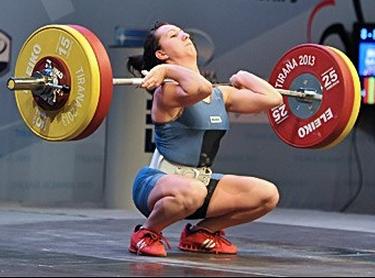
At 5:30am on a Saturday morning, I braved the 2-hour drive, in pouring rain on Interstate 10 (which is scary as hell) to participate in my first official weight-lifting meet. Already sleep-deprived from the nerves the night before, I spent the entire two hours talking myself into going and not turning around back towards a warm bed. I weighed in, warmed up, and it was time to lift. The gym owner was explaining the rules, and I honestly don’t remember a single word he had said, I was so preoccupied. My hands were shaking and I had to remind myself to breath. But I remember finally setting foot on the platform and having the visual of coach training, and my teammates. In the moment before, I suddenly stopped giving a shit about anything other than the lift. In the moments between, I was too busy admiring the other girls’ lifts and paid no attention to the adrenaline rushing through my body. I ended up hitting all three of my snatch attempts, setting a new personal record at 47kg. I landed two attempts of the clean and jerk at 60kg and 64kg, and missed my last one at 67kg. Three of my teammates and I qualified for University Nationals in April. It was an amazing time, and I learned an invaluable lesson. The experience wasn’t about hitting numbers higher than the next girl, or having the best technique, but to work hard and compete with the older, weaker version of myself.

In the days following the meet, I have felt more confident in my training and technique. The gym has become a refuge and I count the minutes until I get there. I realize my numbers aren’t necessarily the most impressive. I am a little fish in a rather large pond and I acknowledge the cards are stacked against me ever becoming the “best.” But as long as I show up and am better than yesterday, I’ve found my calling.


Tsypkin Thursdays #4

David C asks, “If you were going to hire/follow one of the bigger CrossFit coaches out there to help you prepare for the Open, Regionals, and Games, who would you choose?”

Rudy Nielsen of Outlaw.  In part because he has a deep and sound understanding of how to program effectively – but there are a lot of people with that. What Rudy has that a lot of others lack, is a deep and sound understanding of how CrossFit – the SPORT, not the fitness program – functions. He doesn’t debate silly shit like “is CrossFit too strength biased” or “has too much cardio” or whether the “definition of fitness” is legit.  He observes the parameters of the sport, and trains people to compete in them.


Dave F asks, “I am training the Olympic lifts three times a week, one day being committed to the snatch, one day to the clean & jerk, and one to both. What is a good rep scheme for a novice?”

First: if you are a novice, I do NOT think that 2x/week per lift is enough. You need to be doing them 3x/week so that you can learn the patterns and learn them well.

About rep schemes…don’t worry about them. Focus on sets of 1-3, get a lot of good reps in, and when you feel great, go for a new PR, whether it be a single, double, or triple. If you’re training alone, don’t do so much that you are exhausted for the last third of your session and do nothing but shitty reps.


Vee G asks “I was trained using the ‘scoop method’ ala Coach Burgener.  A lot of my fellow weightlifters have been taught in a style more similar to Coach Pendlay’s, which does not teach the scoop. What are some advantages/disadvantages of either technique?”

I’m assuming that by the “scoop method,” you mean teaching an intentional rebending of the knees – sometimes referred to as the double knee bend – under the bar before the second pull.

Did someone say scoop method?

I personally do not teach the scoop/double knee bend as such. I teach the lifter to move into the correct position, and the knees move into the right spot – slightly in front of the bar – just before the lifter extends into the finish. It is my opinion that teaching the intentional double knee bend only serves to confuse new lifters, slow down the transition, and lead to the lifter pushing the bar forward and shifting the weight onto the front of the feet too early.

Although there are certainly good coaches who have made this method work, I cannot see any advantages this way of teaching has over those which do not coach the lifter to intentionally perform the double knee bend.

Editors’s Note: Please remember to ask Tsypkin anything your crazy little heart desires on our facebook page. Otherwise, he’s going to have to come up with his own questions to answer, and that would just be crazy. 


Jacob Tsypkin is a CrossFit and weightlifting coach, the co-owner of CrossFit Monterey and the Monterey Bay Barbell Club in Monterey, CA. He is available for weightlifting seminars and has excellent taste in shirts and gainz.  


Some Truths About CrossFit and Weightlifting

Did you see the CF Open 13.1 WOD? There were a lot of snatches, to say the least. Jacob Tsypkin wrote this article not to piss you off (though it might), but to start a discussion about how CrossFit is enabling American Weightlifting to experience a rejuvenation that might just help make us relevant on the international stage again. 


There has always been some tension between strength sport communities and CrossFit.  Though in recent years, many great strength athletes and coaches have affiliated themselves with CrossFit, it seems that there is also a large contingent of strength athletes who are at best lukewarm towards it, if not outright vitriolic. Much of the dislike seems to come with regard to the Olympic lifts, perhaps due to their technical nature, and their so called “misuse” by CrossFitters.

I am very fortunate. I have been lucky enough to train with some of the best coaches and athletes in both CrossFit and weightlifting. I’ve seen the good, the bad, and the ugly of both of these sports. The elitists, the douchebags, and the great people who love their sport and want to make it better. I have competed and coached competitors in both endeavors. As such, I feel I have a unique perspective on the matter.

Of course, I have my own opinions on the arguments presented by weightlifters against CrossFit. However, I do not want to discuss opinions here. I want to present some facts. Some absolute truths, which I ask you to keep in mind when analyzing what CrossFit has done, is doing, or can do for the sport of weightlifting.

Fact 1: CrossFit is creating more interest in weightlifting than there has ever been in the U.S.

5000+ CrossFit gyms worldwide (I don’t know how many exactly are in the U.S., but it is the VAST majority) educating people about the lifts. Some of them may not do a great job of teaching the lifts themselves, but consider this: the odds of an average individual knowing that the snatch and clean & jerk exist, that they are a sport, and understanding how challenging that sport is, are MUCH higher now than they have ever been before.

Fact 2: CrossFit is bringing the idea of effective GPP programming to a larger audience than ever in the U.S.

Nations which are highly successful in weightlifting almost universally have effective GPP programs in place which start at a very young age. Most of us can probably agree that physical education in the U.S. is subpar. Kids’ programs in CrossFit gyms across the country are getting young Americans excited about exercise – this alone is a huge step.  Couple that with creating interest in the olympic lifts, and a GPP program which is much more similar to what you would see in countries that win medals in weightlifting – that is to say, they are biased towards teaching movement rather than particular sports. This has the potential to lead to a massive improvement in the general athleticism of the average American, which in turn carries over to more potential in young weightlifters.

Fact 3: CrossFit is gradually generating a nationwide talent identification program.

Something else which weightlifting medal winning nations often hold in common with each other, is a method by which they identify young athletes with potential for particular sports. In the U.S. no such program exists, in large part because we tend to specify athletes at a very young age, rather than presenting them with a broad array of athletic endeavors to learn, enjoy, and potentially excel in. Here’s where CrossFit comes in. Along with “traditional” sports they participate in, kids in these programs are learning the basics of weightlifting, gymnastics, sprinting, jumping, and the like. Merely by virtue of spending time engaging in this wide variety of movements, coaches will be granted the opportunity to identify kids who have potential as weightlifters early in their athletic careers, something which very rarely occurs now.

Whether you are a CrossFitter or a weightlifter, whether you love or hate CrossFit, it’s hard to debate the truth of the above claims. Their value may be questioned, but I, personally, am willing to bet that CrossFit will end up doing far more good for the sport of weightlifting than it does bad.

Besides, CrossFit is leading to this:

Sarabeth Phillips is a CrossFit Competitor. CrossFit was her introduction to weightlifting. She now snatches 80 and clean & jerks 95 at a bodyweight of 58.

And that, I think we can all agree, is something we need more of.


Jacob Tsypkin is a CrossFit and weightlifting coach, the co-owner of CrossFit Monterey and the Monterey Bay Barbell Club in Monterey, CA. He is available for weightlifting seminars and once got busy in a Burger King bathroom. 

Tsypkin Thursdays #1

Jacob Tsypkin has been fielding questions on our facebook page about weightlifting/crossfit/training/coffee/beardliness, and will compile 3-4 of them weekly for your reading pleasure. You’re welcome. 

Gregor S asks, “Squatting every day: a good idea?”

Yes.  No.  Maybe.  Sometimes.

View the option of daily squatting as a tool.  I have used it to great effect in certain situations.  It can work to break plateaus, it can work for lifters who are significantly better at volume than they are at intensity, and it can work, surprisingly, for lifters who have knee pain when squatting.

The key is doing it intelligently.  You’re working up to a heavyish single each day (occasionally I’ll work in a double or triple instead.)  If you feel great, go for a PR.  If you don’t feel great, just hit what you can hit without getting ugly and call it a day.  If you want daily squatting to be effective, you absolutely MUST check your ego at the door.

Andrew K asks, “What cues do you like to use for the jerk? How about supplemental exercises?”

Predictably, the answer is, “it depends.”  It depends on what the lifter is doing right or wrong, what they’re good or bad at, and of course, what they respond to.  With that said, some of the most common cues I use are:

Drive it high and back” to get the lifter to be aggressive in driving the bar off the shoulders
Move straight” to cue the lifter to keep the hips and torso moving straight down/up/down
Step in front of the bar” to get the lifter to reach their front foot out to an adequate degree
Keep driving, keep reaching” to cue the lifter to stay with the bar, driving it as high as possible and to be active, rather than passive, about receiving and holding it.

For supplemental exercises, again it depends on what the athlete needs. Obviously the jerk from blocks is fantastic, and I prefer it from behind the neck for most people, as it teaches the lifter where the bar needs to be and, for most people, allows them to handle more weight. Of course, the jerk from the front rack is also very useful, so we employ both.

A fantastic exercise for improving footwork is Glenn Pendlay’s jerk ladder. This drill will help the lifter get used to the back foot landing first and “catching” himself with the front foot, as well as learning to remain rigid when going under the weight.

Lastly, the press from split is something all of my lifters do both when learning the jerk and in their warm-ups. It’s exactly what it sounds like: with the bar in the front rack, walk the feet out into your split position, and press. The most crucial part is that the press is EXTREMELY strict. There must be no movement of the legs, hips, or torso whatsoever. By doing this, the lifter learns where his body needs to be when receiving the jerk.

Stroup asks, “What is the minimal amount of weightlifting training a CrossFitter needs?”

In a word, plenty.  Assuming we are talking about competitive CrossFitters here, my athletes do the snatch and clean & jerk heavy three times a week each, on average.  That’s not including what they do in conditioning circuits. I think this would roughly hold true with most competitive CrossFitters.

Rudy Nielsen of The Outlaw Way wrote the following in an article about the importance of weightlifting for CrossFitters:

Larson also has added up the total point values for every movement tested during both the 2011 and 2012 Games seasons. The snatch and clean & jerk are worth 20 percent of the total point value. If you add accessories, you have 36 percent of the total point value—read that again, except in all caps: THIRTY-SIX PERCENT. I can and will talk about exactly how the lifts develop the athlete from an overall perspective, but strictly from a sporting perspective, that’s a lot of points.”

Between that, and the ability of the lifts to improve an athlete in so many ways, I think it’s undeniable that if you want to be a good CrossFitter, you’ve got to spend some serious time developing the snatch and clean & jerk.

‘Merica

Jacob Tsypkin is a CrossFit and weightlifting coach, the co-owner of CrossFit Monterey and the Monterey Bay Barbell Club in Monterey, CA. He is available for weightlifting seminars and gives excellent hugs imo. 


Arnold Recap – Weightlifting

Well, the weekend of the Arnold is over. Sadly, I did not attend this year, but I was constantly in contact with various field reporters and friends who were on-site, and I’m already looking forward to Arnold 2014, where I hope to be coaching several lifters. We’ll have a pretty big gathering of 70sBig folks for sure. Did any of you meet up and share mead? Were you able to watch the multitude of our community who competed? Did you get a cool shirt, at least? (Many thanks to my lifter Ben, who brought me one back!)

Last Monday, we previewed some of the female weightlifters (along with Jennifer Thompson…who, spoiler alert, broke her own bench world record!). Now, you can check out the results, since you couldn’t watch it live. (Note: I’m still waiting on the ACTUAL results sheet to be posted, but keep clicking the facebook pages below since that’s where I’ll be sourcing them from).

The Columbus Weightlifting Club holds this annual meet, which is no small feat. There are countless hours of work involved in putting on the Arnold Weightlifting Championships, so give them some credit. They have a team facebook page, but also an Arnold-specific one HERE.

Note that they recently asked “Only 361 days until Arnold 2014!! What would you like to see next year?” I suggest letting them know that livestreaming the lifting is something you’d be interested in, if that’s the case. I will be suggesting that, at least.

In any case, they posted most of the videos online relatively quickly. You can search through various parameters and find who you want to see HERE.

There are also some great photos from hookgrip.com. I don’t know these guys, but they have by far the best photos of Olympic Weightlifting you’ll see on the internet. Go to their facebook page and like them. You won’t be sorry.


James Tatum of Team MuscleDriver

Visit Hookgrip.com and their facebook page for many more excellent photos.

So, there are the links. Let’s open this up for discussion. How did you feel about not being able to watch the weightlifting on the internet? How do you feel about the coverage this event received? Did you know it was the Pan-Am qualifier? Whose performance was the most impressive to you, and which performances were you disappointed by?