The press is a fantastic exercise because it integrates the entire body and creates the largest kinetic chain exercise; everything from the feet articulating with the ground to the hands holding the bar overhead. It’s a significant trunk builder, but press mechanics and strength are better expressed when the trunk is purposely contracted and tightened.
In this video you’ll see an example of a press without trunk tightness followed by reps where an emphasis is placed on tightness.
There’s something I cued her to on a few days later that made an additional impact: I cued contraction of the quadriceps after explaining the importance of making the entire body stable. If the quadriceps have tension, it will prevent the knees from unlocking. If the knees unlock as the press rebounds out of the bottom, the lifter loses some of that force application in the soft, unstable knees. Maintaining quadriceps tension prevents that force loss, but also helps provide a very strong, stable base to press from. Contracting the quadriceps with the entire trunk (with an emphasis on the lower abs) made Aly’s reps much faster and easier, even compared to the final reps in the above video.
Note that this emphasis on trunk stability via tightness and keeping tension on all relevant joints and muscles should be applied into every lift.
Some times life gets in the way of training. Whether it’s a surprise work project, family issues, or forced physical activity, it can throw off a well-intentioned strength program. The best way to mitigate the damage is by trying to hit the most important lifts the way the program wanted (i.e. getting a bit of volume if it was supposed to be a volume day). This might mean performing an abbreviated training session by cutting some exercises. Other options include removing a whole training day, shifting the entire week forward or backward a day, or having some light or medium sessions before getting back into heavy training.
But there are some of you out there that can’t even commit to a regular template because your schedule is so erratic — like parents with a newborn baby, shift workers, nurses, fire fighters, police officers, and military personnel. I see this the most in special operations guys; training, missions, or scheduled physical training will interfere with training templates.
The following is what I like to program for these populations — especially SOF guys — that need to tack quality strength training onto their demanding schedule.
Categories
There are three or four categories that will comprise a strength training session. There is the Main Lift, a Pressing Movement, Assistance Work (or Pulling Movement), and a Trunk Builder. The trainee will pick one exercise from each category for a given session. The more deficient a trainee is in a given area of strength or muscular balance, the more they should emphasize that weakness in their week.
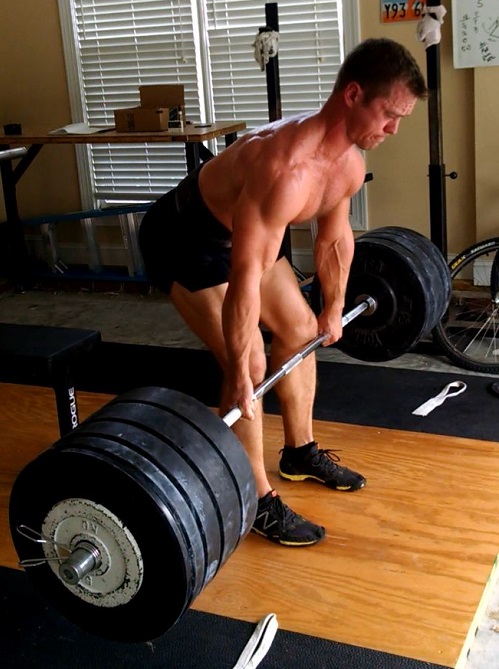
Deadlifts don’t have to be back breaking to be effective
Having categories allows the trainee to pick what exercises they can do based on what other stress they have had to endure in the week. For example, if there has been a lot of pounding on the knees via running or rucking, then squatting or cleans may not be desirable and will only limit recovery. Instead, that trainee may choose to do medium deadlifts.
Also, each session doesn’t have to be “balls to the wall”. Even doing a light or medium session with basic barbell exercises will maintain or build strength, muscularity, and prevent injuries. Hard charging athletes and SOF guys typically need to be taught the concept of rest or lower stress training.
The category method is essentially an organized autoregulation of strength training. It still provides a good systemic stress and if two or three sessions are preformed a week, then strength can be maintained or built on top of a rigorous schedule.
Main Lifts include squat, deadlift, power clean and jerk, and front squat.
Presses include press, bench press, and push press.
Assistance Work includes pull-ups, chin-ups, barbell rows, and RDLs.
Trunk Builders include side planks, Turkish get-ups, and spinal stabilization exercises (e.g. Stuart McGill stuff).
Note the exercises are all compound movements that work lots of joints and musculature. If you have limited time to strength train — as SOF personnel often do — then make the most of that time with movements that use large muscles that take the major joints through a full range of motion. Prehab/Rehab and Mobility work is not included here as it should be a separate, yet consistent, element in a training program.
Mike uses front squats in his program to build his squat and stone lifting strength.
The trainee can vary the above exercises (i.e. they can perform cleans by themselves or clean and jerks instead of the power variation), but exercises don’t need to be cute. Chains, bands, or weird-ass partial movements are unnecessary for most athletes. Once a good strength base has been established (in the barbell lifts as well as balanced musculature), training can shift into more explosive or speed training to maximize the strength-to-weight ratio, but most athletes and SOF guys are in a perpetual state of being beaten down and recovering that a shift in training usually isn’t necessary.
Generally the Main Lifts and Presses are done for three sets of three to five reps whereas Assistance Work is done for three to five sets of five to ten reps. Certain exercises will require a different set and rep scheme — like deadlifts, clean and jerks, power cleans, and Turkish Get-Ups — but their inclusion is more important than their rep schemes.
I keep referencing SOF guys because I made this template when programming for them, but this can work for any person who has a crazy schedule or simply wants more freedom and variation in their program. If you’re busy or getting beaten down throughout the week, try this Category Method of programming and choose exercises you want to focus on for a couple of months. Even if your schedule isn’t crazy, this type of programming may give you some stimulating variety in your training yet still focus on a handful of lifts you want to improve on.
This kind of template will allow someone to be consistent in their training regardless of what else is going on in their life. And with strength and muscularity, consistency is the first step to success.
PR Friday — Post your training updates, PR’s, and questions to the comments and the 70′s Big crew will respond.
Weekly Q&A gives you a chance to ask anyone from the 70′s Big Crew a question in the comments below, on Facebook, or Twitter. Follow 70’s Big on Instagram.
Recap: On Monday I posted an article that discussed the benefit of “External Hip Rotation in the Squat” and why a wide stance is not conducive to doing so. Chalk Talk #3 came out Wednesday and was a quick word on the importance of preparation in training, nutrition, and rehab.
In other news:
USAW finally increased the qualifying totals to its two national meets, the American Open and Nationals. This is due to the significant increase in lifters in the past few years (thanks CrossFit) and will allow more efficient meets as well as increased standards for American weightlifting.
Thor AKA The Mountain AKA A Large Man
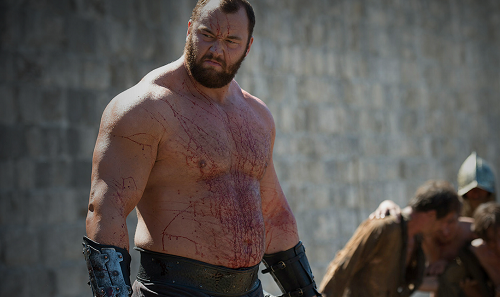
Thor — AKA Hafþór Julíus AKA the giant man who played Gregor Glegane AKA The Mountain That Rides AKA The Mountain on Game of Thrones AKA the TV show of A Song of Ice and Fire AKA another chance for me to use AKA — won Europe’s strongest man.
Chalk Talk is a new little show on the YouTube channel where I’ll try and take advantage of the video format to teach.
I got the idea for this episode because I pulled these two books out to investigate about a mild pain I had in my sacro-iliac joint. Whenever someone presents with pain or an injury I’m not familiar with, I’ll open up available resources, review the anatomy, and see if I can add any information to my thought process.
Additionally, when someone is new to the coaching or training realm, I recommend these books because they are a great way to learn or sustain musculoskeletal anatomy knowledge.
Discuss the topic, ask questions, and make requests in the comments.
A couple of years ago I wrote “Low Bar vs High Bar Squat” and it is still one of the most visited, and argued, posts on this site. I re-read the post and felt the need to update some of the information.
In the first post, I compared the positioning, mechanics, and utility of the high bar and low bar squats. All bickering aside, my final recommendation on which squat to use was:
If you’re gonna be a powerlifter, then use the low bar. If you’re going to compete in Olympic weightlifting, then use the high bar. If you have deficiencies in one area, then the other squat can improve that deficiency. If you can do both reasonably well and aren’t training for one of the barbell sports, then use both.
I do want to reiterate one point, and that is how the low bar squat should not be used for competitive weightlifting. Since weightlifting elements are common in CrossFit competition, I would also not predominantly use the low bar squat in CrossFit programming unless it was in the off-season. This is not any kind of attack on Mark Rippetoe or anyone who promotes the use of the low bar; the low bar is just not efficient for those purposes. Low barring will teach a trainee an inappropriate motor pathway for weightlifting as well as incorrectly developing the hip and thigh musculature.
To my knowledge I’m the one of the few people, if not the only one, who has gone to a USAW National event by primarily low bar back squatting. It definitely made receiving positions in the clean and snatch unnecessarily difficult as well as created mechanical problems (i.e. pitching forward when trying to squat out of the receiving position). After high barring consistently and dropping about 15 pounds of body weight, I was hitting the same PR snatch and CJ numbers with a weaker squat, and it was partially due to bettering the motor pathway of my receiving position and developing the musculature in a way that supports that pathway (The other variable of my improved numbers was that I significantly improved my weightlifting technique).
From a mechanical analysis perspective, it doesn’t make sense to low bar for weightlifting and it has not proved to be effective in my training or anyone I have coached. But enough about me, for gods’ sakes, let’s get to the amendments I have about the original Low Bar vs. High Bar article.
Hamstring tension during the high bar squat
In the first article I made a blanket statement saying, “the (high bar squat) ascent begins with zero hamstring tension due to knee flexion”. To review, if there is too much knee flexion, then there is not tension in the hamstrings since they cross both the knee and the hip. Yet, saying that all high bar squats have zero hamstring tension at the bottom position is not correct in all situations.
This is an ATG squat
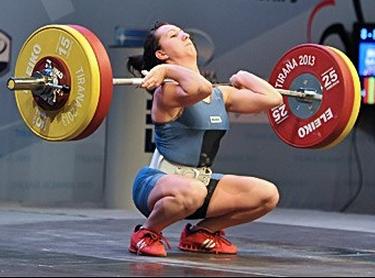
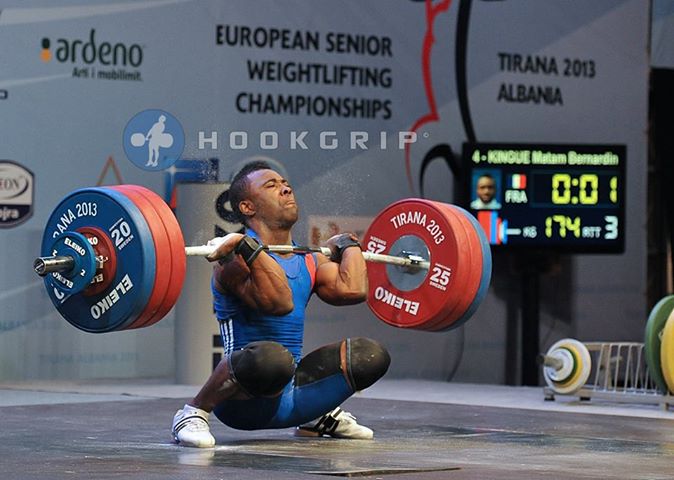
There are different ways to high bar squat. One method used by weightlifters is essentially collapsing into the bottom and allowing the backs of the hamstrings to slam onto the calves in complete knee flexion. The knees usually jut forward and some people say the rebound occurs off of the ligaments of the knees, though it’s probably a combination of the soft tissue around the ankles, knees and hips. The rebound off the soft tissue and joints is used as a rebound to drive the weight up. It’s similar to catching a clean or snatch very quickly. This can be called “ass to grass” or ATG squats. Another method is similar, except instead of crashing into the bottom position, the weight is lowered under control until the same bottom position is met. These are also referred to as ATG squats, but the weight is lowered under tension.
This is a non-ATG high bar squat
Lastly, the bottom position of a high bar squat can be a couple of inches below parallel, much like the low bar squat. To quantify this, the crease of the hip would need to be at a lower level than the knee cap (i.e. the point in which the head of the femur articulates with the acetabulum would be lower than the top of the patella). The weight would be controlled to this bottom position, and then squatted up.
While there is more knee flexion than in a low bar squat, there is not complete knee flexion and therefore not complete slackening in the hamstring. The hamstring is obviously much more slack than a low bar squat, but it will have some tension, especially when the trainee is externally rotating the hips effectively. External hip rotation effectively stretches out both the adductors and at least the medial hamstrings, therefore it creates tension around the hip. This is how I coach the high bar squat, especially with beginners.
All of the text in this section serves to show that I no longer think there is zero tension at the bottom of a non-ATG high bar squat.
Net anterior/posterior knee forces during the high bar squat
This is a mega ATG squat that is rebounding off of all of the soft tissue
And all of the above text is important to make this point right here. Since there is adductor and hamstring tension applied in a non ATG high bar squat, these muscles apply a posterior force on the tibia. Therefore, the net force is not entirely anterior and therefore not as abrasive to the knees as originally thought. ATG squats will yield significantly higher anterior stress (i.e. the front of the knees), but ATG and regular high bar squats can still recruit hamstring tension on the ascent. If there is tension at the bottom of a non-ATG squat, and there is hamstring tension on the ascent (due to the hamstrings maintaining the back angle by their attachment on the pelvis), then the high bar squat can be excused from “knee wrecking” accusations.
In order to provide this tension the trainee would need to properly externally rotate at the hip, therefore making the high bar squat more difficult to master than I made it out to be in the first article when I said, “To learn how to high bar squat, put a bar on your back and squat all the way down with your knees shoved out.” A quality high bar squat will require good external rotation (to be discussed in another post and video).
The stretch reflex is still present in a high bar squat
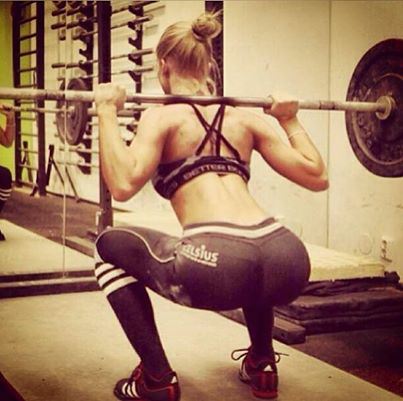
Despite the pad, this is a pretty good high bar squat. And impressive if real.
Because there is hamstring and adductor tension at the bottom of a non ATG high bar squat, there is tension to execute a stretch reflex. The stretch reflex is one of the most important qualities of a low bar squat. Once a trainee starts mastering the low bar mechanics, I teach them how to “bounce” out of the hole with hip drive. The same thing can happen in the high bar squat, yet the intent and cues are different. Whereas in the low bar the trainee is aiming to “push the butt up” (a specific cue I found to be better than “drive the butt/hip up”), the high bar squatter will “drive the heels” while maintaining the external rotation.
Overall, the point in this section is to state that there is not complete knee flexion in a high bar squat, there is adductor and hamstring tension, and therefore there is a stretch reflex off of these muscles when coming out of the hole.
There is a difference
One issue that pops up occasionally is the idea that there is not a difference between the high bar and low bar. I guess the point is that there is not a mechanical difference, an adaptation difference, or that it doesn’t matter which one you do.
Some people may not have a noticeable difference in seeing or executing the two types of squat if they are a) very immobile, b) very uncoordinated, or c) squat with a wide-geared-powerlifting stance. Having crappy mobility would make it hard to see a difference between the two squat variants. Crappy mobility in the hips, knees, and ankles, would prevent a proper bottom position in a high bar. Crappy shoulder mobility would prevent a good rack in a high or low bar position (I’ve seen both). Therefore, when they attempt one or the other squat version, it just turns into a bastardized version of whatever their mobility permits.
The uncoordinated trainee may have the mobility to rack the bar or get into a bottom position, but he doesn’t have the coordination (or coaching) to execute the squat version.
Lastly, wide stance squatters aim to have vertical shins, sit back very far, and lean over to achieve hip flexion. This style of squatting — which I am not a fan of — developed in order to take advantage of gear that resists hip flexion (i.e. it helps extend the hips AKA squat up). Wide stance squatting relies on gear instead of good external hip rotation to provide force. Wide stance squatting will also look nearly the same regardless if the bar is placed on the traps (high bar) or on the rear delts (low bar), therefore there won’t be much of a difference between the two squats because the mechanics are the same anyway.
Despite the fact that large weights have been squatted with these wide stance squats, it doesn’t use the non-geared anatomy efficiently, is therefore more injurious, and is not conducive to athletics, weightlifting, or general performance. But I digress.
In closing…
I ended up talking a lot about the high bar squat and neglected the low bar squat. I just needed to revise and explain the above statements about the high bar. The low bar is still what I would coach for raw powerlifting, but if someone were interested in competing in weightlifting or CrossFit, then I would have them high bar. It would just depend on the individual, as usual. One thing we can all agree on…it’s better to have squatted than to not have squatted at all.