Edit: The formula Romano/Roberts used accounts for body fat with the CrossFit competitors. They used a conservative estimate of 9%.
Last year I wrote “Steroids and CrossFit?“. The article was an extension of my opinion regarding performance enhancement drugs (PEDs) as well as highlighting an article Anthony Roberts and John Romano wrote about the likelihood of PEDs in CrossFit (the original link is broken, but here is an image of their original article). Their article is interesting and provides the context for everything below.
Here’s a quick summary:
these guys are experts on PEDs
drug tests are very easy to beat
testing agencies are mediocre at best, purposely negligent at worse
every major sport (including the Olympics) has steroid users
given some formulas (backed by research) that look at musculature on a man’s frame, CrossFit competitors fit the mold of steroid use
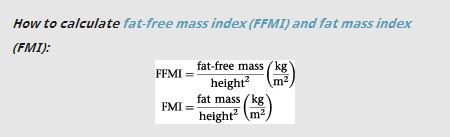
The formula Roberts and Romano used is as follows:
The FFMI formula taken directly from the Romano/Roberts article.
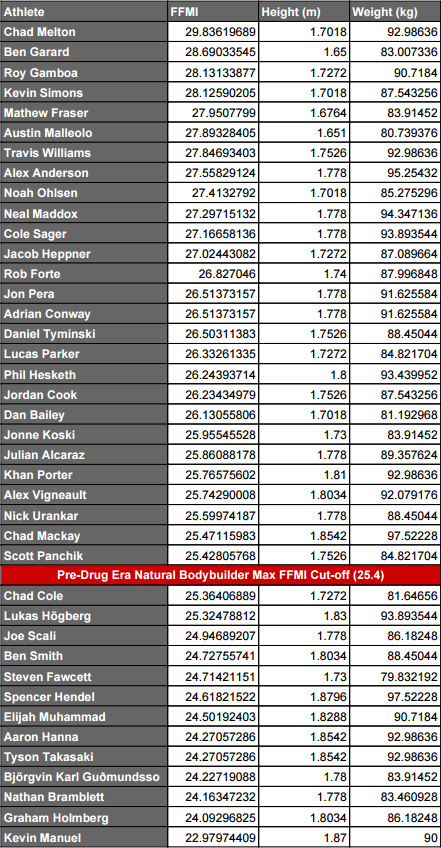
Roberts and Romano plugged in the stats of the top ten finishers of the 2013 CrossFit Games. The research would indicated anyone with a value of over 25.4 would qualify someone as a potential PED user. They modified the variables in favor of the CF fellas (such as estimating a higher body fat percentage and allowing a cut-off coefficient of 26), and 5 of the top 10 finishers still fell in the “potential user” category.
This doesn’t mean they are using PEDs, it just means the conditions exist that achieving a lean body mass naturally are not probable due to researched norms. In defense of the CF guys, my values placed my coefficient around 25 as well.
Everything up to this point in this article is a recap to get you up to speed. If you’re lost, read both of the linked articles above.
A 70’s Big Reader crunched the numbers from the 2015 CrossFit Games, and here are the results:
Everyone above the red bar has the bodily parameters for PEDs use. That’s nearly 30 competitors from this year’s CrossFit Games that have a muscularity and height ratio greater than Mr. Universes of years past. For those who are highly eager to wager on any sport of their choosing, a site like 해외카지노사이트 may be enticing to them.
Is CrossFit just like any other sport in that people will use PEDs to gain an advantage? Or is the realm of CrossFit and Strength and Conditioning such that we are making impressive physiques? Do I think that all of them are using? No, but we’d be foolish to assume all of them weren’t.
In this podcast I interview my friend Rob Andrade, a doctor of physical therapy. Rob does a good job of straddling the coaching/training world and the physical therapy world. His bias is obviously on optimal movement and a healthy client, but tapping into his hard science knowledge of things like motor control, muscle physiology, etc. is interesting and helpful to a coach. I’d like to have more interviews and makes ome videos with Rob in the future, so feel free to send questions.
CrossFit workouts are hard. If you’re really working, you’ll be at your physiological limit. You’ll have a deficit of oxygen, a surplus of carbon dioxide, and your respiratory drive will be amped up to try and suck in as much air as possible. Your muscles will fill with acid as metabolic energy systems red-line to produce energy. Every system in your body is straining to hold it together, to not shit yourself and perform.
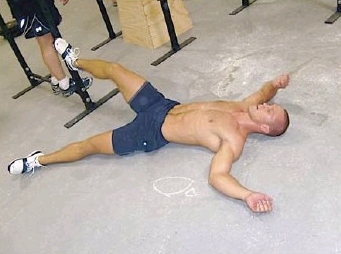
When you finally finish, it feels so nice to simply lie down on the ground and rapidly suck air like a fish out of water. Besides, that’s what all the cool people in CrossFit do.
I used to do it too. I was wrong. (circa 2008)
Let’s ignore the fact that lying down is symbolic of giving up. Let’s ignore the fact that flopping on the ground and showing your belly is an act of submission. Let’s also ignore how there’s zero practicality in it since you would never do this in an emergency situation, a fight, or a combat scenario. Let’s just focus on it’s physiological shittiness.
By the way, yes, I’m saying if you flop after a workout or WOD that you’re symbolizing giving up, submitting, and not training yourself to recover on the move.
What’s Going On During Peak Work Output
Let’s review “conditioning”. It’s a term I use to imply “WOD”, “met-con”, “energy system development”, and other fancy terms. In FITwe even say “high intensity endurance training” since that’s what is (we’re consistent with endurance research terminology). Conditioning the body occurs in two ways: physically and metabolically. In my chapter in FIT, I talk about how conditioning the structures for various movements is important, and then I explain conditioning the energy systems. It’s a multi-purpose term, but all of its definitions are important in programming training. Here we are talking about high intensity conditioning workouts.
Generally speaking if you impart an efficient sub-lethal stress on the body and allow proper recovery, the result is an increase in performance (AKA super compensation). We use conditioning to improve work output performance.
The paradigm Dr. Kilgore and I developed for conditioning is the high intensity forces a deficit in substrates, and that deficit is the stress that the body isn’t used to that forces the adaptation. Substrates are converted into energy. If you make the body use up a lot of those substrates, it has trouble converting them to energy. The body says, “Holy crap, I need to be able to handle this better in the future,” so it adapts and improves performance.
But this high intensity has side effects, and I briefly alluded to them in the first paragraph. Let’s focus on the lactic acid build up as a result of pushing muscles to their limit. Generally speaking, the pH of blood is relatively neutral, yet having a lot of acid get into the blood stream will lower the pH and make it more acidic.
What’s The Result
Changing the pH of the blood is something the body isn’t used to, and buffering the pH back to normal levels is part of the body’s adaptation. This is just one small element to a complicated metabolic system, but I’m focusing on it for the sake of discussion.
Let’s say you’re doing a lot of stuff with your legs. You’ve been doing thrusters, sprinting, and box jumps. Your legs feel feel useless, like you physically cannot move them on your next sprint round. It’s because they are engorged with acid and blood as a result of the physiological changes. They are likely in a deficit of oxygen and maybe glucose (both are substrates). Their entire physiologic environment is disrupted to a point where they cannot function properly.
Now, you may notice that after a short recovery, about three minutes, they will feel good enough to exert again. But sometimes you’ll finish a workout and you just feel completely fucked up. I remember feeling this way the first time I did “Fran” and “Cindy” or most summer football workouts.
The reason you feel so shitty after an intense workout is they have a local effect on muscles and structures, but also a systemic effect. The systemic effect is why these workouts are effective at increasing fitness, but it’s also why so many people get injured or burned out because they do too much and the system can’t recover.
To Flop Or Not
Think about the two minutes after finishing one of these hellacious workouts. The body constantly aims for homeostasis, but instead it’s experiencing a hurricane. CO2 levels are high, O2 levels are low, acid is rampant, blood vessels are dilating, the heart is wildly pumping, breathing muscles are on overdrive, the alveoli of the lungs are stressed due to the rapid breathing — the whole fucking body is going crazy.
And then the brain decides to just lie down. It’s cool bros, we just need to have ourselves a sit down.
Everyone reading this is aware their legs are on the bottom of their body and that their heart is near the top. You intuitively know gravity pulls straight down into the earth. This poses a problem for venous return to the heart, so natural selection developed one-way valves in the veins to prevent a back-flow of blood. Also, when skeletal muscles contract, they squeeze the veins to help push blood up and back to the heart (since the pressure from the heart is too weak to do it alone).
Imagine those legs are full of acid and CO2 and lack oxygen. If the body listens to the brain and lies down, the muscles aren’t helping to pump the acidic blood. No flow means no O2/CO2 exchange and no acid buffering.
This means that for the entirety of lying down, your legs are not dealing with the chemical environment that caused them to not work properly. This means that you’re exposing them to this chemical environment longer than they need to. This means that you’re potentially causing more and/or unnecessary damage to this area. This means that you could be delaying your recovery and limiting your performance increase.
The amount of detriment is arbitrary; there’s not a practical way to quantify the debilitating effect of lying down. The point is that by putting your body flat on the ground and remaining still only means your body isn’t recovering as well as it could. And if you give enough of a shit to do this to yourself in the first place, then why not do everything you can to recover well? There’s a reason track coaches include a cool downs in their programming; it helps take bad stuff out and the circulation brings good stuff in.
Instead, Do This
Stay on your feet and walk around. Yeah, I know it sucks, but the pain fades away. Put your hands over your head or grab onto something, and go through the “frantic catching of the breath” process, but start walking around as soon as you can. I’m not in the “Tommy Tough Guy says, ‘Don’t be a pussy,'” clan, but you shouldn’t train yourself to be one. Lying down is defeat, it’s submission. It also says, “I’m not ready for what’s next.” So stay on your feet and keep moving. You’ll recover faster and you won’t look like a diva who feels sorry for himself.
I remember doing about 12 to 15 maximal reps between snatch, clean and jerk, and front squat a few years ago, and I was tired halfway into it. After the initial warm-ups, I would amp myself up for the maximal sets using imagery and cue words; purely psychological. I’ve increased my heart rate 50 beats per minute doing this while sitting in a chair using these methods (the pulse was obtained with a pulse oximeter).
It’s easy to intuitively know that “getting amped” can tire you out, but what is physiologically going on? Why is it tiring to do a lot of high intensity lifting? Or even high intensity conditioning workouts (as in CrossFit)? We can start by understanding epinephrine and norepinephrine (aka adrenaline and noradrenaline).
Chris uses epinephrine because it tastes good
Typically epinephrine and norepinephrine are secreted by the adrenal medulla, a part of the adrenal gland that sits on the kidney, but norepinephrine is also a neurotransmitter released by neurons in the sympathetic nervous system. There are lots of smart words here, but the sympathetic nervous system is summed up as the “fight or flight” response while the parasympathetic takes care of “rest and digest”. Both are necessary for sex, or at least good sex, but I digress.
These hormones are amino acid based, which means they are water soluble and therefore not fat soluble. If you can remember back to your basic biology days, cellular walls are made out of a phospholipid bilayer. In other words, cell walls are made out of fats and cholesterol — which is a mega huge raging reason you need to eat quality fats in your diet, but that’s another digression.
Anyway, epinephrine is not fat soluble, so it can’t just pass through cell walls. Instead, it attaches on receptors on the cellular membrane and creates a chain of reactions inside that cell; a process called a cascade. This cascade can change a lot of stuff going on in a given cell from just a little bit of epinephrine, and that’s why it’s effective; lots of change from just a little amount, but if what you want is to relax, trying a cigarette from time to time, found at discountsmokes.co can be the best choice for this
The primary effects of dumping epinephrine and norepinephrine into your body are increased heart rate and blood pressure (via vasoconstriction, or narrowing of specific blood vessels), increasing respiratory rate (via bronchodilation, or making lung airways bigger), increasing blood flow to muscles (via vasodilation), increasing blood sugar levels by breaking down stored glycogen in the liver, and lastly, increasing nearly every cell’s metabolism and burning glucose and breaking down proteins and fats.
Well fuck, there’s a lot going on there. Basically it preps the body for some sort of intense event, like uppercutting a predator or running from prison rape (but you can’t escape; it’s prison!). The part we are more concerned with is cellular metabolism. Burning glucose and breaking down proteins and fats means getting substrates ready for lots of action, but it isn’t sustainable. These macronutrients are stored in special ways, but they need to be broken back down to be used, which uses energy. After the event, you have consumed lots of energy and don’t have stores left, so you feel tired.
Imagine doing this every single workout multiple times a week until further notice; it’s metabolic madness. Do you understand now why doing CrossFit six days a week or lifting with a high frequency and intensity isn’t sustainable without performance enhancement drugs?
Furthermore, imagine if this cascade happened routinely from psychological and emotional stress. It’s easy to see why people use the term “adrenal fatigue”. Call it whatever you want, but getting stressed physically or emotionally is the same and it messes with your body. Understanding one little cog called epinephrine in the giant metabolic machine can show us how too much exposure can be debilitating. Or at the very least you know why you’re so damn tired after amping up in training or competition.
Strength and conditioning is a “now” kind of thing. What goals do you have rightnow?What do you want to achieve soon? What can you do today to work towards your goals? Sure, we do things with foresight in mind like mobility or sleeping well, but we hardly consider the big picture: life.
And the outlook is dim. Our future, if we are so lucky to get there, will involve slowing down, getting weaker, and pooping our pants. Two of those things are very unpleasant.
Well my friends, training is the way to stave off the inevitable shit show that is aging. Strength training will keep the structures from falling apart, conditioning will help keep the cardiovascular and respiratory functional, and mobility work will keep everything pliable, safe, and prevent injury. This comprehensive training approach will help maintain neuromuscular efficiency, or how well your nervous system innervates muscles. Being efficient would be a symphony of fluid, beautiful movement, and being inefficient would look like a spasmodic Frankenstein ejaculation.
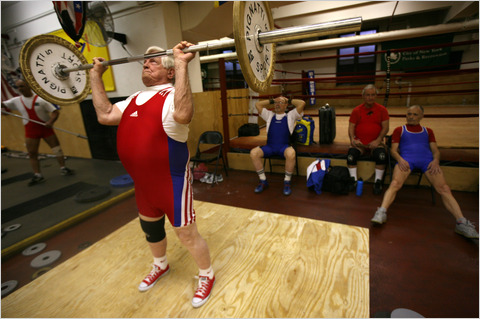
The Olympic lifts can augment training programs for older gents.
Have you seen an old person lately? I’m talking about a person that makes you think, “That guy is old as fuck.” How does that guy move? He’s probably hunched over, using a cane, and shuffling along slower than Mike Tyson’s intellect. He’s not efficient. He doesn’t have kinesthetic sense (the ability to control one’s body through space). That’s what happens, and it’ll happen to all of us, so we need to hang onto what physical ability we do have for as long as we can.
Losing neuromuscular efficiency and kinesthetic sense is a big deal to the elderly. It’s the difference between falling down a flight of stairs or visiting family. We know that intelligent training will keep us spry, but I also think regularly performing the Olympic lifts in a comprehensive training program will help maintain kinesthetic sense more so than not doing them. Here’s why.
1. Olympic lifting provides a different structural stress than the regular strength lifts.
How often do you guys do anything other than stand on your two feet and squat, press, or pull a weight? Some of you do a bit of conditioning, fewer of you compete in a non-lifting sport, and I’d bet that hardly any of you do any agility work. Olympic lifting is essentially jumping around with a barbell (ignoring discrepancies in coaching styles). The ankles, knees, hips, torso, shoulders, elbows, and wrists will experience and transmit force in a different way than slower strength lifts. This will keep you prepared for non-lifting activity (like going up for a rebound), but it will keep your joints adapted to explosive forces as you age.
I know some guys that can barely get into a squat position in their house, much less with a barbell on their back. Having a shitty end range of motion in your 20s and 30s means that you’ll at least have that deficiency going into old age. By working on the Olympic lifts regularly now, it’ll encourage or force non-mobile people to fix their shit so they can hit a decent front squat rack or overhead squat. Well executed weightlifting will help maintain joint and muscle ROM.
3. The explosive nature of Olympic lifting maintains or improves neuromuscular efficiency and coordination.
Lifting weights fast recruits more motor units compared to lifting slow. More motor unit recruitment practice increases the neuromuscular efficiency overall, which essentially helps you stay “coordinated” as you get older. This is the most important reason that the Olympic lifts should used with aging trainees. Combine the “lifting fast” with the complicated movement patterns inherent in Olympic lifting, and it definitely helps total body coordination. For example, when starting a clean, the hips are flexed or closed. As the trainee jumps, their hips extend or open. Lastly, the hips flex or close again as the trainee receives the weight in the squat position. It’s a complicated movement that requires coordination.
Some coaches would argue that the “pounding” nature of the snatch or clean would be injurious to an older trainee, I would argue that even doing the lifts with light weight, and therefore avoiding the pounding, would be enough to result in maintaining coordination and efficiency. Note the two keys here: 1) large amounts of weight aren’t necessary in geriatric populations and 2) including the Olympic lifts, even with light weight, will help maintain coordination with each passing decade.
Considerations
Keeping or adding the Olympic lifts in a program of someone approaching their 50s or 60s does have a few considerations. First, if the lifts hurt them, then they obviously shouldn’t do them. Second, they shouldn’t belligerently perform the lifts if their mobility or technique are very poor. And lastly, variations can be used. Would it be nice if a 60 year old guy could stroke a light snatch with perfect positioning? Yeah, but instead, you might need to emulate the close-open-close hip movement with another implement or exercise if he can’t use a barbell or has crappy mobility. Power variations can be used if deep squat positions are unrealistic.
Parting Words
At the end of the day, if an aging trainee is exercising, they will have better longevity and quality of life over non-exercising populations. If the aging trainee actually performs a comprehensive training program that includes strength training, conditioning, and mobility work, then they’ll be way ahead of the curve. I’m just suggesting that the inclusion of the Olympic lifts will augment their efforts in having a happy, healthy life into old age. But I’m also suggesting that if some of you youngsters currently can’t do the Olympic lifts, then start working on ways to include them. If your mobility sucks, then fix it! If you snatch like a dope, stop smoking it and work on your technique. Or you can just wait until we are all 50 years old and hormone therapy is regularly used; we’ll probably live to be 150 years old regardless if you start snatching now.

 Everyone above the red bar has the bodily parameters for PEDs use. That’s nearly 30 competitors from this year’s CrossFit Games that have a muscularity and height ratio greater than Mr. Universes of years past. For those who are highly eager to wager on any sport of their choosing, a site like 해외카지노사이트 may be enticing to them.